

To take notes you’ll actually reuse, focus on keeping them clear and organized. Use descriptive headings, highlights, and visuals like diagrams or mind maps to make key ideas stand out. Choose tools that suit your style, whether digital or handwritten, and review your notes regularly to reinforce learning. Well-structured, engaging notes save time and boost retention, making it easier to revisit and apply information effectively—if you want to discover more, keep exploring these helpful strategies.
Key Takeaways
- Use descriptive headings and organize notes hierarchically for quick scanning and easy retrieval.
- Incorporate visuals like diagrams and color coding to make notes more engaging and memorable.
- Keep notes concise, focusing on key ideas and summaries for efficient review.
- Regularly review and update notes to reinforce learning and prevent clutter.
- Choose tools that suit your environment and preferences, ensuring notes are accessible and easy to search.
Why Clear, Organized Notes Make Reusing Information Easier
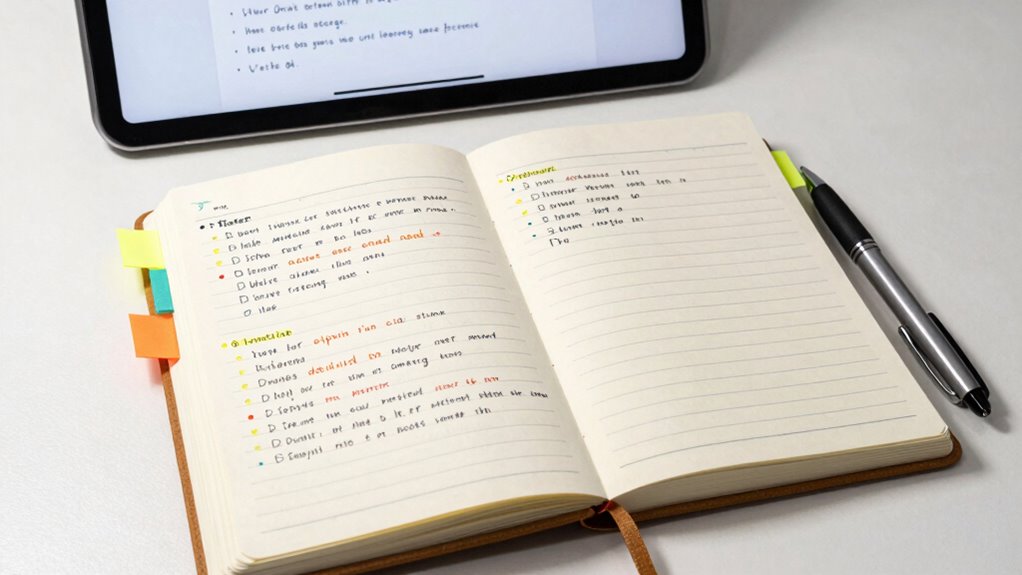
Have you ever struggled to find important information in messy notes? Clear, organized notes make reusing information much easier. Techniques like mind mapping help you visualize connections between ideas, making complex topics more understandable. Color coding adds another layer of clarity, allowing you to quickly identify key points, categories, or themes. When your notes are structured with these methods, you spend less time searching and more time reviewing and applying the material. Organized notes also boost retention, helping you recall details effortlessly. By creating a visual hierarchy with colors and a logical flow with mind maps, you turn chaotic scribbles into valuable resources. Incorporating European cloud innovation into your note organization can inspire sustainable and secure approaches to information management. This clarity not only saves time but also enhances your ability to reuse and build on previous knowledge effectively.
Choosing the Best Tools and Formats for Your Note-Taking Style

Choosing the right tools and formats for your note-taking style is essential because it determines how effectively you can capture, organize, and review information. If you prefer speed and flexibility, digital apps like Evernote or Notion let you quickly jot down ideas, add tags, and search easily. On the other hand, handwritten methods, such as notebooks or index cards, offer tangibility and may improve retention for some learners. Consider your environment and how you plan to review notes—digital tools are great for portability and multimedia, while handwritten methods can foster better focus and creativity. Additionally, understanding contrast ratio in projectors can help you optimize your viewing setup for clarity and detail, making your media experience more immersive. Being aware of tool usability can also help you select options that fit seamlessly into your workflow, increasing your productivity. Some research suggests that incorporating sound vibrations into your routine can enhance focus and relaxation, which might influence your note-taking preferences. Exploring ergonomic design can make your note-taking sessions more comfortable and sustainable over time. Furthermore, considering note organization techniques can improve long-term retention and ease of review. Ultimately, the best approach aligns with your habits and goals, so experiment with different tools and formats until you find what feels most natural and effective for you.
How to Use Descriptive Headings for Easy Note Scanning

Using descriptive headings in your notes makes it easier to locate and review key information quickly. Organize your notes with clear, specific headings that reflect the main ideas, creating a logical note hierarchy. This structure helps you group related concepts through keyword clustering, making it simpler to find related details at a glance. When headings are descriptive, scanning your notes becomes efficient—you can jump directly to sections that matter most. Consistent use of headings also supports your memory by highlighting the relationships between topics. By carefully crafting your note hierarchy with meaningful headings, you’ll save time during review sessions and enhance your overall note reuse, ensuring your notes serve as an effective, quick-reference resource.
Adding Visuals and Highlights to Improve Memory and Engagement
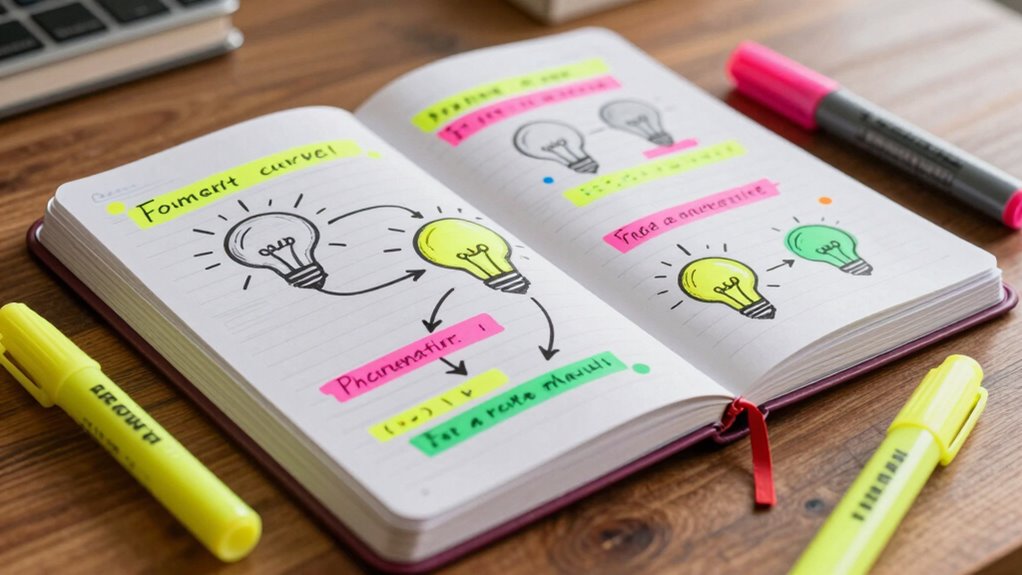
Adding visuals and highlights to your notes can substantially boost your memory and keep you engaged during review sessions. Using techniques like color coding helps differentiate concepts at a glance, making key ideas stand out. Mind mapping visually organizes information, linking concepts with lines and shapes that reinforce connections. To envision this, imagine:
| Visual Technique | Description |
|---|---|
| Color Coding | Assigning colors to topics for quick recall |
| Mind Mapping | Creating diagrams that connect ideas |
| Highlights | Emphasizing crucial points with markers |
| Diagrams | Visual summaries for complex info |
These visuals turn plain notes into interactive tools, making it easier to revisit and retain information. Incorporating color coding and mind mapping to transform your notes into engaging, memory-friendly resources can also reflect your understanding of effective note-taking methods. Additionally, understanding the importance of piercing care and hygiene, such as proper cleaning techniques, can help maintain your notes’ clarity and accuracy. Recognizing the role of visual organization techniques in effective note-taking can further improve your ability to review and recall information efficiently. Developing a consistent note review process can reinforce these visual strategies and enhance long-term retention. Utilizing active recall techniques alongside visuals can also strengthen your memory of the material over time.
Creating a Routine to Review and Keep Your Notes Fresh

To keep your notes effective and fresh, establishing a consistent review routine is essential. Regularly revisiting your notes helps reinforce learning and prevents digital decluttering from turning into clutter. Schedule weekly or biweekly review sessions to go over key points and update outdated information. During these reviews, consider note sharing strategies to deepen understanding—discussing notes with peers can reveal gaps and solidify concepts. Keep your digital workspace organized by deleting irrelevant notes and consolidating similar ones. This ongoing process ensures your notes remain relevant, accessible, and easy to reuse. By making review a habit, you transform static notes into a dynamic resource that continuously supports your learning and productivity.
Frequently Asked Questions
How Can I Adapt Note-Taking Techniques for Different Subjects?
You can adapt your note-taking techniques for different subjects by using mind mapping for complex topics and color coding to highlight key concepts. For science, create diagrams with colors for formulas and processes. In history, use color codes for dates and events. Mind maps help organize ideas visually, while color coding makes important details stand out. This flexible approach keeps your notes clear, engaging, and easy to review across various subjects.
What Are Common Mistakes to Avoid When Organizing Notes?
You should avoid color coding pitfalls that create confusion, like using too many colors or inconsistent schemes. Don’t let organization clutter pile up; keep your notes tidy and structured to find info quickly. Make sure your notes aren’t scattered or disorganized, which wastes time. Regularly review and refine your system so it stays helpful. Staying intentional about these aspects helps you reuse notes efficiently and prevents unnecessary frustration.
How Do I Balance Detailed Notes With Quick Review?
Balancing detailed notes with quick review is like walking a tightrope—you need both precision and speed. Focus on note summarization during lectures to capture key ideas swiftly, then add visual cues like diagrams or highlights for quick reference later. This way, your notes remain thorough yet easy to scan. Practice condensing information while including visual cues, so you can review efficiently without sacrificing depth when needed.
Can Digital Notes Replace Handwritten Ones Effectively?
Digital notes can effectively substitute handwritten ones if you leverage digital handwriting tools and note synchronization. You get the flexibility of quick edits, easy organization, and seamless sharing, all while maintaining the personal touch of handwriting. By syncing your notes across devices, you guarantee your ideas stay accessible and up-to-date. This way, digital notes become a practical, efficient alternative that enhances your note-taking process without sacrificing the benefits of handwriting.
How Do I Customize My Note System for Long-Term Use?
You’ll want to customize your note system by making it as unique as your handwriting. Use color coding to highlight key ideas and organize information visually. Create personalized templates that suit your style, making note-taking faster and more intuitive. Ironically, the more you tailor your system, the less you’ll need to overhaul it later. This way, your notes become a reliable, reusable resource—like a well-worn map that’s easy to follow.
Conclusion
Your notes are your secret weapon—when clear and organized, they transform from clutter into a treasure trove of knowledge. By choosing the right tools, using descriptive headings, and adding visuals, you make your notes a vivid map of your learning journey. Remember, consistent review keeps this map fresh and navigable. After all, isn’t the true value of notes not just in writing them, but in letting them guide you forward?