If you’re choosing between OLED, QLED, and LED TVs, here’s a quick guide: OLED TVs offer perfect blacks, deep contrast, and wide viewing angles, ideal for movie buff enthusiasts. QLED TVs deliver bright colors, high brightness levels, and good contrast, making them great for well-lit rooms. LED TVs are often more affordable and consume less power but lack the deep blacks and vibrant colors of OLED and QLED. To find out which fits your needs best, keep exploring these technologies.
Key Takeaways
- OLED screens emit their own light for perfect blacks and high contrast, ideal for immersive viewing.
- QLED uses quantum dots to boost brightness and color vibrancy, suitable for bright rooms.
- LED TVs rely on backlights and are generally more affordable but have lower contrast and color accuracy.
- OLED offers wider viewing angles and deeper blacks, while QLED balances brightness with vibrant colors.
- QLED and LED tend to be more energy-efficient than OLED, especially during bright scenes.
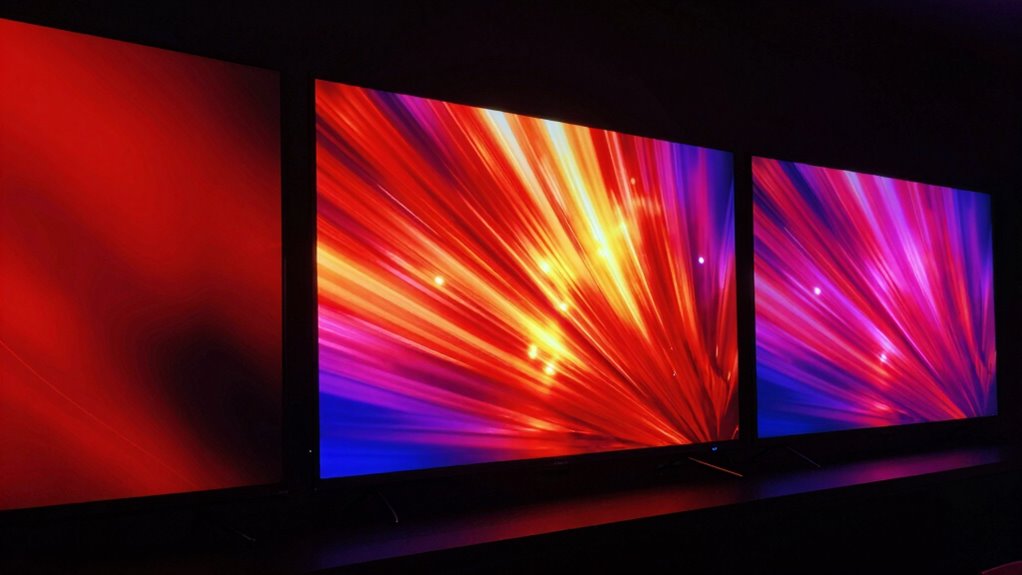
Have you ever wondered how your TV displays such clear and vibrant images? It all comes down to the type of display technology it uses, mainly OLED, QLED, or traditional LED. Each of these has unique features that influence picture quality and energy efficiency, so understanding their differences helps you choose the best TV for your needs.
Starting with OLED, you get incredible picture quality. Each pixel in an OLED screen emits its own light, allowing for perfect black levels and stunning contrast. When a pixel is off, it’s truly black, not just a dark gray, which makes images pop with depth and detail. This level of contrast enhances the overall picture quality, making movies and games look more realistic and immersive. Additionally, OLED screens can display wider viewing angles without losing brightness or color accuracy, so everyone gets a good view regardless of where they sit. However, OLED TVs tend to consume more energy than LED or QLED models because each pixel emits its own light, especially when displaying bright scenes. Still, advancements are making newer OLEDs more energy-efficient, balancing performance with power consumption. Energy efficiency is a key consideration when choosing between display types.
QLED technology, on the other hand, uses quantum dots to boost brightness and color. These TVs have an LED backlight that shines through a layer of quantum dots, which produce pure, vibrant colors. The result is a picture with excellent brightness, making QLED TVs especially great in well-lit rooms. While they don’t reach the perfect black levels of OLEDs, they still deliver high contrast with rich colors. QLEDs are generally more energy-efficient than OLEDs because their LED backlighting can be optimized for brightness and power use, especially in scenes that don’t require full illumination. This means they can produce bright, colorful images without drawing as much power, which is good for your energy bills and environmental impact.
Traditional LED TVs use an LED backlight behind an LCD panel to display images. They’re usually the most affordable option and offer decent picture quality, especially for casual viewing. However, their contrast and color accuracy are often inferior to OLED and QLED models. In terms of energy efficiency, LED TVs can vary widely depending on their size, backlight settings, and screen technology, but they tend to consume less power than OLEDs when displaying bright content. Still, their picture quality isn’t quite as sharp or vibrant, especially in scenes requiring deep blacks and nuanced contrast.
Frequently Asked Questions
Which TV Type Lasts the Longest With Proper Care?
You’ll find that LED TVs tend to last the longest with proper care because their durability factors include less risk of burn-in and degradation over time. To maximize longevity, follow maintenance tips like avoiding static images, keeping the screen clean, and ensuring proper ventilation. QLEDs also last well, but OLEDs may experience burn-in sooner if not carefully managed. Regular maintenance helps any TV type stay in top condition longer.
Are OLED TVS More Energy-Efficient Than QLED or LED?
Sure, OLED TVs are more energy-efficient than QLED or LED, right? Well, not exactly. While they do consume less power when showing dark scenes, their overall energy consumption can be higher during bright, colorful content. So, if you’re aiming for true power efficiency, don’t rely solely on OLED’s sleek tech. Instead, consider your viewing habits and how each TV type balances energy consumption with performance.
How Do Refresh Rates Compare Across OLED, QLED, and LED?
You’ll notice that OLED panels often have faster refresh rates, making them ideal for gaming performance and smooth motion. QLEDs also offer high refresh rates, but LED panels might lag behind slightly, affecting response times. When comparing panel response for gaming, OLEDs usually excel due to their quicker pixel response, resulting in less motion blur and better overall performance. So, if gaming is a priority, OLEDs provide a noticeable advantage.
Can QLED TVS Suffer From Burn-In Like OLEDS?
QLED TVs don’t suffer from burn-in like OLEDs, so you’re safe from permanent image ghosting. While the burn-in risk on QLEDs is virtually nonexistent, their longevity comparison to OLEDs favors QLEDs, which can last longer without image retention issues. So, if you watch diverse content and worry about burn-in, QLEDs are your best bet for a worry-free, long-lasting viewing experience.
What Are the Best Uses for Each TV Type?
You should choose an OLED TV for the best picture quality, with stunning contrast and deep blacks, ideal for movies and immersive viewing. QLED TVs excel in bright rooms and offer vibrant colors, making them great for gaming performance and daytime viewing. LED TVs are budget-friendly and suitable for casual use, but they don’t match OLED or QLED in picture quality or gaming experience, making them best for everyday TV watching.
Conclusion
Choosing between OLED, QLED, and LED TVs isn’t just about tech specs; it’s about your viewing experience. While OLED offers stunning contrast and perfect blacks, QLED delivers brightness and vibrant colors. LED TVs are the budget-friendly option, providing decent quality. Think of it like choosing between a vivid sunset, a bright cityscape, or a cozy lamp. Your choice depends on what matters most—deep blacks, bright visuals, or affordability—making your TV journey uniquely yours.