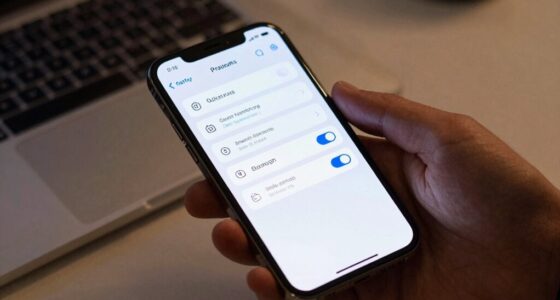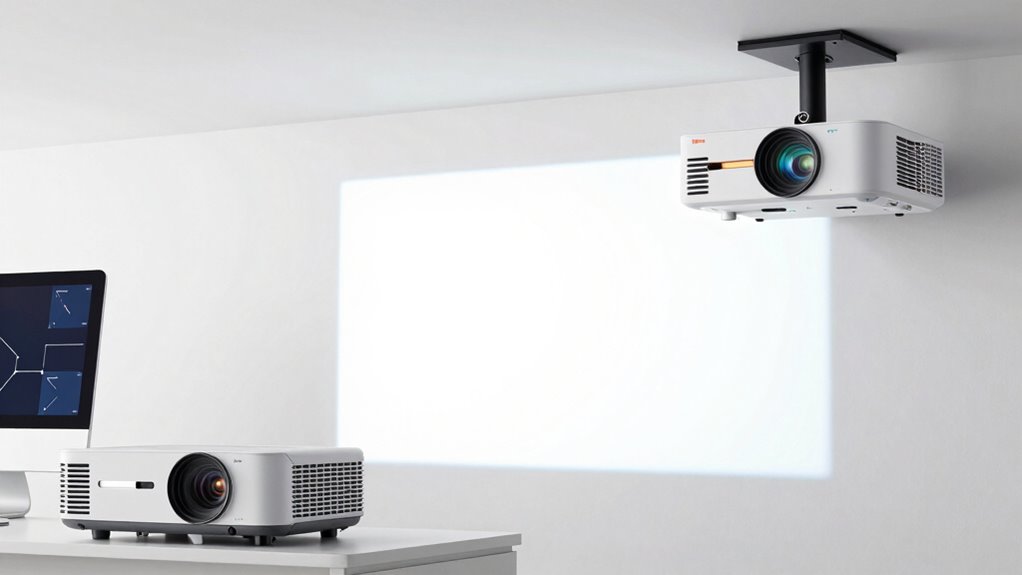

With keystone correction, you quickly adjust the image digitally to fix distortion caused by off-angle setup, but it may reduce picture quality. Lens shift involves physically moving the projector lens itself, allowing for precise positioning without sacrificing image clarity. Setting up with keystone is simpler and ideal for temporary fixes, while lens shift offers more flexible, permanent placement options but requires a projector with this feature. Keep exploring to understand which method best fits your needs.

Prime made for students and young adults
- Fast, free delivery for dorm and study essentials
- Prime Video and Amazon Music included
- Member-only deals
Key Takeaways
- Keystone correction digitally adjusts the image to fix trapezoidal distortion, suitable for quick, minor alignment tweaks.
- Lens shift physically moves the projector lens to reposition the image without distortion, ideal for permanent setups.
- Keystone correction is a software fix that can reduce image sharpness if overused, while lens shift maintains original image quality.
- Installing with lens shift allows flexible off-center placement, whereas keystone correction compensates for misaligned projector positions.
- Lens shift typically involves higher cost and bulk, while keystone correction offers a simple, cost-effective solution for setup adjustments.

When setting up a projector, you might wonder whether to use keystone correction or lens shift to get a perfect image. Both options aim to correct image alignment issues, but they approach the problem differently. Keystone correction is a digital or optical adjustment that compensates for trapezoidal distortion caused by projecting at an angle. While it’s convenient and quick to use, relying heavily on keystone correction can introduce some image distortion, affecting picture clarity and sharpness. It’s best suited for small adjustments when the projector can’t be perfectly aligned with the screen. However, overusing keystone correction might lead to a less natural image, with potential pixelation or blurriness, especially at extreme settings.
On the other hand, lens shift offers a more elegant solution by physically moving the lens inside the projector. This method shifts the image vertically or horizontally without altering the image’s shape, providing a much cleaner, distortion-free picture. Because lens shift doesn’t rely on digital manipulation, the image maintains its original resolution and clarity. This feature is especially valuable if you need a flexible setup, such as in a multi-purpose room or a space where permanent installation is necessary. Lens shift provides installation flexibility, allowing you to position the projector off-center or at an angle, without cropping or skewing the image. This makes it easier to hide the projector or avoid obstructions, all while ensuring a sharp, undistorted picture.
Additionally, understanding how image distortion affects the overall viewing experience can help you choose the right setup for your space. While keystone correction is simple and quick, it’s best used as a temporary fix or for minor adjustments. If you want a cleaner, more precise image, especially in permanent installations, lens shift is the superior choice. Its ability to prevent image distortion from the outset means you get a high-quality picture without sacrificing resolution or clarity. Keep in mind that lens shift requires a projector designed with this feature, and it might be more expensive or bulkier than models relying solely on keystone correction.
As an affiliate, we earn on qualifying purchases.
Frequently Asked Questions
Which Setup Method Offers Better Image Quality?
Lens shift offers better image clarity because it allows you to adjust the image without tilting or keystone correction, preserving the projector’s ideal lens alignment. While it involves a more complex setup, it results in a sharper, more consistent picture. Keystone correction may be simpler to use initially, but it can degrade image quality over time. So, for the best image clarity, lens shift is the superior choice despite the setup complexity.
Can Keystone Correction Cause Image Distortion?
Keystone correction can cause image distortion, making your picture look like it’s been stretched or squished, much like a funhouse mirror. When you tweak keystone issues, you might sacrifice image quality for alignment, leading to less sharpness and potential distortion. While it’s a handy fix, it’s not perfect—so use it sparingly. If possible, aim for a setup that minimizes keystone correction to keep your image crisp and true to life.
Is Lens Shift Adjustable After Installation?
Yes, lens shift is adjustable after installation, giving you greater mounting flexibility and easier image alignment. Unlike keystone correction, which digitally alters the image and can cause distortion, lens shift physically moves the lens inside the projector, allowing you to fine-tune the picture without sacrificing quality. Once installed, you can easily adjust the lens shift to perfectly align the image with your screen, making setup more convenient and precise.
Do Both Methods Work Equally in Different Room Sizes?
They say “a chain is only as strong as its weakest link,” and the same applies to room sizes. Lens shift offers better room flexibility, making it ideal for different room sizes, while keystone correction might struggle with larger or irregular spaces. Lens shift is more complex to install but provides consistent image quality. If you want adaptability across various rooms, lens shift is your best bet, despite the installation effort.
Which Setup Method Is More Cost-Effective Overall?
Lens shift is more cost-effective overall because it offers easier installation and minimizes aesthetic impact, saving you money on complex setup or wall modifications. Keystone correction might seem cheaper initially, but it can degrade image quality and requires frequent adjustments, leading to higher long-term costs. With lens shift, you get a straightforward, clean setup that preserves image clarity, making it the smarter investment for your space.
As an affiliate, we earn on qualifying purchases.
Conclusion
Ultimately, understanding the subtle nuances between keystone correction and lens shift helps you create a seamless viewing experience. While keystone offers convenience, lens shift provides a more refined approach to image alignment. By choosing the right method, you gently steer your setup toward harmony, avoiding unnecessary compromises. Remember, the journey to perfect projection isn’t just about technical adjustments but about crafting an environment where visuals effortlessly blend into your space’s natural flow.
As an affiliate, we earn on qualifying purchases.
projector mounting bracket with lens shift
As an affiliate, we earn on qualifying purchases.
As an affiliate, we earn on qualifying purchases.
Halloween Picks
halloween
As an affiliate, we earn on qualifying purchases.