
TL;DR
Open a free Amazon Business account
Business pricing, bulk buying and tax-exempt orders.
Create a free accountAs an affiliate, we earn on qualifying purchases.
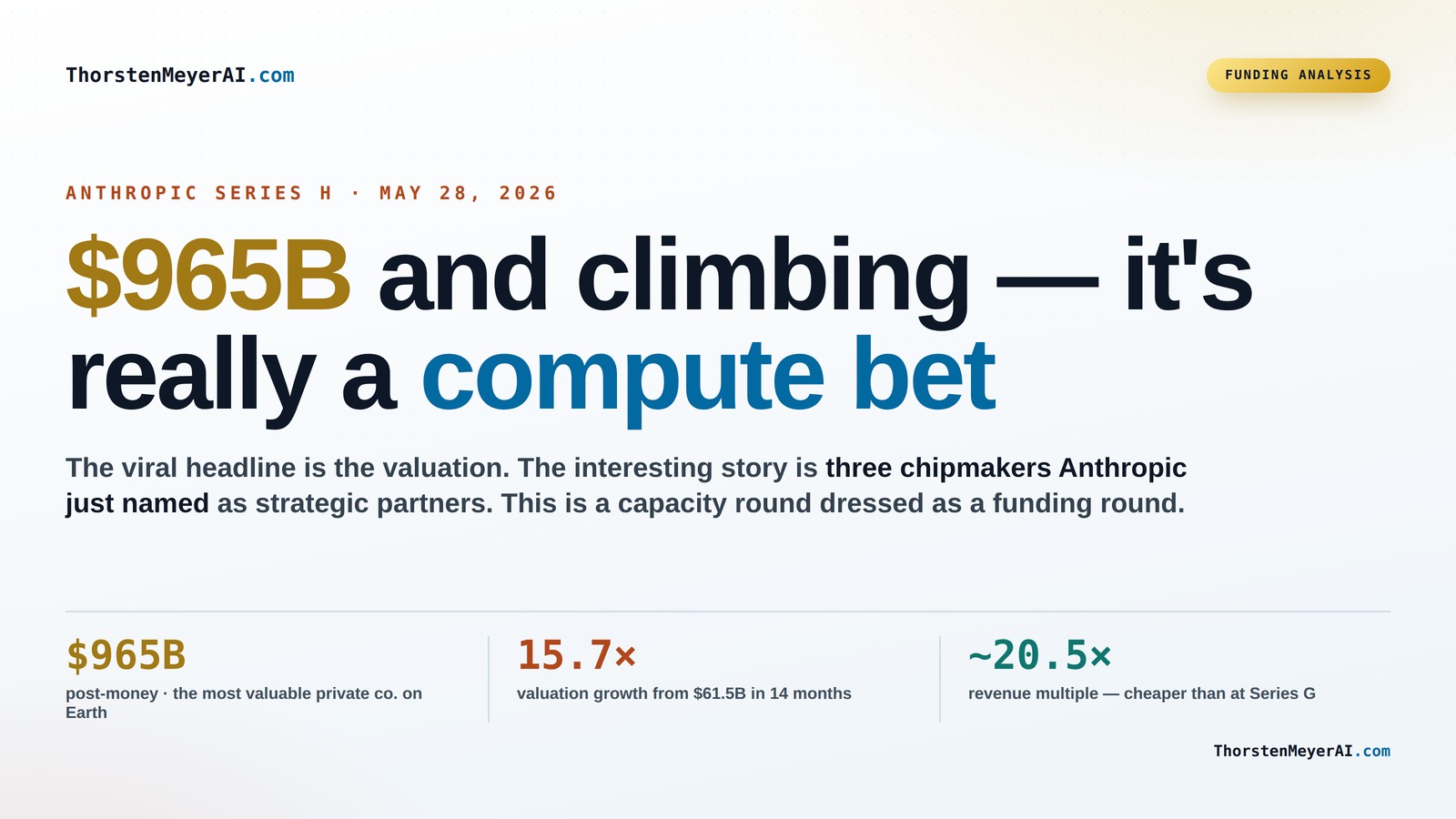
Anthropic’s $65 billion Series H funding, pushing its valuation past $965 billion, signals a focus on expanding compute capacity rather than traditional growth. The company’s rapid revenue growth and strategic chip partnerships reveal that infrastructure access is now the key battleground in AI dominance.
Imagine a startup raising nearly a trillion dollars. Sounds like a bubble, right? But what if most of that money isn’t just for building products — it’s for something more fundamental: increasing compute power. Anthropic’s latest $65 billion round isn’t just a record; it’s a clear signal that the real value in AI today is the capacity to train and run massive models.
In this article, you’ll see why this isn’t your typical funding story. We’ll break down how this massive influx of capital is shaping AI’s future — mainly through more GPU clusters, data centers, and chip partnerships. It’s a shift from chasing technology for its own sake to locking in the infrastructure needed for the next wave of AI breakthroughs.
$965B and climbing — it’s really a compute bet
The viral headline is the valuation. The interesting story is in the press release’s middle paragraphs — and in three chipmakers Anthropic just named as strategic partners. This is a capacity round dressed as a funding round.
The numbers nobody can quite parse in sequence
Read together they describe a trajectory with no precedent in enterprise software. Read individually, each looks like a typo.
From $61.5B to $965B in fourteen months
Salesforce took roughly two decades to reach revenue numbers Anthropic just blew past. The sequence below is the part most coverage skips — it’s not the size, it’s the shape.
Anthropic’s valuation ladder · Mar 2025 → May 2026
Five rounds, fourteen months. Bar height is the valuation; the climb itself is the story. Tap any milestone for context.
The multiple actually got cheaper
Bubbles look like multiples expanding while revenue lags. Anthropic’s pattern is the inverse — the valuation tripled, but revenue grew faster, and the multiple compressed.
Revenue-to-valuation multiple · Series G → Series H
Same company, three months apart. The denominator (revenue) is outrunning the numerator (valuation) — exactly the opposite of what a bubble narrative predicts.
10+ gigawatts and three chipmakers
When you name Micron, Samsung & SK hynix alongside your equity backers, you’re saying the binding constraint isn’t demand or model quality — it’s the physical supply of memory chips. The Series H is a capacity round.
Compute commitments backing Anthropic’s capacity bet
$200B+ in announced compute spend across multi-year contracts. The $65B Series H raise has to be read against that bill, not against operating losses.
A genuinely durable bet — or a structural exposure?
Both readings can be true at once. The answer arrives over the next 18–24 months as the gigawatts come online and either fill with paying demand or don’t.
Revenue growth has no precedent in B2B software ($1B → $47B in 17 months). The multiple is compressing, not expanding. Claude is the only frontier model on all 3 major clouds. Enterprise AI spend share went from ~10% to >65% in a year. Compute commitments are tied to specific contracts with capacity dates.
20× revenue is not cheap by any historical software-investing standard. Revenue is reported gross of cloud-reseller pass-throughs, which inflates the top line. Profitability is 2 years out. Amodei’s own warning: a 12-month delay in AI progress “would make him bankrupt” — the compute commitments are a structural exposure to demand persistence.
The valuation race — and the IPO context
Anthropic shipped Opus 4.8 the same morning as Series H — not a coincidence. One week after OpenAI filed confidentially for IPO. The late-2026 frame is set: two frontier AI companies racing to public markets, each pitching durability.
Key Takeaways
- Anthropic’s $965 billion valuation signals a shift from model innovation to infrastructure dominance in AI.
- The $65 billion Series H is primarily a compute capacity expansion, not just a typical funding round.
- Demand for Claude is skyrocketing, pushing revenue past $30 billion and fueling aggressive infrastructure investment.
- Control over GPU supply chains and data centers is becoming the new strategic moat for AI leaders, similar to the trends highlighted in this discussion on compute bets in AI funding.
- Revenue growth is compressing multiples, indicating investor confidence in capacity-led scaling rather than just model development.
As an affiliate, we earn on qualifying purchases.
Why a $965 Billion Valuation Is a Game-Changer in AI
Anthropic’s valuation soaring past a trillion dollars signals more than just investor hype. It shows that the market now sees AI as a compute-intensive industry. The focus is on who controls the capacity to train and serve models, not just who creates the models themselves.
Compared to OpenAI’s valuation of around $852 billion earlier this year, Anthropic surpasses it. Yet, the real story isn’t the number — it’s what that number represents: a massive push for infrastructure. Think of it like buying a fleet of supercharged data centers instead of just developing new algorithms.
For example, Anthropic’s recent quotes reveal they’re committed to over 10 gigawatts of compute capacity — enough to power hundreds of the world’s largest AI models. That’s a game-changing scale, similar to how cloud giants like Amazon and Google became infrastructure leaders in the 2010s.

data center hardware for AI infrastructure
As an affiliate, we earn on qualifying purchases.
As an affiliate, we earn on qualifying purchases.
This Is Less a Funding Round, and More a Compute Expansion Play
When you hear ‘Series H’ at this scale, it might sound like a typical startup raise. But in Anthropic’s case, it’s more like a massive infrastructure investment. The $65 billion isn’t just cash for growth — it’s a strategic move to buy more GPUs, data centers, and chip partnerships.
Consider this: Anthropic named three memory chipmakers — Micron, Samsung, SK hynix — as part of its ‘strategic infrastructure’ plan. That’s a clear sign they’re locking in hardware supply chains to fuel future models, as discussed in this analysis of AI infrastructure investments.
In practical terms, this means more training power, faster inference, and the ability to handle even larger models — all crucial for staying ahead in AI. It’s like upgrading from a regular car to a fleet of supercars to win the race.

As an affiliate, we earn on qualifying purchases.
Revenue Growth Sparks a Surprising Multiple Compression
Here’s a twist. Despite the huge valuation, Anthropic’s multiple on revenue is actually shrinking. In February, it traded at about 27× revenue. Now, at a $965 billion valuation with roughly $47 billion in annualized revenue, the multiple is around 20.5×.
This means revenue is growing faster than valuation. It’s like the company is becoming cheaper relative to its income — a sign of strong demand and confidence in future growth.
For example, Anthropic’s revenue surged from about $9 billion at the end of 2025 to over $30 billion by April 2026. That’s a 3x increase in just four months, driven largely by skyrocketing demand for Claude, the company’s flagship model.
In comparison, OpenAI’s valuation of $852 billion against roughly $13 billion of 2025 revenue put it at about 65×. So, Anthropic’s multiple is significantly lower, hinting that investors now see more value in capacity than just in the models themselves.

As an affiliate, we earn on qualifying purchases.
Demand for Claude Is Blowing Past Expectations
Anthropic reports that Claude’s demand exploded in 2026. The company’s run-rate revenue jumped from about $9 billion at the end of 2025 to over $30 billion in early April 2026. That’s a 3x increase in just a few months. It’s like the AI version of a viral app going mainstream overnight.
Imagine hundreds of companies rushing to integrate Claude into their workflows — from finance to healthcare. That’s why Anthropic is throwing so much money into infrastructure: to keep up with this surge.
For example, a major financial firm might use Claude for real-time trading signals, requiring thousands of GPU-hours daily. Meeting this demand at scale needs the kind of capacity that only a giant infrastructure push can provide.

Safety and Interpretability—The Heart of the Capital Spend
Anthropic’s focus on safety and interpretability isn’t just a brand angle — it’s a core reason for this massive capital infusion. The company plans to use part of the $65 billion to develop safer, more transparent AI systems.
Think of safety research like building a sturdy foundation for a skyscraper. You need more than just shiny models; you need to understand how they work, how to prevent misuse, and how to make them trustworthy.
For example, Anthropic’s recent projects include advanced alignment techniques and interpretability tools that help explain AI decisions in real-time — crucial for industries like healthcare and finance, where trust is everything.

What This Means for the Future of AI Infrastructure
This funding round cements infrastructure as the real prize in AI. Control over GPU supply chains, data centers, and chip partnerships becomes the new strategic moat.
Imagine a world where AI companies fight not just over models, but over access to the fastest, largest compute clusters. That’s what Anthropic’s move hints at — a future where hardware capacity determines who leads in AI innovation.
For instance, with over 10 gigawatts of compute committed, Anthropic aims to build an ecosystem similar to how cloud giants built their dominance — by owning the backbone infrastructure that powers AI’s next phase.
Your Questions, Answered: The Real Impact of Anthropic’s Mega-Raise
- Why did Anthropic need $65 billion? To massively expand compute capacity, support safety research, and meet soaring demand for Claude.
- Is this really about funding? Mostly. It’s a capacity investment, securing hardware supply and data center access to stay ahead.
- Will this make Claude grow faster? Yes, the extra compute will allow faster training, larger models, and better services, boosting growth.
- How does this compare to OpenAI? Anthropic’s valuation is higher, but its multiple is lower, reflecting confidence in infrastructure-led growth.
- Is this sustainable? It depends. Rapid revenue growth suggests strong demand, but the capital intensity raises questions about long-term profitability.
Conclusion
What you’re seeing with Anthropic is a clear message: the future of AI hinges on who controls the compute backbone. This massive raise isn’t just about money — it’s about locking in the hardware needed to power the next wave of AI breakthroughs.
As the lines between funding and infrastructure blur, expect more companies to chase this compute-driven race. The real question isn’t just how smart your models are, but how much power you can bring to bear.

Flea & tick season Picks
flea and tick prevention
As an affiliate, we earn on qualifying purchases.
![Paxos Made Simple (2001) [Pdf]](https://rottenpanda.com/wp-content/uploads/2026/07/paxos-made-simple-2001-pdf-featured-560x300.jpg)





![Sean Carroll Explains The Biggest Ideas In The Universe – Full Interview [Video] (2025)](https://rottenpanda.com/wp-content/uploads/2026/09/sean-carroll-explains-the-biggest-ideas-in-the-universe-full-interview-video-202-featured-260x140.jpg)