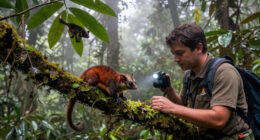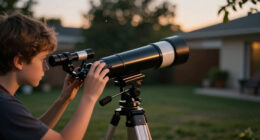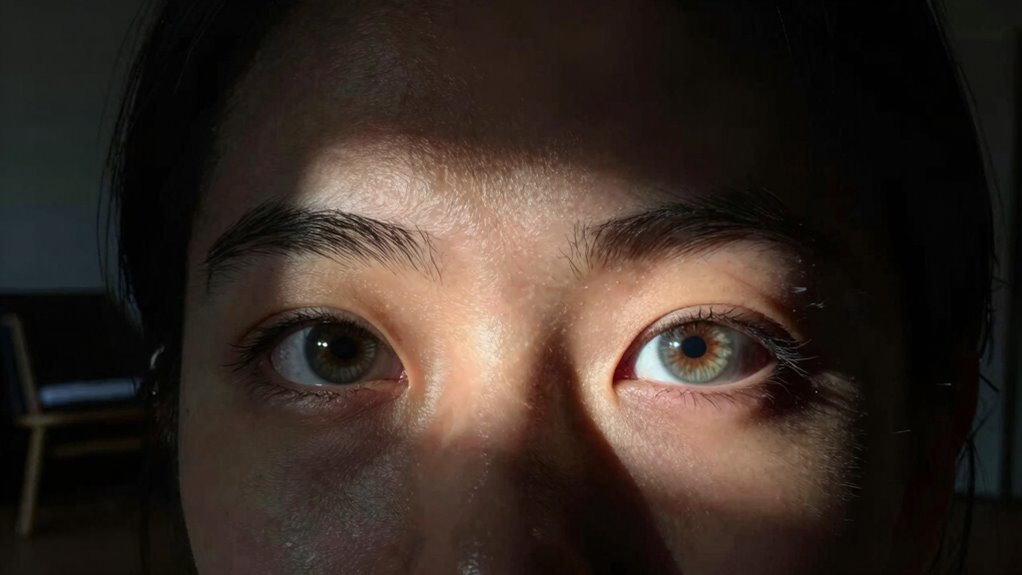

Your eyes adapt to darkness faster than you might think thanks to quick changes like pupil dilation, which lets in more light almost instantly. Meanwhile, your retina adjusts through biochemical processes, regenerating pigments like rhodopsin in rods to boost sensitivity within minutes. These combined responses happen rapidly, allowing your vision to improve quickly in low light. If you want to understand how these mechanisms work together, keep exploring how your eyes truly adjust in darkness.

Prime made for students and young adults
- Fast, free delivery for dorm and study essentials
- Prime Video and Amazon Music included
- Member-only deals
Key Takeaways
- Pupils rapidly dilate to increase light entry within seconds of darkness.
- Retina’s rods quickly regenerate rhodopsin, boosting low-light sensitivity.
- Biochemical processes support swift retinal recalibration in darkness.
- Visual adaptation involves both immediate pupil response and gradual retinal adjustments.
- The combined mechanisms enable your eyes to adapt to darkness faster than perceived.

When you move from a bright room to a dark one, your eyes quickly begin to adjust, allowing you to see better in low light. This rapid adaptation is thanks to a combination of biological processes that work together to optimize your vision. One of the first responses your eyes have is pupil dilation. As the surrounding light diminishes, your pupils automatically expand, letting in more light so you can see more clearly. This dilation happens within seconds and is your eyes’ immediate way of compensating for the darkness.
When entering darkness, your eyes rapidly adjust through pupil dilation to enhance low-light vision.
But pupil dilation is just the beginning. Your retina, the layer of tissue at the back of your eye, also plays a crucial role in adapting to low light. It contains two types of photoreceptor cells: rods and cones. Cones are responsible for color vision and function well in bright conditions, while rods are highly sensitive to light and are essential for seeing in darkness. When you step into a darker environment, your rods take over, allowing you to perceive shapes and movements even with minimal light. This shift from cone to rod vision is vital for quick adaptation and relies heavily on retinal regeneration.
Retinal regeneration involves a complex process where your retina’s cells recalibrate to the new lighting conditions. When exposed to darkness, the chemical pigments within rods, called rhodopsin, are regenerated. Rhodopsin is responsible for capturing light signals, and its regeneration boosts your rods’ sensitivity. This process isn’t instantaneous but occurs rapidly enough that you notice a significant improvement in your vision within a few minutes. Over time, more rhodopsin accumulates, enhancing your ability to see in the dark. Additionally, the biochemical processes involved are supported by your eyes’ natural ability to adapt swiftly to changing environments. Recent studies also show that light sensitivity can be further improved through certain practices, emphasizing the adaptability of your visual system. This entire process is a remarkable example of the eye’s visual adaptation capabilities.
This combination of pupil dilation and retinal regeneration ensures that your eyes adapt faster than you might expect. Pupil dilation grants immediate access to more available light, while retinal adjustments refine your visual sensitivity over the next few minutes. Your eyes are constantly working behind the scenes, fine-tuning their response to changing light conditions. So next time you find yourself navigating a dark room, remember that your eyes are already in motion—dilating pupils and regenerating retinal pigments—to make sure you see as clearly as possible, even in the shadows.
As an affiliate, we earn on qualifying purchases.
Frequently Asked Questions
How Long Does Full Night Vision Typically Take to Develop?
Full night vision usually takes about 20 to 30 minutes to develop. During this time, your eyes adjust through increased light sensitivity and pupil dilation, allowing more light to reach your retina. As your pupils dilate, your eyes become more receptive to low light, helping you see better in darkness. Be patient, as this process varies slightly depending on your overall eye health and prior exposure to bright light.
Can Diet Influence How Quickly My Eyes Adapt to Darkness?
Yes, your diet can influence how quickly your eyes adapt to darkness, primarily due to nutrient impact. Consuming foods rich in vitamin A, such as carrots and leafy greens, helps maintain healthy rod cells, speeding up night vision adaptation. Good dietary habits that include these nutrients support your eyes’ ability to adjust faster to low light. So, eating a balanced diet with key vitamins can improve your night vision over time.
Are Some People Naturally Better at Adapting to Darkness?
Some people are naturally better at adapting to darkness due to genetic factors and environmental influences. Think of your eyes as tiny athletes, trained by your genes and surroundings to perform better in low light. Your genetic makeup can influence how quickly your eyes adjust, while exposure to dim environments strengthens this ability. So, yes, some individuals have an innate edge, but environmental factors also play a vital role in sharpening your night vision.
Does Age Affect the Speed of Dark Adaptation?
Age definitely affects how quickly your eyes adapt to darkness. As you get older, age-related vision changes can slow down your dark adaptation mechanisms, making it take longer for your eyes to adjust after bright lights. You might notice this during nighttime driving or moving from bright to dim environments. Your eyes’ ability to recover in darkness diminishes with age, so you may experience delayed adaptation compared to when you were younger.
Can Eye Conditions Impair My Ability to Adjust to Darkness?
Oh, sure, your eye condition might turn adjusting to darkness into a comedy of errors. If your eye health isn’t tip-top, vision training can help, but some conditions like cataracts or retinitis pigmentosa slow things down. You might stumble into shadows longer than most. So, take care of your eyes, get regular check-ups, and don’t skip vision training—your eyes will thank you when the lights go out.
As an affiliate, we earn on qualifying purchases.
Conclusion
As you step from a bright room into darkness, your eyes begin to adjust almost instantly, revealing the subtle glow of distant streetlights like stars flickering to life. It’s a quiet reminder that your eyes are more adaptable than you realize, seamlessly shifting to help you see in the shadows. Next time you find yourself in the dark, trust that your eyes are working behind the scenes, turning night into a canvas you’re more prepared to explore than you’d think.
retinal regeneration supplements
As an affiliate, we earn on qualifying purchases.
As an affiliate, we earn on qualifying purchases.
As an affiliate, we earn on qualifying purchases.
Fall Picks
fall essentials
As an affiliate, we earn on qualifying purchases.


![GPT-5.6 Sol Ultra produces proof of the Cycle Double Cover Conjecture [pdf]](https://rottenpanda.com/wp-content/uploads/2026/07/gpt-5-6-sol-ultra-produces-proof-of-the-cycle-double-cover-conjecture-pdf-featured-560x300.jpg)