
Earthquakes happen when tectonic plates move and cause faults in Earth’s crust to slip suddenly, releasing energy that shakes the ground. The severity depends on factors like how deep the quake occurs, the amount of stress built up, and the type of fault involved. Some quakes are more destructive because of their size, depth, or ground conditions. To understand why some quakes are worse than others, keep exploring the forces behind these natural events.
Key Takeaways
- Earthquakes are caused by sudden crust shifts along faults due to stress accumulation from tectonic plate movements.
- Tectonic plate interactions at boundaries generate seismic energy, with faults acting as release points for built-up stress.
- Shallow earthquakes tend to be more destructive because their energy concentrates near the surface, causing more damage.
- The magnitude and energy released during an earthquake determine its severity and potential for destruction.
- Factors like soil conditions, building resilience, and earthquake depth influence why some quakes cause more damage than others.
What Causes Earthquakes?
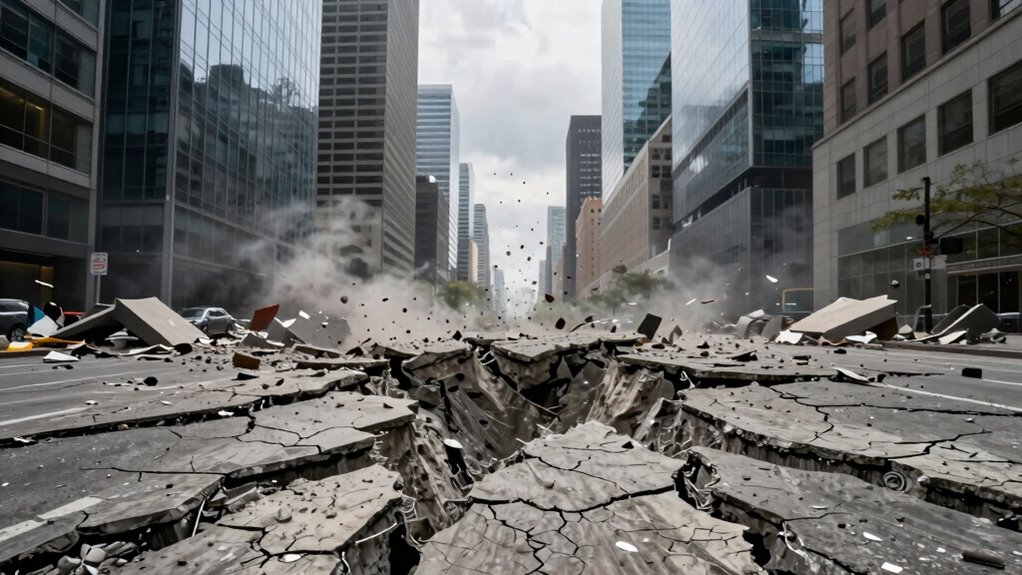
Earthquakes occur when the Earth’s crust suddenly shifts along faults, releasing stored energy as seismic waves. While scientists study seismic precursors—small tremors or unusual ground changes—that sometimes precede quakes, predicting exactly when an earthquake will happen remains challenging. These precursors can include foreshocks, changes in groundwater levels, or slight ground deformation, but they don’t always lead to a major quake. Understanding these signs helps improve earthquake prediction efforts, but there’s no foolproof method yet. You should know that most earthquakes result from stress accumulating along fault lines, which eventually causes the crust to slip unexpectedly. Recognizing seismic precursors is vital, but the unpredictable nature of these signals makes precise forecasting difficult, emphasizing the need for better monitoring and preparedness.
How Do Tectonic Plates Move and Trigger Quakes?
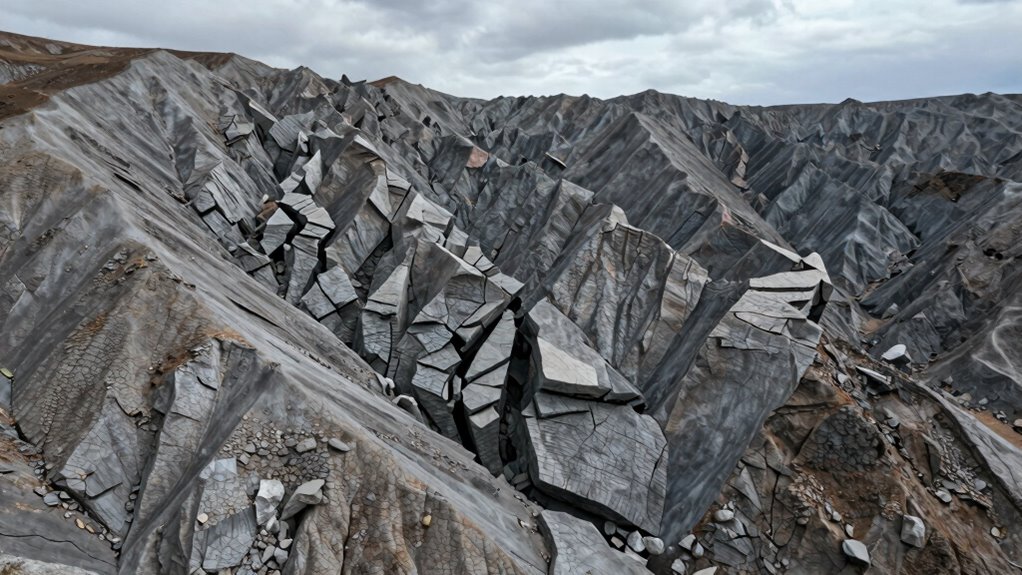
Tectonic plates are large, rigid sections of Earth’s crust that constantly move and interact at their boundaries. This tectonic motion causes seismic activity, which leads to earthquakes. You can think of these plates as giant puzzle pieces constantly shifting. Here’s how their movement triggers quakes:
- Divergent boundaries: plates pull apart, creating new crust and causing earthquakes.
- Convergent boundaries: plates collide, forcing one beneath the other and building stress.
- Transform boundaries: plates slide past each other horizontally, generating friction and seismic activity.
- Mantle convection: heat-driven currents in Earth’s mantle push plates, fueling their movement.
- The plate boundary types influence the severity and frequency of earthquakes in different regions. Additionally, the specific characteristics of each boundary type determine the potential for earthquake magnitude and damage.
Understanding these processes helps you grasp how tectonic motion directly influences earthquake occurrence and severity.
How Do Fault Lines and Stress Build Up to Cause Earthquakes?
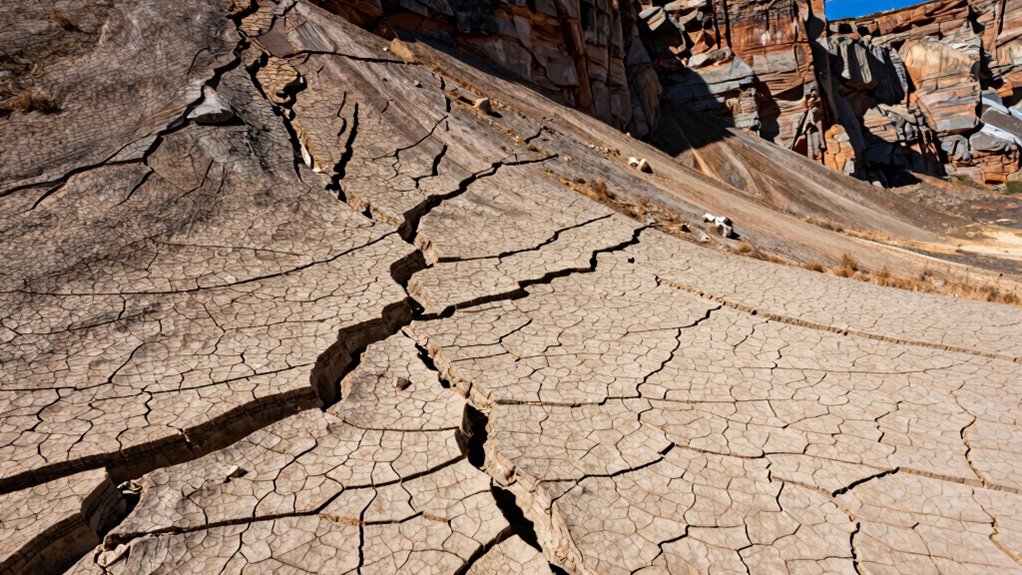
You might notice that fault lines are like cracks in Earth’s crust where stress can build up. As tectonic forces push against these faults, stress accumulates until it reaches a breaking point. When this happens, sudden slippage occurs, releasing energy and causing an earthquake. Understanding the underlying mechanisms helps explain why some earthquakes are more destructive than others. The stress accumulation process varies depending on the type of fault and the rate at which tectonic plates move.
Fault Line Dynamics
How do fault lines and stress buildup lead to earthquakes? The key lies in fault line interactions within seismic fault zones. Over time, tectonic forces cause stress to accumulate along these faults. When the stress exceeds the fault’s strength, it releases suddenly, causing an earthquake. Here’s how this process unfolds:
- Faults slip gradually during fault line interactions, but stress still builds up.
- Tectonic plates push against each other, increasing pressure in seismic fault zones.
- Strain accumulates until the fault can no longer hold it.
- Sudden slip releases energy, resulting in an earthquake.
- Proper piercing care and hygiene is essential to prevent complications that could be exacerbated by stress or injury, similar to how fault stress builds up over time.
- Recognizing signs of stress accumulation can help in understanding potential earthquake triggers, emphasizing the importance of monitoring fault activity.
- Monitoring seismic activity and understanding fault behavior are crucial in predicting and mitigating earthquake impacts.
Understanding fault line dynamics shows how stress concentrates and releases, shaping the intensity of earthquakes. This process explains why some faults produce more powerful quakes than others.
Stress Accumulation Process
Fault lines act as the boundaries where stress from moving tectonic plates accumulates over time. As plates shift, stress builds up in the fault stress zone, causing rocks to deform elastically. This stress buildup continues until it exceeds the rocks’ strength, leading to a sudden release of energy—an earthquake. The table below shows how different factors influence stress accumulation:
| Tectonic Movement | Fault Stress Level | Resulting Earthquake |
|---|---|---|
| Converging Plates | High | Strong earthquake |
| Diverging Plates | Moderate | Moderate earthquake |
| Sliding Plates | Varies | Varies |
| Locked Faults | Extreme | Major earthquake |
Understanding this process helps explain why some faults produce bigger quakes than others.
Sudden Slippage Events
When the accumulated stress in a fault line reaches its limit, rocks suddenly slip past each other in a rapid movement, releasing stored energy as seismic waves. This process, known as fault slippage, causes the seismic release that we feel as an earthquake. Several factors influence these sudden events:
- Stress buildup over time increases the likelihood of fault slippage.
- Faults locked by friction prevent gradual movement, setting the stage for a release.
- Once stress surpasses frictional resistance, slip occurs abruptly.
- The seismic release propagates through Earth’s crust, causing ground shaking.
These sudden slippage events are the direct cause of most earthquakes, demonstrating how built-up stress and fault mechanics combine to produce powerful, rapid energy releases that reshape the ground beneath your feet.
What Are the Different Types of Earthquakes and Their Sources?
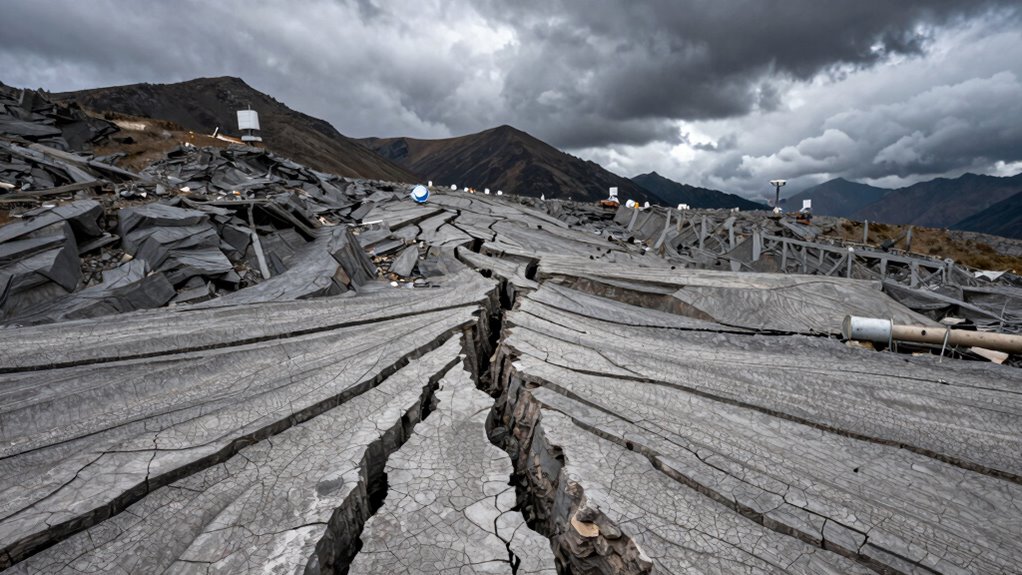
Earthquakes come in several types, each originating from different geological processes. The main types include tectonic earthquakes, caused by the movement of Earth’s plates, and volcanic earthquakes, linked to magma activity. There are also collapse earthquakes from underground caverns and explosions, and explosion earthquakes from nuclear tests. Tectonic earthquakes produce various seismic wave types, like P-waves and S-waves, which help scientists understand their sources. These seismic wave types are essential for earthquake prediction techniques, as analyzing wave patterns can reveal where and how an earthquake started. Understanding these different sources allows geologists to better assess risk and develop strategies for early warning. Recognizing the origins of each earthquake type helps you grasp why some are more damaging than others, depending on their source and seismic characteristics.
Why Are Some Earthquakes More Destructive Than Others?
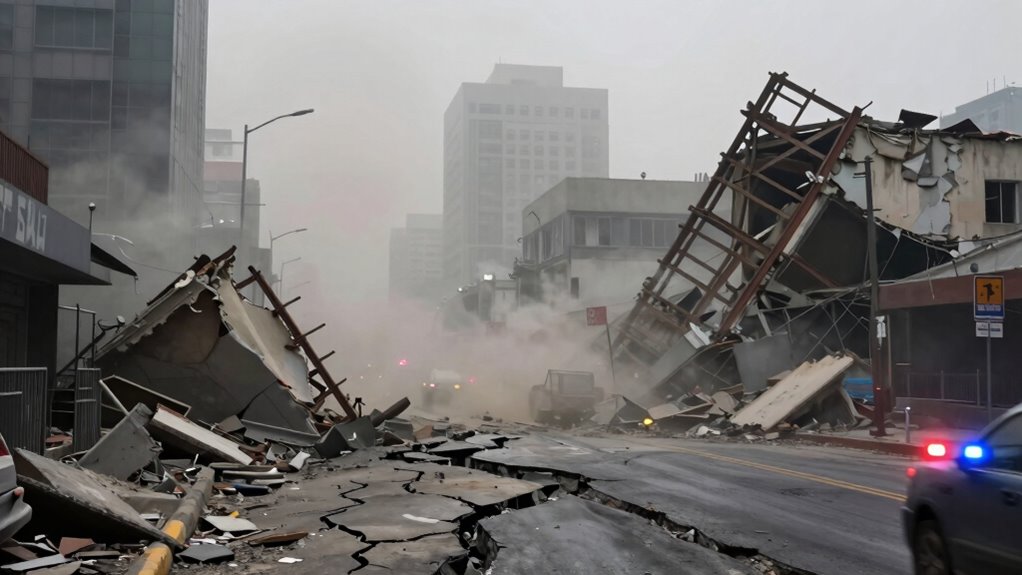
The destructive power of an earthquake depends largely on its magnitude, depth, and the location where it occurs. Your seismic risk increases if an earthquake hits densely populated areas or structures not designed for strong shaking. Historical patterns show that some regions experience more destructive quakes due to repeated stress accumulation and fault activity. To understand why some earthquakes are worse, consider these factors: 1. Magnitude: Larger quakes release more energy, causing greater damage. 2. Depth: Shallow earthquakes tend to be more destructive than deep ones. 3. Local infrastructure: Poorly built structures amplify shaking effects. 4. Regional seismic history: Areas with frequent, intense activity are more prone to severe damage. Additionally, the presence of Free Floating tectonic plates can influence how stress is accumulated and released along fault lines. The complexity of fault mechanics also plays a significant role in determining the severity of an earthquake’s impact. Understanding these elements helps explain why certain earthquakes have devastating impacts compared to others. Furthermore, seismic wave propagation can affect how energy disperses during an event, influencing the extent of destruction across different regions. Recognizing the interaction of seismic forces is essential for improving earthquake preparedness and mitigation strategies. Moreover, advances in seismic monitoring technology have enhanced our ability to detect and analyze these forces in real-time, potentially saving lives through early warning systems.
How Does Earthquake Depth Affect Damage and Intensity?
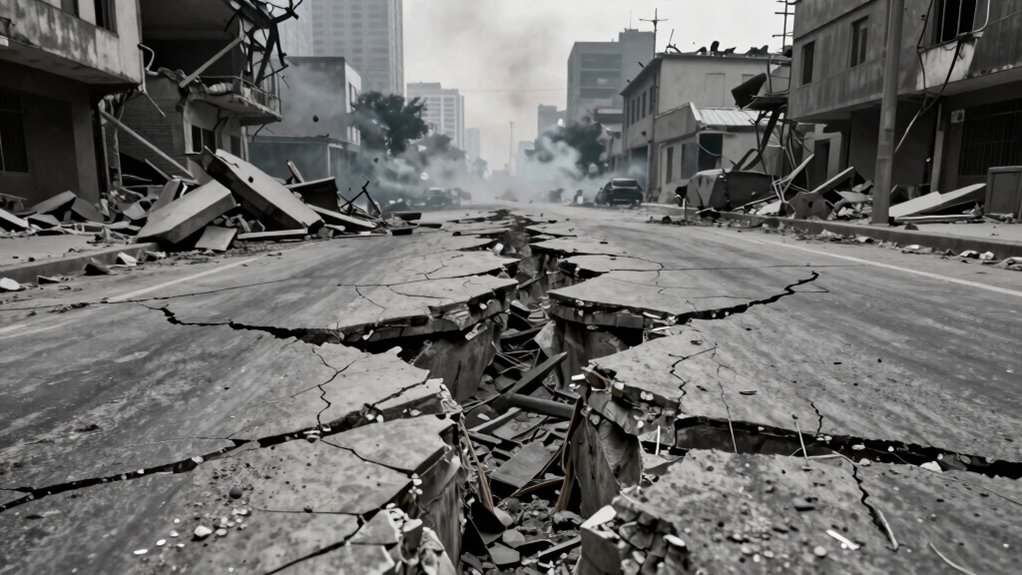
You’ll notice that shallow earthquakes often cause more intense damage near the surface, while deeper quakes tend to spread their energy over larger areas with less destruction. This difference affects damage patterns and how buildings respond, making resilience a tough challenge. Understanding these variations helps you grasp why some earthquakes are more devastating than others. Additionally, imaging techniques used to study seismic activity can reveal details about earthquake depth and energy distribution. These advanced methods are essential for earthquake prediction and improving safety measures. Recognizing the role of seismic waves in transmitting energy helps scientists assess potential impact zones more accurately. Moreover, the seismic wave patterns generated by different quake depths provide valuable insights into their potential for damage. Incorporating seismic imaging technologies enhances our ability to analyze and interpret quake behavior, ultimately aiding in disaster preparedness.
Surface vs. Deep Quakes
While deeper earthquakes release more energy overall, their effects on the surface often differ markedly from those of shallow quakes. Shallow quakes tend to cause more visible damage, including surface rupture, because their energy concentrates near the surface. In contrast, deep tremors usually produce less obvious surface shaking but can still be destructive. Here’s what you should know: 1. Shallow quakes cause more intense shaking and surface rupture, leading to greater structural damage. 2. Deep tremors spread energy over a wider area, often resulting in less localized destruction. 3. Damage from surface rupture is typically more direct and severe during shallow quakes. 4. The impact of deep earthquakes is usually felt over larger regions but with less destruction at any one point. Additionally, the earthquake depth significantly influences how the energy affects different areas, shaping both the extent and nature of the damage. Your understanding of quake depth helps explain why some earthquakes are more damaging than others.
Damage Distribution Patterns
Earthquake depth considerably influences how damage and intensity are distributed across affected areas. Shallow earthquakes, occurring near the surface, tend to produce more severe damage patterns because their energy concentrates in impact zones close to the epicenter. You’ll notice these impact zones experience the worst destruction, with buildings and infrastructure often heavily damaged or destroyed. Conversely, deep earthquakes release energy over a larger area, resulting in less intense damage but wider damage patterns. The intensity diminishes with distance from the epicenter, spreading the impact over a broader region. Understanding how earthquake depth shapes these damage patterns helps you anticipate which areas are most vulnerable, allowing for better planning and response strategies to minimize destruction and protect communities. Additionally, seismic wave propagation varies with depth, influencing how energy travels through the Earth and affects surface structures. Recognizing the impact of depth on damage can improve seismic risk assessments and preparedness efforts.
Building Resilience Challenges
Deep earthquakes pose unique challenges for building resilience because their energy spreads over a larger area, often reducing the severity of damage at any single point. However, their widespread impact complicates urban planning and emergency preparedness, as areas farther from the epicenter can still experience strong shaking. To address these challenges, you should focus on:
- Designing flexible structures that withstand long-distance seismic waves.
- Implementing all-encompassing urban planning to avoid densely populated, vulnerable zones.
- Enhancing early warning systems to give communities more preparation time.
- Promoting public awareness campaigns to improve emergency preparedness across all regions.
- Understanding earthquake depth is crucial for assessing potential damage and prioritizing safety measures.
How Do Building and Ground Conditions Influence Earthquake Damage?

Building and ground conditions play a crucial role in determining how much damage an earthquake can cause. If your area has loose or saturated soil, soil liquefaction can occur, turning solid ground into a fluid-like state that undermines foundations and causes buildings to sink or tilt. Additionally, ground amplification can intensify shaking, making structures more vulnerable. Soft soils tend to vibrate more than bedrock, increasing the seismic energy transmitted to buildings. These conditions explain why some locations suffer greater destruction despite experiencing similar quake magnitudes. Knowing your ground type helps assess risk and prepare accordingly. Soil stabilization techniques can help minimize the risk of liquefaction and ground vibration effects. Understanding ground response is essential for effective seismic risk mitigation. Moreover, conducting geotechnical assessments can identify specific vulnerabilities and inform appropriate mitigation strategies. Recognizing local soil conditions is vital for developing resilient infrastructure and ensuring safety during seismic events.
Where Do Earthquakes Happen Most Frequently?
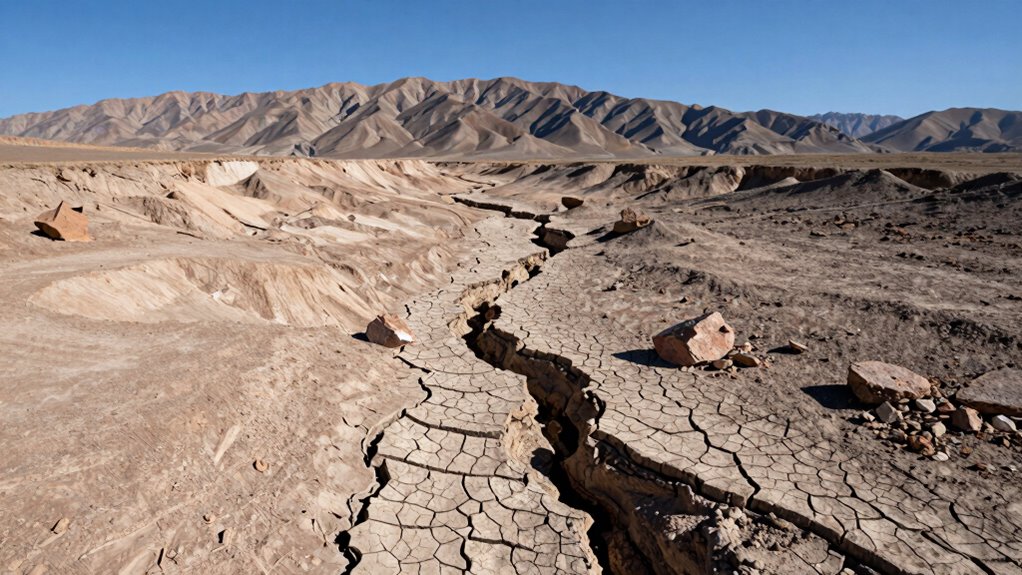
Most earthquakes occur along specific regions known as tectonic plate boundaries, where Earth’s crust is constantly shifting. These zones are the most active, but some earthquakes also happen at seismic hotspots far from boundaries. Here are the main areas where earthquakes happen most frequently:
- Plate Boundaries: Subduction zones, transform faults, and divergent boundaries experience frequent seismic activity.
- Seismic Hotspots: These are volcanic regions like Hawaii where magma movement causes earthquakes away from plate edges.
- Pacific Ring of Fire: An active zone encircling the Pacific Ocean, home to many of the world’s largest earthquakes.
- Mid-Ocean Ridges: Underwater mountain ranges where tectonic plates pull apart, causing frequent seismic shifts.
Knowing these regions helps you understand where earthquakes are most likely to occur.
How Are Earthquake Magnitude and Energy Measured, and What Do They Mean?
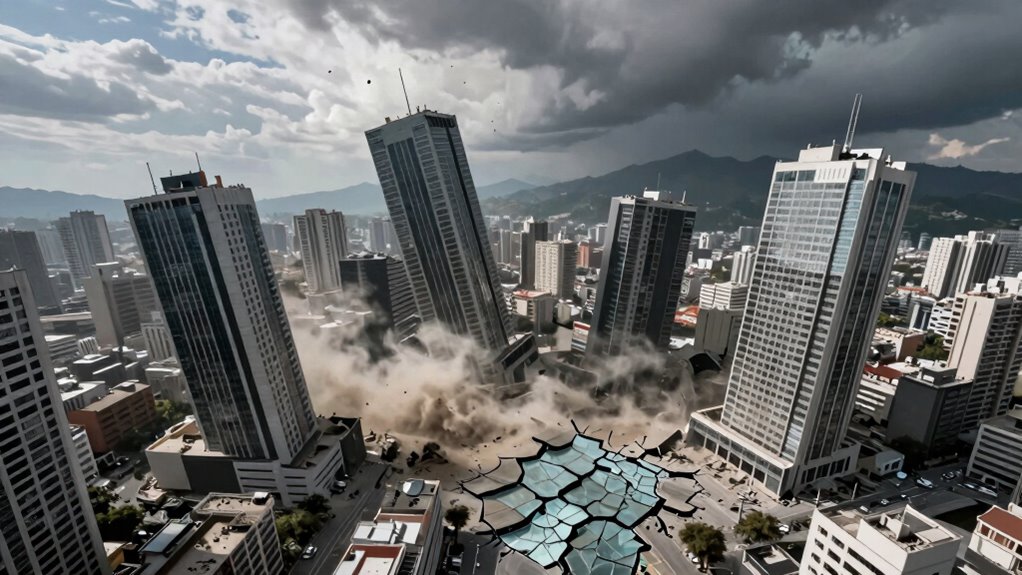
When an earthquake occurs, scientists measure its strength using two key ways: magnitude and energy. Seismic magnitude quantifies the size of the quake based on seismic waves recorded by instruments called seismographs. Energy release refers to the total energy emitted during the quake, indicating its destructive potential. To visualize this, consider the table below:
| Seismic Magnitude | Energy Release |
|---|---|
| 4.0 (Minor quake) | 1 trillion joules |
| 6.0 (Strong quake) | 1 quadrillion joules |
| 8.0 (Major quake) | 1 quintillion joules |
| 10.0 (Great quake) | 1 sextillion joules |
A higher seismic magnitude means more energy is released, resulting in more intense shaking and damage.
Frequently Asked Questions
Can Earthquakes Be Predicted Accurately Before They Occur?
Earthquakes can’t be predicted accurately before they happen. Seismic forecasting helps identify areas at higher risk but can’t specify exact times or magnitudes. That’s why earthquake preparedness is crucial; you should always have emergency plans and supplies ready. While scientists monitor seismic activity, a precise prediction remains out of reach. Staying prepared ensures you’re better equipped to handle the unexpected when an earthquake occurs.
How Do Human Activities Influence Earthquake Frequency?
Human activities can markedly influence earthquake frequency through induced seismicity. When you engage in activities like hydraulic fracturing, geothermal energy extraction, or deep-well waste disposal, you increase the likelihood of earthquakes. These human actions alter underground stress and fault lines, sometimes triggering tremors that wouldn’t occur naturally. While not all human activities cause earthquakes, they can definitely contribute, especially in areas with pre-existing fault lines or high tectonic stress.
Are There Early Warning Systems for Earthquakes?
Yes, there are early warning systems for earthquakes. You’ll find these systems use seismic sensors to detect initial, less-damaging waves called P-waves. Once detected, they send early alerts seconds to minutes before the more destructive S-waves arrive. These alerts give you precious time to take protective actions, such as dropping, covering, and holding on, potentially saving lives and reducing injuries during a quake.
What Role Do Underground Water and Reservoirs Play in Earthquakes?
Imagine underground water quietly shifting beneath your feet—this is where reservoirs and underground water can influence earthquakes. Reservoir effects, caused by large water bodies filling or emptying, change pressure on fault lines, potentially triggering seismic activity. When water seeps into cracks or builds up behind dams, it can lubricate faults or add weight, increasing the risk of quakes. So, your water usage directly ties into the Earth’s seismic behavior.
How Does Earthquake Risk Vary Between Urban and Rural Areas?
You’ll notice that earthquake risk is higher in urban areas due to increased urban seismicity, which results from dense building infrastructure and human activities. In contrast, rural areas face risks mainly from natural rural fault zones, which are often less active but can produce significant earthquakes. While urban zones are more vulnerable because of population density, rural fault zones may experience less frequent but potentially more destructive quakes.
Conclusion
Think of earthquakes as nature’s silent symphony, where tectonic plates dance beneath your feet. Their power, like a storm’s fury, depends on how deep and forceful the quake strikes. By understanding these hidden forces, you can better prepare for when the earth whispers or roars. Remember, each tremor is a reminder of the delicate balance holding our world together—a symbol of nature’s raw, unstoppable energy. Stay aware, stay safe.