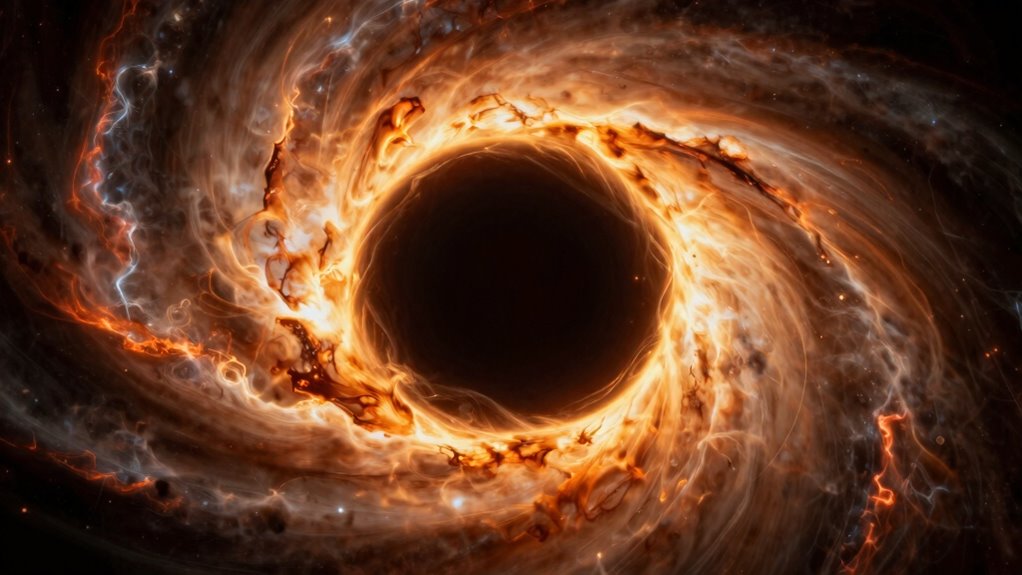

A black hole is a region in space where gravity is so intense that nothing can escape, not even light. They form when massive stars exhaust their fuel and collapse under their own gravity, creating a core of infinite density surrounded by an event horizon—a point of no return. Black holes influence spacetime, warp light, and reveal much about the universe’s structure. If you’re curious, there’s much more to uncover about these fascinating cosmic phenomena.
Key Takeaways
- A black hole is a region in space with gravity so intense that nothing, not even light, can escape it.
- Black holes form from collapsing massive stars after they exhaust their nuclear fuel.
- They consist of a singularity—an infinitely dense point—surrounded by an event horizon, the boundary of no return.
- Black holes warp spacetime significantly, causing effects like gravitational lensing and time dilation near their edges.
- They are key to understanding fundamental physics, including gravity, quantum mechanics, and the universe’s evolution.
What Is a Black Hole and How Do They Form?
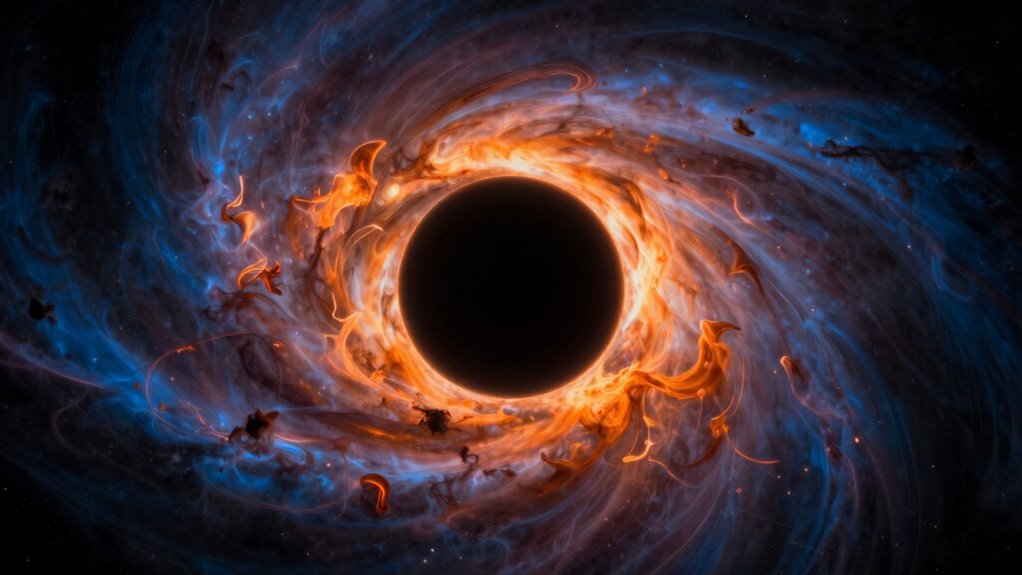
Have you ever wondered what happens when a massive star exhausts its fuel? When that occurs, gravity overwhelms the star’s internal pressure, causing it to collapse inward. This process forms a black hole, a region with gravity so intense that nothing, not even light, can escape. Black hole thermodynamics helps us understand how these objects interact with their surroundings, including phenomena like Hawking radiation—a form of radiation emitted due to quantum effects near the event horizon. As the star collapses, its core compresses to a point known as a singularity, where density becomes infinite. The event horizon marks the boundary beyond which escape is impossible. This formation process is driven by gravity’s relentless pull, shaping the mysterious and fascinating nature of black holes. Understanding black hole formation provides insight into the fundamental forces of the universe. Furthermore, recent research in black hole physics explores how these cosmic objects influence the fabric of spacetime itself, revealing their profound impact on our understanding of gravity and the universe. Additionally, scientists continue to study event horizon dynamics to uncover more about the mysterious boundary that defines a black hole’s edge. A deeper understanding of black hole thermodynamics also helps explain how black holes can lose mass over time through processes like Hawking radiation.
What Are the Different Types of Black Holes?
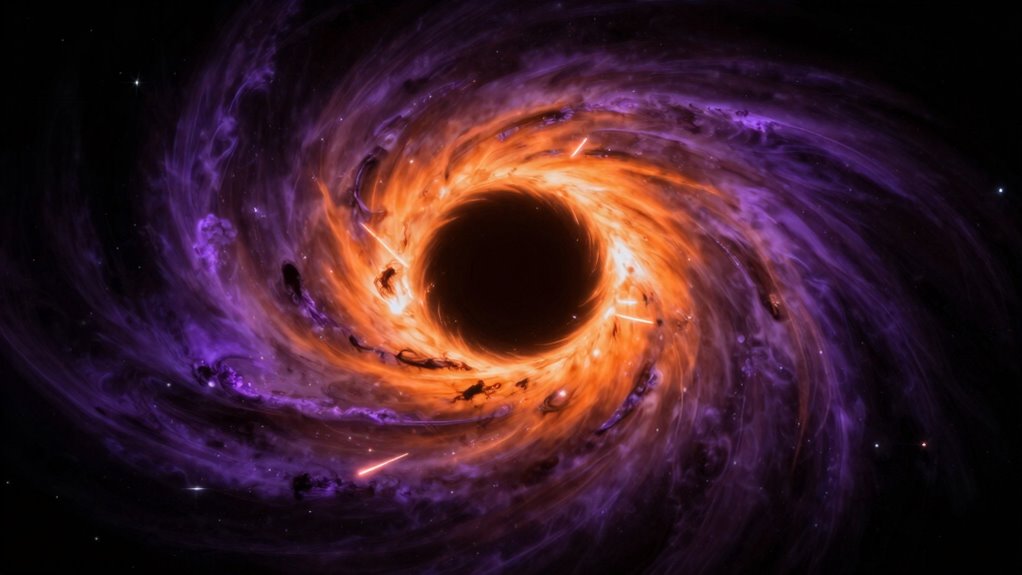
Black holes come in different types, mainly stellar and supermassive, each forming through distinct processes. You’ll find stellar black holes created when massive stars collapse, while supermassive black holes grow large enough to anchor entire galaxies. Understanding these differences helps you grasp the variety of black holes in our universe. European cloud innovation plays a role in advancing scientific research related to these cosmic phenomena, enabling more detailed observations and simulations.
Stellar Black Holes Formation
Stellar black holes form when massive stars exhaust their nuclear fuel and undergo a supernova explosion, collapsing under their own gravity. During stellar evolution, these stars shed mass and influence galaxy dynamics through their energetic events. Once the core collapses, it creates a dense black hole. Key aspects include:
- The star’s initial mass determines if it becomes a stellar black hole.
- Supernova explosions disperse outer layers, leaving a compact core.
- The collapsing core’s gravity becomes so intense that not even light escapes.
- This process is influenced by the star’s environment and interactions.
- Stellar black holes are common remnants in galaxies, shaping their evolution.
Understanding their formation helps clarify how different black holes arise from stellar evolution and impact galaxy dynamics over cosmic time.
Supermassive Black Holes
Supermassive black holes are extraordinary cosmic objects that sit at the centers of most galaxies, including our own Milky Way. They contain millions to billions of times the Sun’s mass, making them vastly larger than stellar black holes. These giants play a key role in galaxy evolution and are linked to concepts like black hole entropy, which measures their disorder. In black hole thermodynamics, supermassive black holes have high entropy, reflecting their immense information content. Understanding their formation and growth involves studying accretion and galaxy mergers. Unlike smaller black holes, they influence their surroundings profoundly. Their properties, including entropy and thermodynamic behavior, help scientists explore fundamental physics, revealing how black holes fit into the universe’s grand structure.
How Do Black Holes Warp Spacetime?
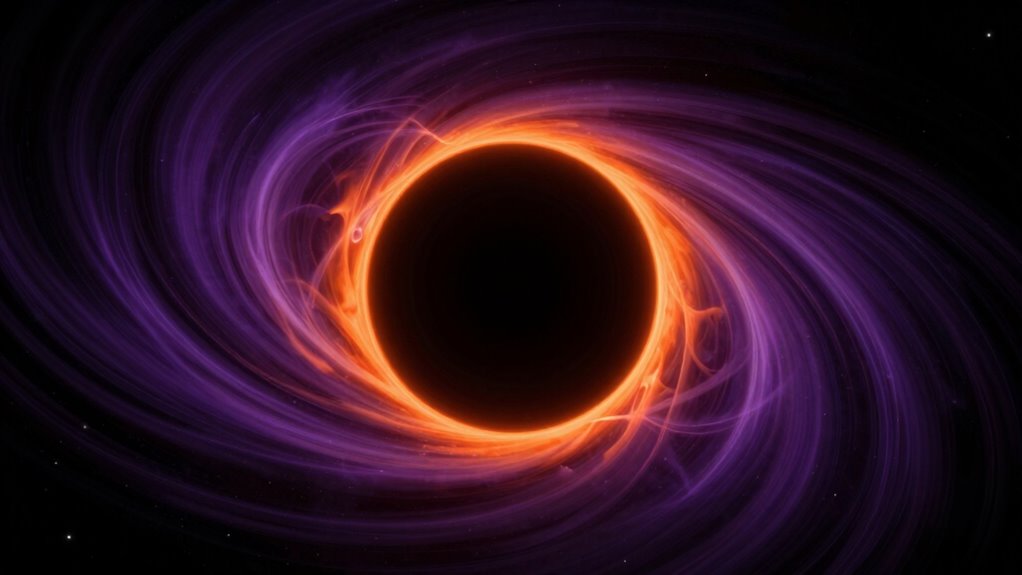
Black holes create a deep gravitational well that dramatically affects the fabric of spacetime around them. As you get closer, the curvature becomes more pronounced, pulling everything inward. This intense warping explains how black holes influence the movement of nearby objects and light. The gravitational lensing effect is a direct consequence of this warping, bending light paths in observable ways. Understanding the curvature of spacetime helps clarify how these phenomena occur and why black holes are so influential in cosmic structures.
Gravitational Well Depth
When a black hole forms, it creates an incredibly deep gravitational well that warps the fabric of spacetime around it. This well is so intense that beyond the event horizon, nothing can escape its pull. The depth of this gravitational well determines how strongly objects are pulled inward. As you approach the event horizon, spacetime curves sharply, and gravity becomes overwhelming. You might notice:
- The gravitational well deepens as mass concentrates.
- Light bends around the black hole, creating gravitational lensing.
- Time slows down near the event horizon relative to distant observers.
- The escape velocity exceeds the speed of light at the event horizon.
- The well’s depth defines how extreme spacetime warping becomes.
- The structure of the spacetime around a black hole is influenced by its mass and spin.
This gravitational well is what makes black holes so powerful, shaping the very fabric of spacetime in their vicinity.
Spacetime Curvature Effects
Ever wonder how black holes bend the very fabric of spacetime? They create intense curvature that warps reality around them. This curvature causes spacetime ripples—disturbances that propagate outward, like ripples on a pond. Near a black hole, gravity becomes so strong that particles can quantum tunnel through the event horizon, effectively disappearing from one point in spacetime and reappearing somewhere else. This quantum tunneling influences the curvature, making spacetime even more distorted. The warping isn’t just a simple dip but a complex, dynamic distortion, shaping how objects move and light travels nearby. These effects show how black holes don’t just trap matter, but fundamentally reshape spacetime itself, illustrating the profound way gravity and quantum phenomena intertwine at these cosmic giants.
How Do Scientists Detect Black Holes?
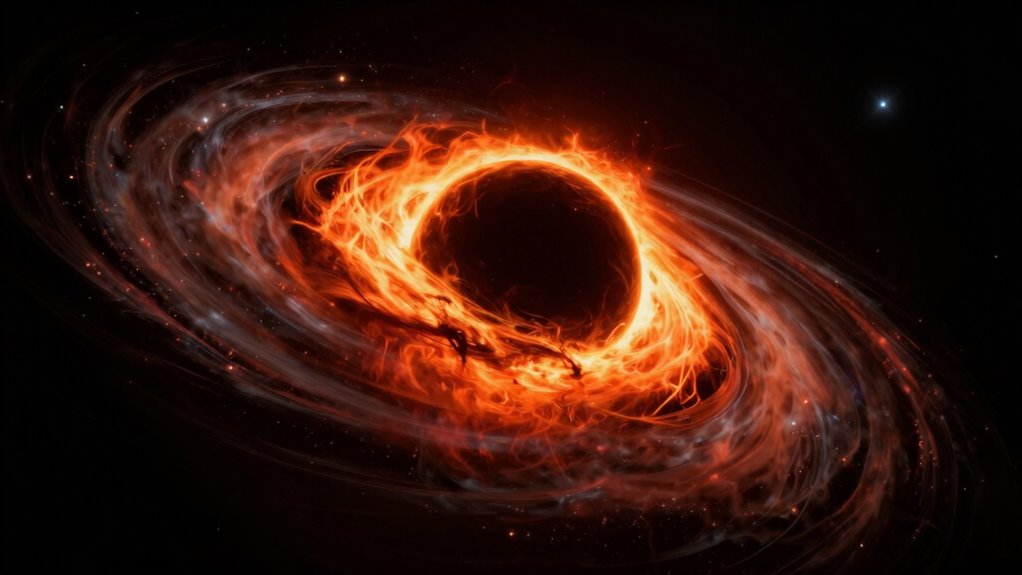
Have you ever wondered how scientists spot something that emits no light? They rely on indirect evidence, observing the effects black holes have on their surroundings.
- They look for high-energy X-ray emissions from matter spiraling into the black hole.
- They track stars orbiting invisible objects, revealing gravitational influences.
- They analyze gravitational waves produced by black hole mergers.
- They study accretion disks heating up due to intense gravity.
- They consider quantum entanglement signals and black hole thermodynamics to understand black hole behavior.
- They also utilize decentralized finance and blockchain-inspired models to simulate and analyze complex gravitational interactions indirectly.
- Researchers are exploring innovative net worth analysis methods to better understand the fundamental properties of black holes through modeling and simulation.
- Advances in computational modeling are enhancing our ability to interpret the subtle effects black holes have on their environment.
- Additionally, scientists are employing spectroscopic techniques to detect signatures associated with black hole activity that are otherwise invisible.
Common Myths and Misconceptions About Black Holes

Many people imagine black holes as cosmic vacuum cleaners that swallow everything in their path, but this isn’t quite true. Black hole paradoxes, like the information loss paradox, challenge our understanding of physics, yet they don’t mean black holes are cosmic monsters. Similarly, the event horizon mysteries often lead to misconceptions—people think it’s a destructive boundary, but it’s simply a point of no return. Black holes are not portals to other worlds or universe-destroying devices; they’re extreme objects governed by physics we’re still learning. The idea that black holes continually devour matter is a myth. Instead, they often emit radiation and have complex behaviors that defy simple notions. Understanding these myths helps you see black holes as fascinating, natural phenomena, not science fiction caricatures.
Why Do Black Holes Matter in Cosmology?
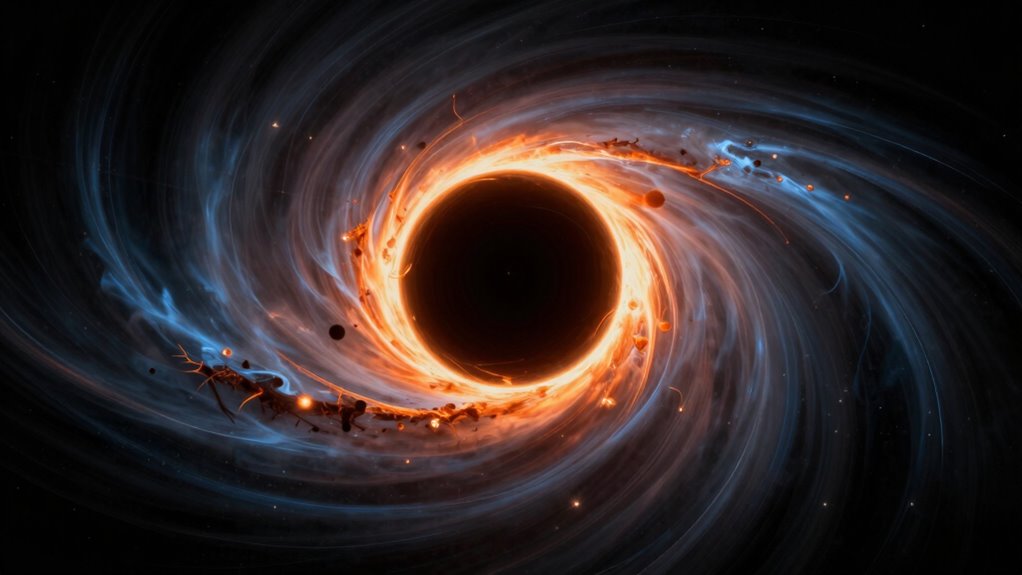
Why do black holes matter in cosmology? They’re key to understanding the universe’s evolution and fundamental physics. Black hole thermodynamics shows that black holes have temperature and entropy, linking gravity and quantum mechanics. This connection helps explain how information is preserved or lost, known as black hole information. Black holes influence galaxy formation and cosmic structure by shaping matter movement. They also serve as natural laboratories for testing theories of the universe. Black hole thermodynamics provides crucial insights into the connections between gravity and quantum physics, revealing quantum-gravity interactions that are otherwise inaccessible. Studying these interactions opens new avenues for understanding the unification of physics. They reveal insights into the universe’s origins and fate. They challenge our understanding of space, time, and information. The study of black holes also enhances our grasp of cosmic evolution, demonstrating their role in shaping the large-scale structure of the universe. They connect quantum mechanics with gravity. They help us understand galaxy growth and evolution. They spark questions about the ultimate nature of reality. In essence, black holes are cosmic puzzles that push the boundaries of cosmology.
What Happens When Matter Approaches a Black Hole’s Event Horizon?

As matter approaches a black hole’s event horizon, it experiences extreme gravitational forces that stretch and compress it in a process known as spaghettification. To you, it might seem like crossing the horizon is seamless, but from a physics perspective, the intense gravity warps space-time. Inside, quantum entanglement plays a role in the black hole’s information paradox, hinting that information isn’t lost but encoded in subtle correlations. Hawking radiation, emitted from just outside the horizon, causes black holes to slowly evaporate over time. When you get close, this radiation becomes significant, revealing the complex quantum processes at work. These phenomena show that black holes aren’t just cosmic vacuum cleaners but extraordinary laboratories for understanding quantum gravity.
What Do Black Holes Tell Us About Dimensions and Time?
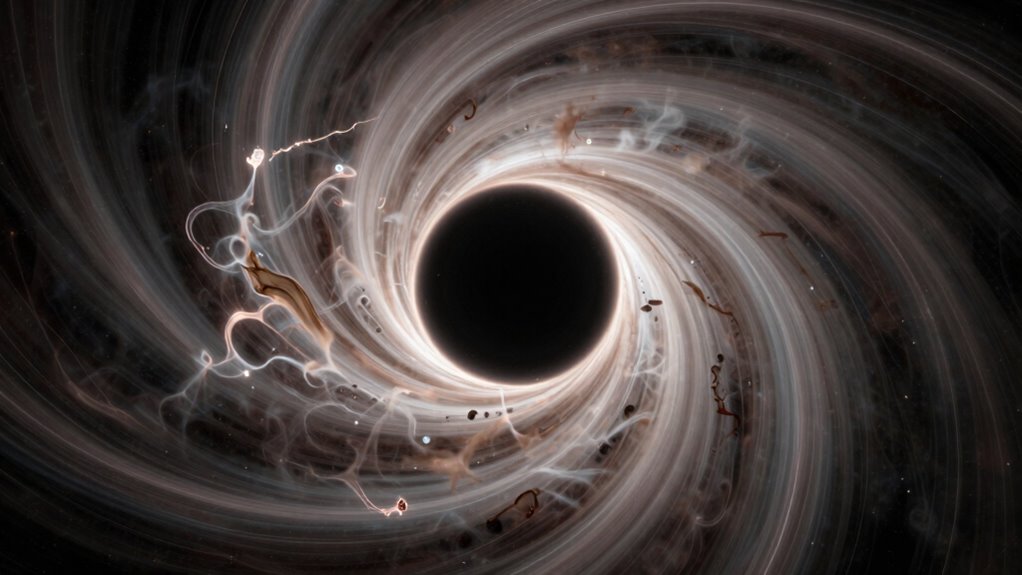
Black holes challenge our understanding of dimensions and time, revealing that the universe might be more complex than it appears. They offer dimensional insights that suggest space could have more than three dimensions, especially near the singularity. You experience extreme effects like time dilation, where time slows down dramatically near a black hole’s event horizon. Black holes hint at extra dimensions beyond our perception — suggesting that the fabric of space might be more intricate than we currently understand. Space may curve or fold in ways we haven’t fully grasped, potentially involving additional spatial dimensions. These phenomena challenge classical physics and hint at new theories. Understanding black holes could unveil secrets about the universe’s true structure, including how space-time itself might be more flexible than previously thought. The study of black holes thus opens pathways to explore fundamental questions about the nature of dimensions.
The Future of Black Hole Research and What It Could Reveal
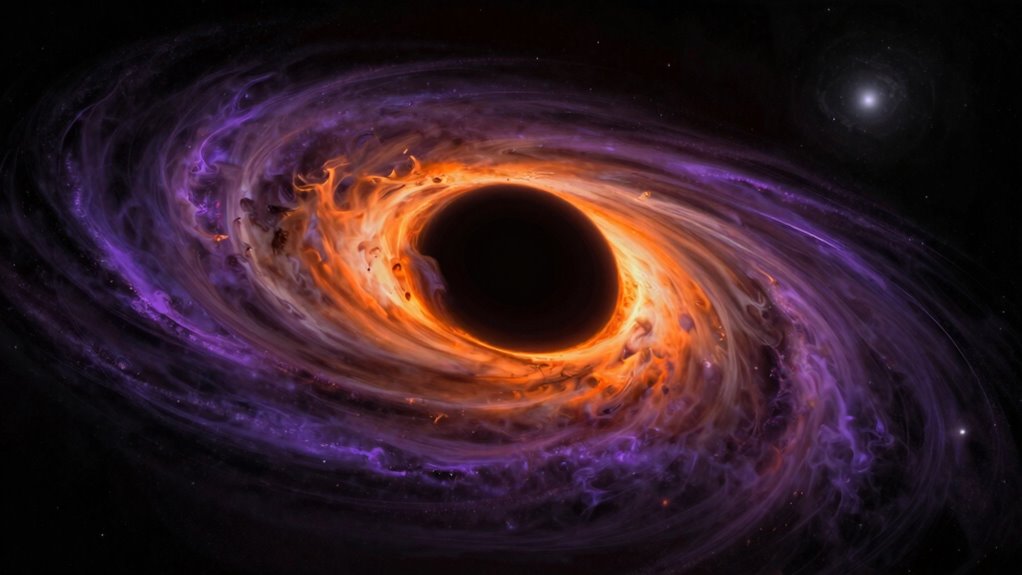
The future of black hole research promises to open deeper understanding of the universe’s fundamental laws. Advances in black hole thermodynamics will help you grasp how entropy and temperature relate to these dense objects. Researchers aim to resolve the black hole information paradox, shedding light on whether information is lost or preserved during black hole evaporation. Breakthroughs in detection technology, like gravitational wave observatories, will reveal new details about black hole mergers and growth. As scientists develop new observational tools, our view of these mysterious objects will become increasingly detailed and precise.
Frequently Asked Questions
Can Black Holes Exist in Galaxies Other Than Our Milky Way?
Yes, black holes exist in galaxies beyond the Milky Way. Through black hole detection methods, astronomers have found many supermassive black holes in other galaxies. These black holes are classified based on their mass and activity level. You can’t see them directly, but their influence on surrounding stars and gas helps scientists confirm their presence. So, black holes are a common feature across the universe, not just in our galaxy.
How Do Black Holes Influence Surrounding Star Formation?
Black holes influence surrounding star formation through accretion effects that can either trigger or suppress it. When a black hole pulls in material, the energy released can heat nearby gas, preventing it from collapsing into new stars. Conversely, in some cases, black holes can compress gas clouds, encouraging star formation. Your proximity to a black hole determines whether it acts as a star formation catalyst or inhibitor.
Are Black Holes Dangerous to Earth or Our Solar System?
Black hole safety is generally not a concern for Earth or our solar system. Cosmic hazards from black holes are minimal because they’re usually far away, and their gravitational pull doesn’t affect us unless we’re extremely close. You don’t need to worry about black holes threatening our planet; they pose little danger as cosmic hazards. Stay informed, but rest assured that black holes aren’t a threat to your safety.
What Role Do Black Holes Play in Galaxy Evolution?
Black holes shape galaxy evolution in profound ways. When black hole mergers occur, they release gravitational waves that ripple through space, signaling massive changes. These mergers help grow supermassive black holes, which influence star formation and galactic structure. You might not see it, but these cosmic events drive the dynamic life cycle of galaxies, acting as invisible architects shaping the universe’s grand design.
Can Black Holes Potentially Evaporate Completely Over Time?
Yes, black holes can potentially evaporate completely over time. Hawking radiation causes black holes to lose energy, which shortens their lifespan. Smaller black holes emit more radiation and evaporate faster, while larger ones take longer. As they radiate away their mass, their black hole lifespan decreases, leading to eventual disappearance. So, given enough time, even the most massive black holes could vanish entirely through this process.
Conclusion
Black holes are cosmic giants that challenge your understanding of reality, warping spacetime like a cosmic whirlpool. As you explore their mysteries, you’ll see they’re not just science fiction monsters but essential keys to understanding the universe’s fabric. Keep delving into their secrets, and you’ll discover they’re the universe’s most intriguing puzzles—waiting to be solved. Like stars in the night sky, black holes continue to beckon, inviting you to uncover what lies beyond.