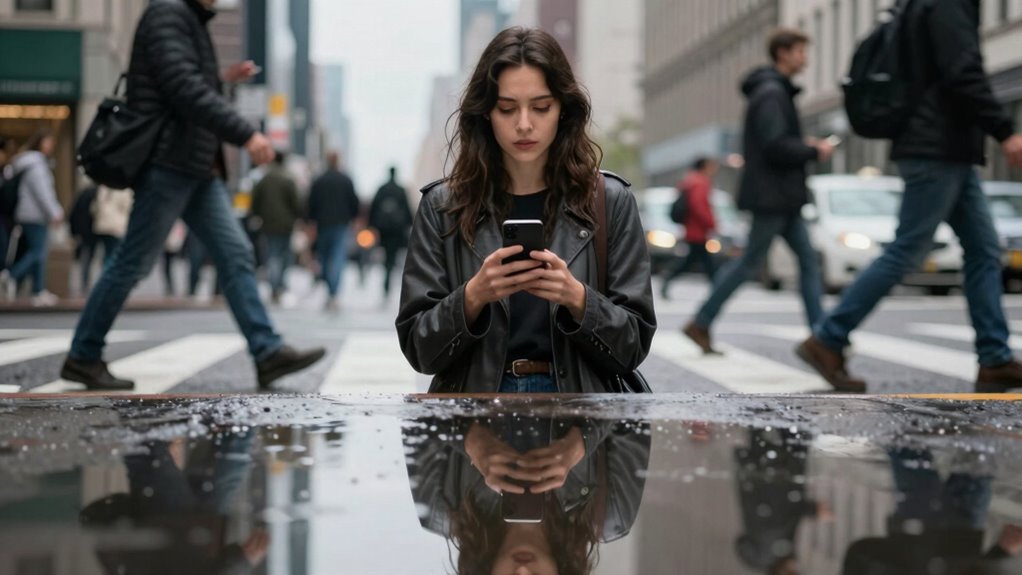

You often misjudge how others see you because your perceptions are shaped by personal biases, emotions, and assumptions. Your brain fills in missing cues based on your self-image, which can distort reality. Factors like insecurity or anxiety make you more likely to interpret neutral or ambiguous signals negatively. Overestimating or underestimating others’ opinions is common, and understanding these perceptual distortions can help you see things more clearly—if you explore further, you’ll uncover how to better grasp others’ true perceptions.

Prime made for students and young adults
- Fast, free delivery for dorm and study essentials
- Prime Video and Amazon Music included
- Member-only deals
Key Takeaways
- Personal biases and expectations distort our perception of others’ facial expressions and social cues.
- Emotional states like anxiety or insecurity influence how we interpret others’ reactions, often negatively.
- We tend to fill in missing social information based on self-image, leading to misjudgments.
- Ambiguous social feedback can be overinterpreted or underestimated due to cognitive biases.
- Our perception is shaped more by internal filters than by actual external signals from others.

Have you ever wondered how accurately you perceive others’ opinions of you? It’s a question many people ask themselves, especially during social interactions. The truth is, we often misjudge what others think of us because our perceptions are shaped by a mix of our own biases and the subtle cues we pick up—like facial expressions and social feedback. You might assume a smile from someone means they’re genuinely happy or that a frown signals disapproval, but these signals can be misleading. Our brains tend to interpret facial expressions based on personal experiences and expectations, which can distort reality. If you’re feeling insecure, you might see a neutral face as judgmental or cold, even when the person isn’t intending to send that message. Conversely, when you’re confident, a simple glance might be read as interest or approval, even if that’s not the case. This disconnect stems from how our minds fill in gaps in social cues with assumptions that align with our self-image. Additionally, our perceptions are often influenced by interpretation biases, which can cause us to see what we want or expect to see rather than what is actually there. These biases are deeply rooted in cognitive processes that shape our understanding of social interactions. Moreover, the way our brains process social cues can be affected by personal experiences, which create individual filters through which we interpret others’ behaviors. Sometimes, our emotional state can override the actual cues, leading us to misinterpret neutral or ambiguous signals.
Social feedback plays a big role in how you view yourself through others’ eyes. You might believe that a compliment or a kind word reflects genuine admiration, but social feedback can be complicated. People often give signals that aren’t as straightforward as they seem, either out of politeness, social pressure, or misinterpretation. Sometimes, you might overestimate the importance of a single comment or gesture, assuming it reveals the full scope of someone’s opinion. Other times, you underestimate the impact of silent cues, like body language or eye contact, which can be more revealing than words. Because you’re naturally inclined to interpret these signals through your own lens, you might see approval where there’s none or miss it entirely. This tendency causes a persistent gap between how you think others see you and how they actually do. Recognizing the role of social cues and their interpretation can help improve your understanding of others’ true perceptions. Furthermore, your own emotional state influences your perception of social cues. If you’re feeling anxious or insecure, you’re more likely to read negative facial expressions or dismiss positive social feedback. Conversely, if you’re feeling good about yourself, you might overlook subtle signs of disapproval or disinterest. This cycle creates a distorted view of your social standing. The reality is, human communication is complex, and facial expressions or social feedback are often ambiguous. Your mind tends to fill in the blanks based on your self-perception, which means you’re often seeing what you want or expect to see rather than what actually exists. Recognizing this can help you become more aware of your biases and approach social situations with a clearer, more accurate perspective.
As an affiliate, we earn on qualifying purchases.
Frequently Asked Questions
How Can We Improve Our Self-Perception Accuracy?
To improve your self-perception accuracy, focus on developing self-awareness by reflecting on your thoughts and behaviors regularly. Be mindful of cognitive biases like confirmation bias or self-serving bias that distort your view of yourself. Seek honest feedback from trusted friends or mentors, and consider their perspectives openly. Practice humility and curiosity about how others see you, which helps counteract biases and creates a more realistic, balanced view of yourself.
Do Cultural Differences Affect How We Perceive Others’ Judgments?
Cultural perception greatly influences how you perceive others’ judgments, and judgment differences can vary sharply across cultures. While some cultures emphasize individual opinions, others prioritize group consensus. This contrast shapes how you interpret feedback, making you more sensitive or dismissive depending on cultural norms. Recognizing these differences helps you understand that perceptions aren’t universal, reducing misjudgments and fostering better cross-cultural communication.
Can Knowing About Biases Reduce Misjudgments?
Yes, knowing about biases can reduce misjudgments by improving your perception accuracy. When you understand perception distortion and become aware of your biases, you’re better equipped to interpret others’ actions and words more objectively. Bias awareness helps you recognize assumptions and avoid jumping to conclusions, fostering more genuine interactions. This self-awareness can lead to more accurate perceptions, reducing misunderstandings and improving your relationships with others.
How Do Social Media Impact Our Self-Image and Judgments?
Social media impacts your self-image by causing self-esteem fluctuations, as you seek online validation. When you post and receive likes or comments, it influences how you see yourself, often making you depend on external approval. This can lead to comparing yourself with others, amplifying insecurities. While online validation provides temporary boosts, it can distort your true self-perception, making you more vulnerable to negative self-judgments over time.
Are There Personality Traits That Influence How We See Ourselves?
Yes, your personality traits greatly influence how you see yourself. Traits like self-awareness, openness, and extroversion shape your personality perception, making you more conscious of your actions and feelings. If you’re high in self-awareness, you tend to accurately assess your strengths and weaknesses. Conversely, low self-awareness traits can cause you to misjudge yourself, leading to distorted self-perceptions. Your personality traits act as filters that influence your self-view daily.
As an affiliate, we earn on qualifying purchases.
Conclusion
So, next time you catch yourself overthinking how others see you, remember it’s often a coincidence—what you worry about might be exactly how they perceive you. Just like bumping into an old friend unexpectedly, our perceptions are sometimes shaped by tiny, unplanned moments. Trust that people see you more kindly than you think, and sometimes, the biggest misunderstandings are just happy accidents waiting to happen. After all, life’s little coincidences can surprise us the most.
emotional intelligence training course
As an affiliate, we earn on qualifying purchases.
As an affiliate, we earn on qualifying purchases.
As an affiliate, we earn on qualifying purchases.
Columbus Day / Indigenous Peoples' Day Picks
long weekend sales
As an affiliate, we earn on qualifying purchases.






![Terence Tao: Math 2.0 [Pdf]](https://rottenpanda.com/wp-content/uploads/2026/10/terence-tao-math-2-0-pdf-featured-260x140.jpg)