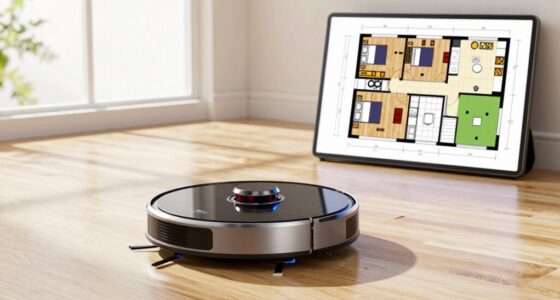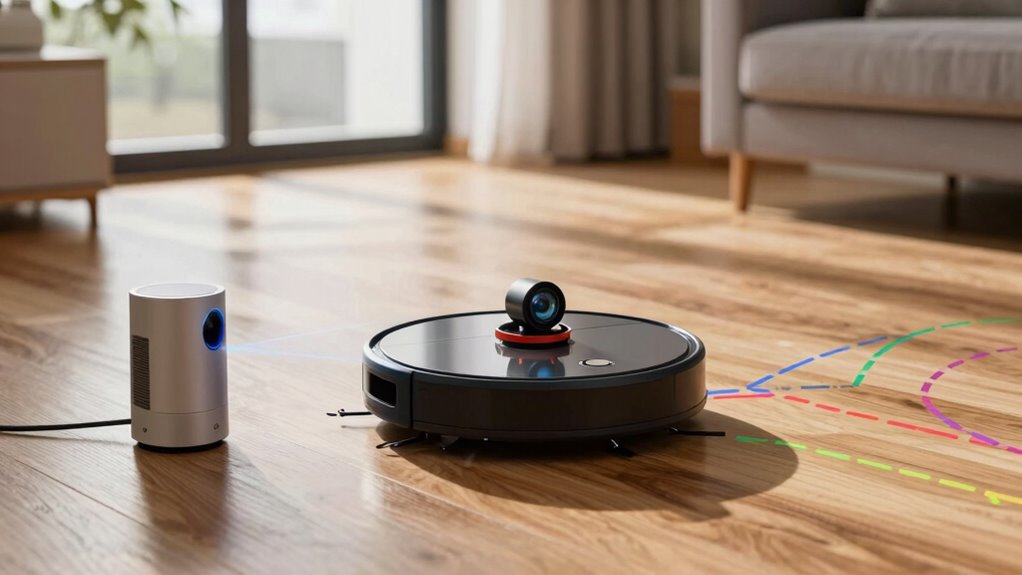

If you choose a robot vacuum with LiDAR, it uses laser sensors to create precise, real-time maps, ensuring thorough cleaning and obstacle avoidance. Cameras rely on visual cues, working well in good lighting but struggling in low-light conditions. Random navigation moves chaotically, often missing spots and less efficient. Understanding these differences helps you select the best tech for your home’s needs—if you’re curious about more, there’s plenty to explore ahead.
Key Takeaways
- LiDAR offers highly accurate, real-time 3D mapping for precise obstacle detection and thorough cleaning.
- Camera-based navigation relies on visual cues, performing well in good lighting but less in low-light or ambiguous environments.
- “Random” navigation moves unpredictably without mapping, suitable for simple spaces but less efficient and prone to missed spots.
- Both LiDAR and camera systems aim to optimize obstacle avoidance and cleaning efficiency, with different strengths and limitations.
- Cost and hardware complexity vary, with LiDAR generally being more advanced and expensive than camera or random navigation methods.
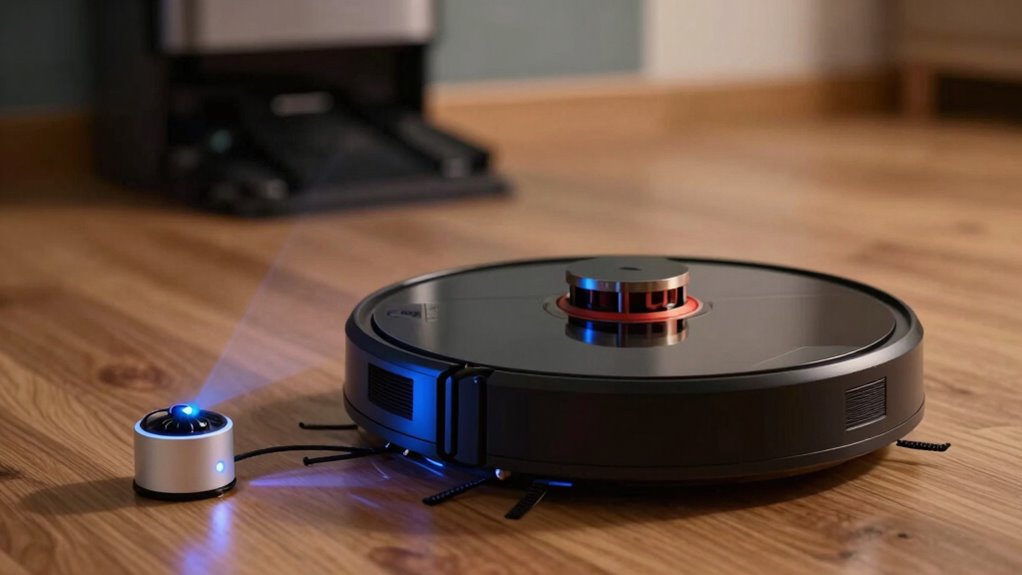
Have you ever wondered how robot vacuums efficiently navigate your home without bumping into furniture or missing spots? It all comes down to their navigation systems, which rely heavily on mapping accuracy and obstacle detection. These features ensure the vacuum knows exactly where it is, what obstacles are around, and how to clean thoroughly without wasting time or energy. Different technologies approach this task in unique ways, each with its own strengths and limitations.
LiDAR (Light Detection and Ranging) is one of the most advanced navigation methods. It uses laser sensors to create detailed, real-time maps of your home. As the robot moves, it emits laser beams and measures how long it takes for the light to bounce back. This data helps generate a precise 3D map of your space, allowing the vacuum to understand the layout with remarkable accuracy. Because of this high level of detail, LiDAR-equipped robots excel at obstacle detection—they can identify objects, detect changes in floor height, and navigate around furniture with minimal errors. This makes them especially effective in complex environments where accurate mapping is vital for thorough cleaning.
LiDAR uses laser sensors to create precise, real-time maps for accurate obstacle detection and navigation.
On the other hand, cameras provide visual data that the robot uses to navigate. These systems capture images or video of the surroundings, enabling the robot to recognize objects, detect obstacles, and understand its environment. Camera-based navigation can be quite effective, especially in well-lit areas, as it allows the robot to interpret visual cues and adapt to dynamic obstacles like moving pets or humans. However, their mapping accuracy can sometimes fall short in low-light conditions or when visual features are ambiguous, which might result in missed spots or minor collisions. Despite this, cameras are advantageous for their ability to recognize specific objects or areas, which can be useful for customized cleaning routines.
Then there’s the “random” navigation approach, where the vacuum moves in a seemingly haphazard pattern. It doesn’t rely on mapping accuracy or obstacle detection but instead uses simple algorithms to bounce around until the area is covered. While this method is less precise and often less efficient, it’s typically more affordable and requires less sophisticated hardware. Random navigation can work adequately in small, clutter-free spaces but often results in missed spots or repeated cleaning of the same area, especially in larger or more complex environments.
Frequently Asked Questions
How Does Lidar Perform in Dark or Low-Light Environments?
LiDAR performs well in dark or low-light environments because it doesn’t rely on ambient light, unlike cameras. However, sensor limitations can affect accuracy if environmental interference, like dust or reflective surfaces, disrupts the laser signals. You’ll find LiDAR remains reliable in darkness, but keep in mind that extreme conditions or obstacles can still impact its navigation. Still, it’s generally a strong choice for low-light cleaning scenarios.
Can Camera-Based Navigation Recognize and Avoid Small or Transparent Objects?
Camera-based navigation struggles with small object detection and transparent obstacle recognition because cameras rely on visual cues that can be obscured or distorted. You might find it difficult for your robot vacuum to recognize tiny items or see through glass or plastic obstacles. This limitation can cause the vacuum to miss or bump into small or transparent objects, making it less reliable in cluttered or transparent obstacle-rich environments.
Do “Random” Navigation Robots Learn or Improve Over Time?
Imagine a curious robot that’s always exploring, gently learning from its environment. While “random” navigation robots don’t truly learn or improve, some models incorporate basic adaptive algorithms that can fine-tune their behavior over time. These machines use simple forms of machine learning to optimize their cleaning paths, making them a bit smarter with each pass, even if they don’t develop complex skills like more advanced navigation systems.
Which Navigation Method Is Best for Multi-Floor or Multi-Room Layouts?
For multi-floor or multi-room layouts, LiDAR navigation is your best choice. It excels at multi-floor mapping and room segmentation, helping your robot understand complex spaces. Cameras can struggle with varied lighting, and random navigation lacks precision. LiDAR provides accurate, consistent navigation across different floors and rooms, ensuring thorough cleaning. Its ability to create detailed maps makes it ideal for multi-level homes, giving you efficient, intelligent cleaning with minimal effort.
How Do These Navigation Systems Handle Temporary Obstacles Like Moving Pets?
If a pet suddenly darts across your path, your robot’s obstacle detection becomes a superhero, instantly recognizing and avoiding the chaos. LiDAR and cameras excel in navigation adaptability, swiftly adapting to moving obstacles, while random systems might stumble or get stuck. You’ll love how these advanced systems keep your floors spotless, even with unpredictable pet antics, ensuring a smooth, worry-free clean every time.
Conclusion
When choosing between lidar, cameras, or random navigation, you hold the power to pick the perfect system for your home. Lidar offers laser-sharp precision, cameras provide versatile vision, and random moves can surprisingly cover ground efficiently. Ultimately, your decision shapes your robot vacuum’s intelligence—making it smarter than a thousand mice scurrying through your house. So, pick wisely and watch your robot conquer your cleaning chaos like a superhero on a mission!