
Peer review helps guarantee scientific research is accurate, credible, and methodologically sound before publication, but it isn’t foolproof. It catches many errors and biases, improving quality and trust in science. However, it can’t eliminate all mistakes, biases, or assess societal impact fully. It also has limitations like potential conflicts of interest and conservatism. To understand what peer review truly does—and doesn’t—continue exploring its role and ongoing innovations.
Key Takeaways
- Peer review verifies research quality, methodology, and accuracy but cannot guarantee absolute truth or detect all errors.
- It helps filter flawed studies, promoting credible science, but may be biased or overlook groundbreaking ideas.
- Peer review improves research standards and reduces bias, yet it has limitations like reviewer subjectivity and scope restrictions.
- Innovations such as open review and AI tools enhance transparency and efficiency but do not eliminate all shortcomings.
- Ultimately, peer review is a valuable but imperfect part of scientific validation, requiring ongoing improvements and critical evaluation.
What Is Peer Review and Why It Matters for Scientific Trust

Peer review is a process that guarantees the quality and credibility of scientific research before it gets published. It helps filter out flawed or unsubstantiated studies, fostering trust in scientific findings. However, it’s not perfect. Publication bias can influence what gets accepted, favoring positive or novel results over negative or inconclusive ones. Reviewer bias also plays a role, as personal beliefs or unconscious preferences may sway judgments. These biases can limit the diversity of published research and skew scientific understanding. Despite these limitations, peer review remains essential for maintaining standards and ensuring that only rigorous work reaches the public. Recognizing its flaws helps you appreciate the importance of ongoing quality assurance and improvements to strengthen the trustworthiness of scientific communication. Being aware of limitations in the process encourages a more critical and informed approach to scientific information. Additionally, the technology used in peer review can vary greatly, impacting the consistency and fairness of evaluations.
Why Do We Need Peer Review?

You need peer review to make sure the research you rely on is trustworthy and accurate. It helps catch errors and guarantees that studies meet high standards of quality. Without it, the scientific community and the public risk accepting flawed or incomplete findings. Additionally, peer review can ensure that research adheres to sound scientific principles, which is essential for advancing reliable knowledge. Proper filtration and pump protection in research tools and methodologies are also vital to maintain accuracy and prevent contamination. Incorporating appropriate screening guidelines can further enhance the reliability of research outcomes, especially in health-related fields like breast cancer diagnostics. Furthermore, attention to piercing aftercare and hygiene practices in related fields exemplifies how meticulous procedures uphold safety and credibility, underscoring the importance of rigorous standards across disciplines. In the context of high-heat outdoor cooking, applying rigorous quality control methods can similarly ensure safety and consistency in culinary research and practice.
Ensures Scientific Integrity
Why is scientific integrity so essential to the research process? It guarantees the credibility and trustworthiness of published findings. Peer review acts as a gatekeeper, upholding publication transparency and ethical standards. It helps catch errors, prevent misconduct, and verify that research adheres to accepted norms. Research ethics are fundamental to maintaining this integrity, ensuring that studies are conducted and reported responsibly. Without this process, false or biased results could spread, damaging scientific progress and public trust. Ethical standards support the credibility of scientific publications and foster confidence among researchers and the public. Here’s a quick comparison: peer review ensures that research meets established quality benchmarks before dissemination.
Promotes Research Quality
To guarantee research findings are dependable and impactful, the peer review process plays a pivotal role in promoting high-quality science. It helps identify flaws, ensure methodology is sound, and validate results before publication. Additionally, cryptocurrency market analysis can benefit from rigorous peer review to improve the reliability of financial forecasts and insights. Moreover, implementing standardized testing procedures can further enhance the consistency and fairness of the review process. However, peer review also addresses issues like publication bias, where only positive or novel findings get published, skewing the scientific record. By encouraging rigorous evaluation, it reduces the likelihood of flawed studies entering the literature. This process is essential in tackling replication crises, where many published results fail to be reproduced. Peer review pushes researchers to improve their work and report transparently, ultimately elevating research quality. Additionally, best small wood stoves are often evaluated through peer review to ensure safety and efficiency standards. While it’s not perfect, it remains a key mechanism for maintaining standards and fostering trust in scientific progress. Implementing transparent review practices can further strengthen the credibility of the process.
How Does Peer Review Catch Mistakes and Improve Science?
Peer review plays an essential role in catching mistakes and enhancing scientific research before it reaches publication. During the process, reviewers scrutinize the data, performing data validation to guarantee accuracy and consistency. They look for errors in calculations, methodology, and interpretation that could undermine the study’s validity. Through careful error detection, reviewers identify inconsistencies, flawed analyses, or missing information. This critical assessment helps prevent flawed research from being published, maintaining scientific integrity. Reviewers may also suggest clarifications or additional experiments, which improve the overall quality of the work. While peer review isn’t perfect, it acts as a fundamental checkpoint for identifying mistakes and refining research, making sure only more reliable, well-validated science moves forward. Additionally, the process encourages transparency and reproducibility, which are essential for scientific integrity, and it often benefits from the use of reviewer guidelines to standardize evaluations. Incorporating exfoliation techniques such as glycolic acid can also help ensure that research involving skin or scalp treatments is based on reliable, reproducible methods. Furthermore, applying quality control measures within the review process can help detect potential biases or errors before publication, strengthening the credibility of the research. Moreover, the review process can benefit from security zone principles to protect sensitive data during evaluation, further enhancing the credibility of published science.
What Are the Main Limitations of Peer Review?
Despite its important role, peer review has significant limitations that can affect the quality of scientific publishing. Bias distortion can influence reviewers’ judgments, leading to favoritism or undervaluing innovative ideas. This bias might prevent groundbreaking research from being accepted or cause accepted papers to be overly conservative. Additionally, peer review has a limited scope; it often focuses narrowly on methodological soundness and relevance, overlooking broader issues like reproducibility or societal impact. Reviewers’ expertise may also be insufficient to evaluate interdisciplinary work thoroughly. These limitations mean that peer review is not foolproof. It can miss errors, reinforce existing biases, and fail to assess all important aspects of research, which can ultimately hinder scientific progress. Furthermore, the scope of peer review may not encompass emerging fields or novel methodologies, which can limit the recognition of innovative research. Recognizing these limitations emphasizes the need for supplementary evaluation methods, such as open peer review or post-publication review, to enhance the reliability and comprehensiveness of scientific validation. The Bias distortion can also be influenced by personal relationships or institutional affiliations, which may skew the review process.
What Are Some Myths About Peer Review?

Many people believe that peer review guarantees the quality and objectivity of published research, but this is a myth. This misconception fuels scientific mythology, suggesting perfection where there’s often only rigorous scrutiny. Peer review helps filter out obvious flaws, but it’s not foolproof against errors or bias. Understanding peer review misconceptions prevents overestimating its power. Here’s a quick comparison:
| Myth | Reality |
|---|---|
| It ensures absolute truth | It improves quality but isn’t infallible |
| It detects all errors | Some mistakes can slip through |
| It guarantees objectivity | Bias can still influence reviewers |
| It’s the final step | Peer review is part of an ongoing scientific process |
Keep in mind, peer review is valuable but not a cure-all.
How Is Peer Review Improving? Are There Alternatives?
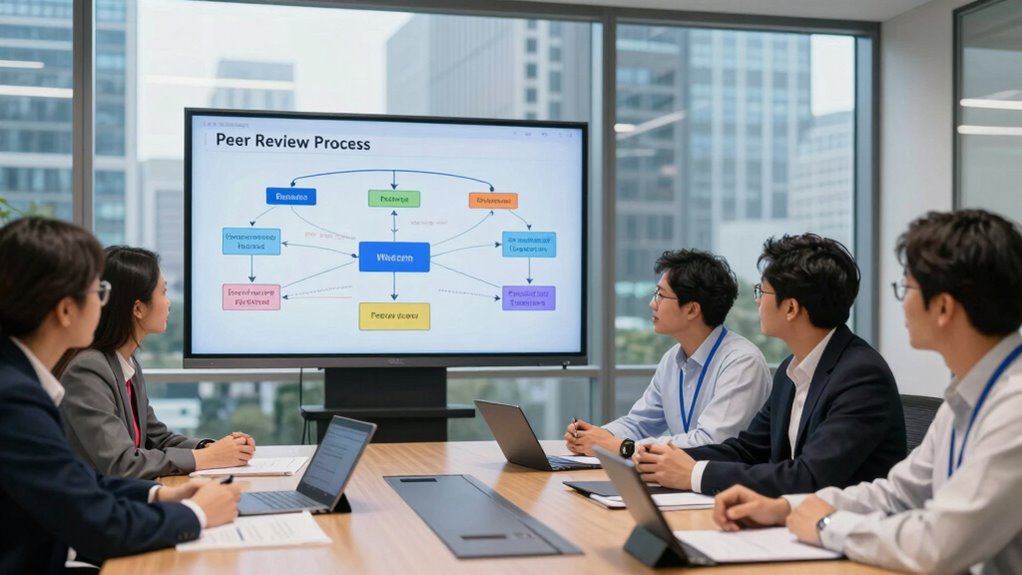
Peer review is evolving with new technologies and processes that aim to make it more efficient and transparent. You might also consider alternative methods like open review or post-publication evaluation, which challenge traditional models. Exploring these innovations can reveal how peer review continues to improve or where it still needs change.
Advances in Peer Review
Recent innovations are making peer review more transparent, efficient, and reliable. You can now see open peer review, where reviewer identities and comments are public, fostering accountability. AI-assisted review helps streamline the process by identifying errors, checking for plagiarism, and evaluating data consistency quickly. Additionally, digital platforms enable real-time collaboration, reducing delays and bias. These advances mean you get faster, clearer feedback, and greater trust in the process. For example:
- Open peer review promotes transparency and accountability.
- AI tools improve accuracy and speed of evaluations.
- Digital collaboration enhances communication and reduces bias.
Together, these changes are transforming peer review from a slow, opaque system into a more open and reliable process. While not perfect, these innovations are definitely pushing peer review forward.
Exploring Alternative Methods
While traditional peer review remains the standard, researchers and publishers are actively exploring alternative methods to improve transparency, efficiency, and fairness. One promising approach is open peer review, which involves disclosing reviewer identities or publishing review reports alongside the article. This transparency can enhance accountability and reduce biases. Alternative methods also include post-publication review, where feedback occurs after publication, allowing the community to evaluate work openly. Some platforms experiment with collaborative reviews, inviting broader participation. These innovations aim to address limitations of conventional peer review, such as delays and lack of openness. By embracing open peer review and other alternative methods, you can help foster a more transparent, inclusive, and efficient scholarly publishing process.
How Should You Read Scientific Research Considering Peer Review’s Limits?

Since peer review isn’t foolproof, it’s important to approach scientific research with a critical eye. To do this effectively, focus on three key steps:
- Evaluate the study’s methodology—look for clear, replicable procedures.
- Recognize potential biases—consider funding sources and author affiliations.
- Practice critical reading—question assumptions and compare findings with other research.
Frequently Asked Questions
How Are Peer Reviewers Selected and Trained?
You are selected as a peer reviewer based on your expertise, reputation, and previous contributions. The journal’s editors conduct reviewer selection, ensuring your background aligns with the manuscript’s subject. After selection, you typically undergo editor training, which guides you on review standards, confidentiality, and ethical considerations. This process helps you provide constructive, unbiased feedback, maintaining the integrity of peer review and supporting the journal’s quality assurance.
What Are the Costs Associated With Peer Review?
You’ll encounter costs like time and effort for reviewers, which can be substantial. These costs can lead to publication bias, as only certain studies get accepted, skewing results. Reviewer anonymity helps protect impartiality but also means you might not see all the feedback openly, potentially increasing bias. Overall, peer review involves balancing these costs with the need to maintain integrity and quality in scholarly publishing.
Can Peer Review Be Biased or Manipulated?
Yes, peer review can be biased or manipulated. While it aims to guarantee quality, review bias may influence judgments based on personal opinions or conflicts of interest. You might think it’s foolproof, but manipulation risks exist when reviewers favor certain researchers or institutions. Recognizing these vulnerabilities helps you understand that, despite its strengths, peer review isn’t immune to bias and manipulation, so always approach published work with critical thinking.
How Long Does the Peer Review Process Typically Take?
The peer review process usually takes anywhere from a few weeks to several months, depending on the journal and the complexity of your submission. You should expect varying publication timelines and review duration, as some journals prioritize faster feedback, while others require more extensive evaluations. To stay informed, check the journal’s guidelines or contact editors directly, so you can plan accordingly for your manuscript’s journey to publication.
Are There Disciplines Where Peer Review Is Less Effective?
You might find peer review less effective in disciplines like computer science or creative arts, where rapid innovation or subjective judgment prevails. While alternative methods like open review or community feedback exist, disciplinary limitations mean traditional peer review may lag behind or overlook nuances. In these fields, embracing diverse evaluation approaches can foster more relevant, timely insights, highlighting that no single system fits all, especially in areas valuing speed and creativity over standardization.
Conclusion
So, while peer review tries to keep science honest, don’t forget it’s not foolproof—think of it as the polite bouncer who occasionally misses a troublemaker. Trust but verify, and stay skeptical of shiny headlines. Remember, even the best-reviewed studies can hide flaws or biases. Ultimately, your curiosity and critical thinking are your best tools—because in the world of science, peer review is just one player in the game of uncovering truth.