The ‘Base Rate’ mistake happens when your brain ignores how common or rare an event actually is and focuses on vivid stories or recent examples instead. This leads you to overestimate the likelihood of rare events or jump to wrong conclusions, especially when relying on faulty judgments like positive test results without considering how common a condition really is. If you’re curious, you’ll discover ways to spot this bias and improve your decision-making process.
Key Takeaways
- People often ignore the actual prevalence of an event, overestimating the likelihood after favorable test results.
- Relying on vivid stories or recent experiences causes misjudgment, overshadowing statistical base rates.
- Misinterpreting test accuracy without considering disease prevalence leads to overconfidence in diagnosis.
- External influences and heuristics cause individuals to neglect objective data, resulting in faulty reasoning.
- Recognizing and questioning assumptions about base rates improves decision accuracy and reduces reasoning errors.
What Is the Base Rate Fallacy and Why Does It Lead to Mistakes?

Have you ever misunderstood the likelihood of an event because you focused on specific details rather than the overall context? That’s a common mistake caused by heuristic errors and cognitive biases. The base rate fallacy happens when you ignore general information about how often something occurs and instead rely on vivid or recent examples. For instance, you might overestimate the chance of a rare disease because you heard a shocking story about it, neglecting the actual low base rate. This bias skews your judgment, making you believe the event is more common than it really is. Your brain tends to focus on specific, memorable details rather than the broader data, leading to errors in reasoning. Recognizing this can be aided by understanding cognitive biases, which influence how we interpret information and make decisions. This awareness helps you avoid falling for these cognitive biases and improves your decision-making.
How Our Brain Ignores Big Data in Favor of Vivid Stories

Your brain often favors vivid stories over large datasets because memorable events stand out more strongly in your mind. This tendency stems from heuristic biases, mental shortcuts that help you process information quickly. Vivid stories activate emotional responses, making them seem more compelling and trustworthy than dry statistics. Your mind simplifies complex data into engaging narratives, which feels easier than analyzing raw numbers. These cognitive shortcuts can lead you to overlook the importance of big data, because stories are more immediate and relatable. Additionally, our reliance on mental shortcuts can cause us to prioritize emotional impact over objective evidence. This bias makes it harder to make rational decisions, as your reasoning relies more on emotional impact than on objective information. Furthermore, understanding how Gold IRA Markets operate can help you recognize these biases when evaluating financial options.
Real-Life Examples of the Base Rate Fallacy in Action

One of the most common examples of the base rate fallacy occurs in medical testing, where people often overestimate the likelihood of having a disease after a positive result. This happens because your heuristic shortcuts lead you to focus on the test outcome rather than considering the actual prevalence of the condition. Cognitive biases, like overconfidence in diagnostic tests, cause you to ignore the base rate—the rarity of the disease in the general population. For instance, if a test is 99% accurate but the disease affects only 1 in 1,000 people, a positive result still means you’re unlikely to have the illness. This misjudgment demonstrates how ignoring statistical context can distort your perception, making you overvalue test results and neglect the importance of base rate information. Recognizing statistical literacy can help improve decision-making processes by emphasizing the significance of comprehensive data analysis, especially when interpreting probability in real-world situations. Additionally, understanding population dynamics and demographic factors can further enhance your interpretation of such data. Developing an awareness of AI applications and their limitations can also prevent misjudgments in fields like healthcare and cybersecurity.
Why Ignoring Statistical Context Causes Poor Decisions

When you ignore the broader statistical context, your decisions become skewed and less accurate. Without understanding the background data, you risk overestimating rare events or underestimating common ones. Recognizing how context shapes outcomes helps you make clearer, more informed choices. For example, understanding the concept of base rates is crucial for proper decision-making in many scenarios. Additionally, being aware of statistical literacy can significantly improve your ability to interpret information correctly and avoid common reasoning errors.
Context Shapes Outcomes
Ignoring the statistical context of a situation often leads to misguided decisions because numbers don’t tell the whole story on their own. When you overlook how context influences outcomes, you risk falling into heuristic simplifications and cognitive biases that distort your judgment. For example, a high success rate might seem impressive but could be misleading if it’s based on a small sample size. Similarly, ignoring underlying conditions can cause you to overestimate or underestimate risks. Recognizing the role of context helps you interpret data more accurately, avoiding shortcuts that lead to errors. Additionally, understanding factors like piercing healing times can influence decisions about body modifications and health precautions. Awareness of investment risks helps you avoid falling for scams or making impulsive choices. Being mindful of cloud service outages, such as the recent Microsoft disruption, demonstrates how reliance on technology can impact decision-making and operational stability. By understanding that circumstances shape results, you become better at spotting when numbers are misleading and making smarter decisions. This awareness keeps you from relying solely on superficial patterns and encourages deeper analysis.
Ignoring Data Skews Reasoning
Failing to take into account the statistical context behind data leads to flawed reasoning because numbers alone can be misleading. When you ignore data skews, you rely on heuristic shortcuts that simplify complex information but often distort reality. These shortcuts are driven by cognitive biases, such as ignoring base rates or overestimating rare events. Without understanding the full data landscape, you risk making poor decisions based on incomplete or skewed information. For example, focusing on sensational statistics rather than the true prevalence can lead you astray. Recognizing and adjusting for data biases helps you see the real picture, reducing reliance on faulty heuristics. Additionally, understanding concepts like statistical significance ensures that you interpret data with greater accuracy. In this way, understanding the full statistical context sharpens your reasoning and improves decision-making quality.
The Impact of the Base Rate Mistake in Healthcare and Medicine
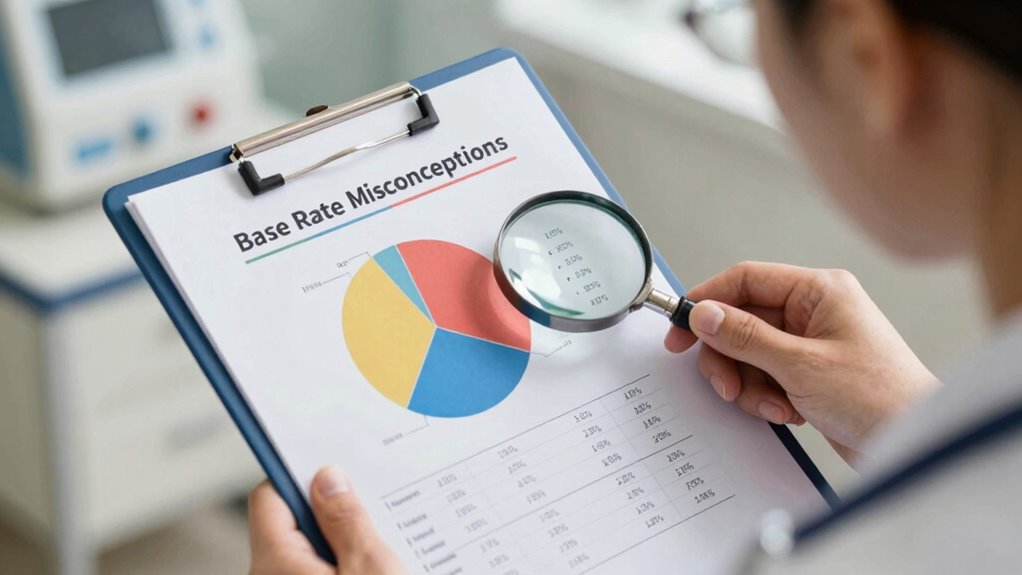
When you ignore disease prevalence, you risk misinterpreting test results and making flawed diagnoses. Relying solely on individual test data without considering base rates can lead your decisions astray. As a result, you might order unnecessary tests or overlook serious conditions, affecting patient outcomes. Understanding disease prevalence is essential for accurate diagnosis and effective treatment planning. Failing to consider pre-test probability can further distort clinical judgment, leading to less reliable conclusions about a patient’s health. Recognizing these statistical concepts is crucial for improving diagnostic accuracy and patient care.
Misinterpreting Disease Prevalence
How often do medical professionals and patients misjudge the actual risk of a disease because they overlook its true prevalence? This common mistake stems from poor statistical literacy and cognitive biases, leading to overestimating rare conditions or underestimating common ones. When you ignore disease prevalence, you might believe a positive test always means high risk, causing unnecessary anxiety or treatments. Recognizing the true prevalence helps you interpret medical information accurately.
- Overestimating rare diseases due to media hype
- Underestimating common illnesses because they seem less dramatic
- Confusing test accuracy with actual risk
- Ignoring base rates in diagnostic reasoning
- Misjudging the importance of population data
Understanding these pitfalls sharpens your reasoning and improves health decisions.
Ignoring Base Rate Data
Ignoring base rate data often leads to serious mistakes in healthcare, especially when interpreting diagnostic tests. Relying on heuristic shortcuts and cognitive biases, such as focusing solely on test results without considering disease prevalence, can distort your judgment. You might overestimate the likelihood of illness after a positive test or dismiss a serious condition because the base rate is low. This neglect hampers accurate decision-making, causing unnecessary tests, treatments, or missed diagnoses. Recognizing the importance of base rates helps counteract cognitive biases, guiding you to interpret test results within the context of disease prevalence. By avoiding the trap of ignoring base rate data, you improve diagnostic accuracy and patient outcomes, making smarter, evidence-based healthcare decisions.
Skewed Diagnostic Decisions
Skewed diagnostic decisions often occur when healthcare professionals overlook the influence of disease prevalence on test interpretations. Relying on heuristic biases and cognitive shortcuts can lead you to overestimate the likelihood of a condition based solely on test results, ignoring the base rate. This mistake can cause false positives, unnecessary treatments, or missed diagnoses. Recognizing the role of disease prevalence helps you make more accurate judgments. Additionally, understanding how essential oils are used in various health contexts can inform more holistic approaches to diagnosis and treatment. Being aware of market trends and insights, such as recent shifts in crypto market surges, can also enhance diagnostic considerations by understanding external influences.
How Business Leaders Fall for Ignoring Base Rates: and How to Avoid It

Business leaders often make the mistake of overlooking base rates when making decisions, believing their intuition or recent experiences are enough to guide them. This tendency stems from heuristic biases, where decision heuristics lead you to rely on vivid anecdotes or immediate impressions rather than statistical realities. These mental shortcuts can cause you to ignore relevant base rate information, skewing your judgment. For example, you might overestimate a new market’s potential based on a recent success story, neglecting the overall failure rate. To avoid this trap, recognize when your instincts are influenced by emotional or recent data rather than objective probabilities. Cultivating awareness of your decision heuristics helps you incorporate base rates effectively, leading to more accurate and rational choices.
Simple Strategies to Recognize and Correct the Base Rate Fallacy

Recognizing and correcting the base rate fallacy begins with simple, deliberate strategies that you can apply during decision-making. Being aware of heuristic pitfalls and cognitive biases helps you avoid jumping to conclusions. To start, pause and ask yourself if you’re considering statistical data or just vivid anecdotes. Cross-check your assumptions with relevant base rates. Use explicit questions like, “What’s the actual probability?” to challenge intuitive judgments. Break complex problems into smaller parts to avoid oversimplification. Keep a mental checklist to remind yourself to incorporate base rate information consistently. Additionally, understanding statistical literacy and how they influence judgment enables you to identify potential errors early. Recognizing the importance of auditory processing skills helps you interpret data more accurately and avoid common pitfalls. Developing cognitive flexibility allows you to adapt your reasoning strategies in different contexts, further reducing errors caused by heuristic pitfalls and cognitive biases. Incorporating knowledge of air purifier maintenance and proper filter management enhances your ability to interpret environmental data more accurately, which can be analogous to assessing statistical information critically. Being mindful of these strategies helps you stay objective and reduces errors caused by heuristic pitfalls and cognitive biases. This approach sharpens your reasoning and supports more accurate, data-informed decisions.
Tools and Techniques to Incorporate Data and Stats Effectively

To incorporate data and statistics effectively into your decision-making, you need practical tools and techniques that make complex information manageable. Developing strong statistical literacy allows you to interpret data accurately, avoiding common pitfalls like misjudging significance or ignoring context. Data visualization tools, such as charts and graphs, help you see patterns and relationships at a glance, making raw numbers more understandable. By learning how to create and interpret these visuals, you can communicate findings clearly and identify key insights quickly. Combining these techniques ensures you’re not overwhelmed by data but instead leverage it to inform smarter choices. Remember, the goal is to make data-driven decisions confidently, using tools that simplify complexity while preserving accuracy.
Why Understanding the Base Rate Fallacy Leads to Smarter Choices

Understanding the base rate fallacy is essential because it reveals how ignoring general probabilities can lead you to flawed conclusions. When you grasp this, you can make smarter choices by recognizing how heuristic biases influence your judgment. Awareness of the fallacy helps you avoid overrelying on decision heuristics that seem intuitive but are misleading.
- Recognize when you’re ignoring statistical context
- Question initial impressions based on rare events
- Use base rates to evaluate diagnostic test results accurately
- Avoid jumping to conclusions from anecdotal evidence
- Improve decision-making by balancing specific details with general probabilities
Practical Tips for Applying Base Rate Awareness Daily

To apply base rate awareness daily, you need to recognize when bias influences your judgments. Incorporate relevant statistical data instead of relying solely on intuition, and question your initial impressions. These simple steps can help you make smarter, more informed decisions every day.
Recognize Base Rate Bias
Recognizing base rate bias starts with paying close attention to how you interpret individual cases. Heuristic biases and cognitive shortcuts often cause you to overlook the broader context, leading to flawed judgments. To spot this bias, ask yourself if you’re relying solely on specific details rather than considering the overall statistics. Be mindful of assumptions that ignore base rates.
Here are some practical tips:
- Question whether you’re focusing too much on vivid details
- Check if you’re ignoring statistical evidence
- Reflect on whether you’re making judgments based on stereotypes
- Pause to consider the base rate before jumping to conclusions
- Recognize when cognitive shortcuts are influencing your reasoning
Being aware of these tendencies helps you avoid skewed perceptions and make more balanced decisions.
Incorporate Statistical Data
Incorporating statistical data into your decision-making process helps counteract the influence of cognitive biases. Heuristic biases often lead you to rely on mental shortcuts or decision heuristics that can distort your judgment. By actively seeking out relevant data, you ground your decisions in objective information rather than assumptions. For example, instead of relying on gut feelings or stereotypes, review actual base rates and statistical evidence. This approach helps you recognize when your intuition might be misleading. Incorporating data encourages more deliberate thinking, reducing errors caused by automatic heuristic biases. Over time, this habit sharpens your reasoning skills, making you less susceptible to biases rooted in incomplete or skewed perceptions, and promotes more accurate, evidence-based decisions in everyday life.
Challenge Intuitive Judgments
Challenging your intuitive judgments requires actively questioning whether your gut feelings align with the actual base rates behind the situation. Heuristic biases often lead to intuitive errors, making you overestimate or underestimate probabilities. To counter this, consider these practical tips:
- Pause before making a judgment to reflect on available data
- Ask yourself if your intuition is based on recent experiences or stereotypes
- Seek out statistical information to verify your initial impression
- Challenge assumptions that feel obvious or instinctive
- Practice comparing your gut feeling against objective base rates regularly
Frequently Asked Questions
How Can Individuals Improve Their Statistical Thinking Skills?
You can improve your statistical thinking skills by questioning heuristic biases and challenging your intuitive judgments. Practice analyzing data objectively, seeking out base rates, and avoiding shortcuts that lead to errors. Develop habits of asking critical questions and verifying assumptions. Reading about cognitive biases and engaging in exercises that highlight statistical reasoning will strengthen your ability to think critically and reduce reliance on faulty intuition.
What Are Common Misconceptions About Probability and Risk?
You might think a rare event is more likely after hearing about a single incident, but only 1 in 1,000 people actually experience it. Common misconceptions include relying on heuristic shortcuts and emotional biases, which distort your perception of probability and risk. These mental shortcuts make you overestimate unlikely dangers or underestimate real threats, leading to flawed decisions. Recognizing these biases helps you assess risks more rationally and make better-informed choices.
How Does Cognitive Bias Influence Decision-Making Beyond the Base Rate?
Cognitive biases, like heuristic shortcuts and emotional biases, deeply influence your decision-making beyond just base rates. You might rely on quick mental shortcuts instead of thorough analysis, leading to errors. Emotional biases cause you to overvalue certain outcomes or ignore risks, skewing your judgment. By recognizing these biases, you can slow down, reflect, and make more rational choices rather than reacting impulsively or based on feelings alone.
Can Technology Help Mitigate the Base Rate Fallacy?
Yes, technology can help mitigate the base rate fallacy. By providing decision support tools that incorporate probability education, you’re better equipped to recognize the importance of base rates. These tools can analyze data objectively and present relevant insights, reducing bias. When you use such technology, you improve your reasoning and make more accurate decisions, especially in complex situations where intuition might lead you astray.
Are Certain Personality Types More Prone to Ignoring Statistical Data?
Certain personality types, especially those with strong intuitive or emotional tendencies, are more prone to ignoring statistical data. These cognitive tendencies, driven by personality biases, lead them to rely on gut feelings or anecdotal evidence instead of probabilities. You might notice that impulsive, overconfident, or highly optimistic individuals often overlook base rates, favoring personal stories over cold data. Recognizing these traits helps you understand why some ignore statistical insights more readily.
Conclusion
By understanding the base rate fallacy, you can see through the fog of vivid stories and focus on real data. Think of it as having a compass for decision-making—guiding you through the noise to clearer, smarter choices. When you recognize this mental trap, you equip yourself to make better judgments in health, work, and daily life. Don’t let emotions or stories steer your ship—use statistics as your steady lighthouse.