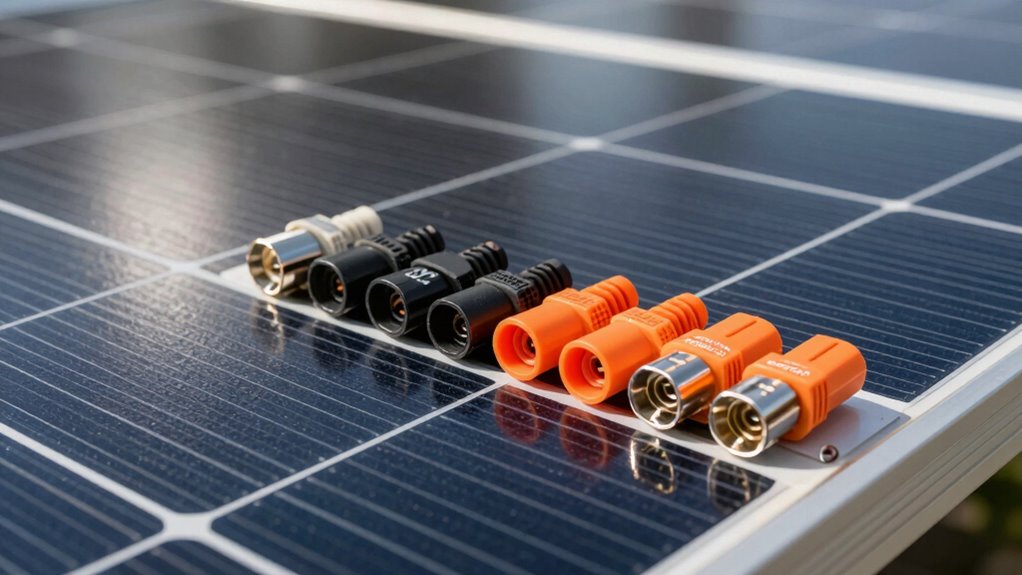

To guarantee your solar panels work safely and efficiently, you need to match their volts (voltage), watts (power), and connectors with compatible inverters and batteries. The inverter should handle the panel’s voltage and wattage to prevent damage and maximize performance. Connectors, like MC4 or proprietary types, must also match for secure connections. Understanding these specs helps avoid system issues. Keep exploring further to understand how all these components work together for ideal solar energy use.
Key Takeaways
- Match solar panel voltage (Voc and Vmp) with inverter voltage ratings to ensure safe operation.
- Ensure panel wattage does not exceed the inverter’s maximum capacity for efficient energy transfer.
- Use compatible connectors like MC4 to securely connect panels to the inverter and system components.
- Consider environmental factors, such as cold weather, which can increase panel voltage, affecting compatibility.
- Verify that batteries and inverters are compatible in voltage and current ratings for safe and efficient energy storage.
Are your solar panels compatible with your existing system? This is a crucial question because compatibility determines whether your setup will operate efficiently and safely. When considering compatibility, you need to look at several factors, including volts, watts, connectors, and how they integrate with your inverter and battery storage system. Your inverter matching is especially important because the inverter converts the DC electricity produced by your panels into usable AC power for your home, so it must be compatible with your panels’ output. If your solar panels produce more voltage or wattage than your inverter can handle, it could damage your equipment or cause system failure. Conversely, if the inverter isn’t rated for the panels’ output, it might not operate at maximum efficiency, wasting energy and money.
Battery storage is another critical aspect of compatibility. If you want to store excess energy generated during the day for use at night or during cloudy days, your battery system must be compatible with your solar panels and inverter setup. Not all batteries work seamlessly with every inverter, so you’ll need to ensure your storage solution can handle the voltage and current your panels produce. Some batteries require specific inverter types, such as hybrid inverters, which are designed to work with both solar inputs and battery storage, ensuring smooth energy flow and management. Proper matching prevents issues like overcharging or underutilization, which can shorten battery lifespan and reduce overall system efficiency.
Connectors are often overlooked but are vital to system compatibility. Different panels come with various connector types, such as MC4 connectors or proprietary ones, and these need to match your inverter’s input ports. Mismatched connectors can lead to loose connections, increased resistance, and potential safety hazards. Making sure your panels’ connectors are compatible with your inverter’s inputs ensures a secure, efficient connection that maximizes energy transfer and minimizes risks.
Voltage compatibility also hinges on understanding the panels’ open-circuit voltage (Voc) and maximum power voltage (Vmp). Your inverter must be rated to handle these voltages, especially during cold weather when voltages tend to rise. Wattage compatibility is equally important; the total wattage of your panels should align with your inverter’s maximum watt capacity to prevent overloads and ensure your system operates at its best. Additionally, considering wave and wind conditions can impact your system’s performance, especially in areas prone to high winds or storms, so proper system design is essential.
In short, confirming your solar panels are compatible involves checking the electrical specifications—volts and watts—matching connectors, and verifying that your inverter and battery storage systems are designed to handle the output. Proper matching not only safeguards your equipment but also maximizes your energy production and savings, making your solar investment worthwhile.

EXBKAMY 32 PCS Solar Panel Connectors MC4, 16 Pairs Male/Female + 2 Wrenches IP67 Waterproof 1000V/30A Solar Connectors,for Solar Power Systems (10AWG)
【Superior Conductivity & Maximum Efficiency】 Constructed with precision tinned copper pins and premium PPO insulation, these connectors minimize…
As an affiliate, we earn on qualifying purchases.
As an affiliate, we earn on qualifying purchases.
Frequently Asked Questions
Can I Mix Different Brands of Solar Panels in One System?
Yes, you can mix different brands of solar panels in one system, but you should consider panel brand compatibility and the impact on mixed panel efficiency. Mixing brands may lead to uneven performance because different panels have varying efficiencies and electrical characteristics. To optimize your system, verify the panels have similar voltage and current ratings, and use compatible connectors. This way, you can avoid potential issues and maximize overall system performance.
What Is the Impact of Shading on Panel Wattage?
Shade impact can profoundly reduce your solar panel’s wattage, affecting overall power output. When shadows fall on even a small part of the panel, it causes power reduction across the entire system, especially if panels are wired in series. You might notice decreased efficiency, lower energy production, and potential strain on your inverter. To minimize shade impact, position panels carefully, trim nearby obstructions, and consider shading solutions to protect your investment.
How Do Temperature Fluctuations Affect Solar Panel Performance?
Temperature fluctuations cause solar panels to experience thermal expansion and contraction, which can lead to efficiency loss. When it gets hotter, your panels may produce less power because their semiconductor materials become less efficient. Conversely, cooler temperatures help maintain ideal performance. To maximize output, guarantee proper ventilation and consider panels designed for your climate. By managing these temperature changes, you help your system operate at its best.
Are There Universal Connectors for All Solar Panel Types?
You might think there’s a universal connector for all solar panels, but that’s not entirely true. Connector standards vary based on panel compatibility and manufacturer preferences. While some connectors like MC4 are widely used and compatible with many panels, others aren’t universal. Always verify the connector standards before installing, ensuring they match your panel type to maintain peak performance and safety. Compatibility is key for a seamless, efficient solar setup.
What Safety Precautions Are Necessary When Connecting Panels?
When connecting panels, you should prioritize grounding safety to prevent electrical shocks or damage, ensuring all equipment is properly grounded. Always verify connector compatibility to avoid loose or incompatible connections that could cause safety risks or performance issues. Wear insulated gloves and use proper tools. Double-check all connections before turning on the system, and follow manufacturer instructions to maintain safety and system integrity.

DOKIO 300W Portable Foldable Solar Panel Kit (20x38in, 15.3lb), with Separate Controller and Dual USB, Monocrystalline Charger for 12V Batteries & Power Stations, RV Camping Trailer Emergency Backup
【TRAVEL LIGHT, POWER ANYWHERE】 Weighing only 15.3lb and folding to 20*38*1.1in, this 300W panel is slim yet powerful,…
As an affiliate, we earn on qualifying purchases.
As an affiliate, we earn on qualifying purchases.
Conclusion
Understanding volts, watts, and connectors is your key to unlock the full potential of your solar setup. When you choose components that harmonize perfectly like a well-tuned orchestra, your system performs at its peak. Remember, compatibility isn’t just a detail; it’s the backbone of efficiency and safety. So, take your time, do your research, and let your solar journey shine as brightly as the sun itself.

ECO-WORTHY (Cubix 100) 48V 600Ah Server Rack Battery LiFePO4 w/Bluetooth | 6 Pack 30.72kWh Solar Battery Kit for Home Backup | UL1973 & UL9540A & CEC Listed (Get Free 6-Layer Rack with 600A Busbar)
UL1973 | UL9540A | CEC LISTED – Completed comprehensive testing by Intertek and has officially earned two key…
As an affiliate, we earn on qualifying purchases.
As an affiliate, we earn on qualifying purchases.

Amp Watt Meter Power Analyzer For Solar Panels Or Wind Turbines System, 150A 200A Aircraft Power Meter Tester Backlight Digital LCD Screen for RC Solar Voltage Current Power (200A)
Comprehensive Measurement Capabilities: This multi-functional watt meter power analyzer accurately measures voltage, current (amp meter), power, discharge capacity,…
As an affiliate, we earn on qualifying purchases.
As an affiliate, we earn on qualifying purchases.