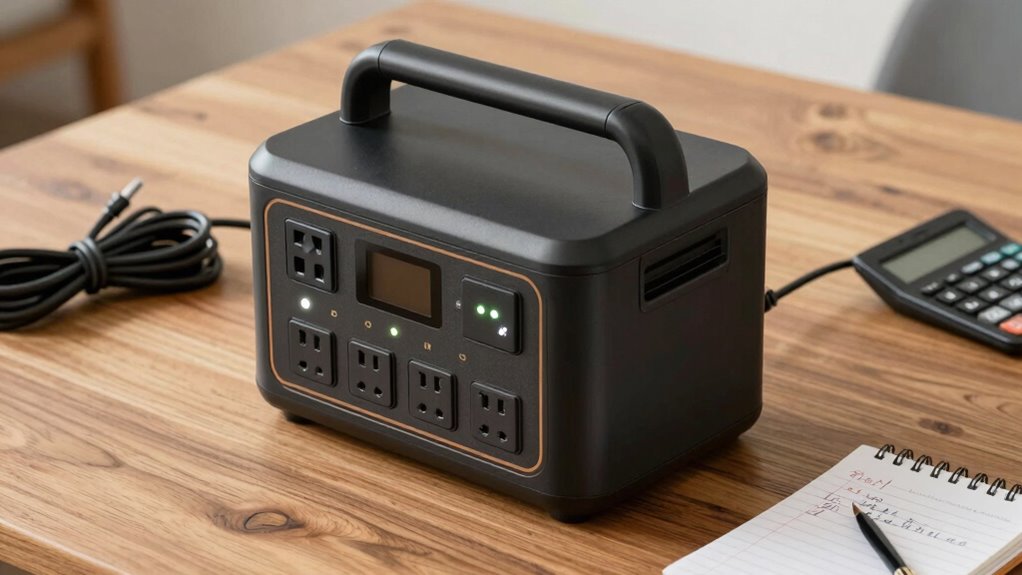

To size a portable power station for outages, start by listing essential devices you want to run, noting their wattage and voltage needs. Add up the total wattage to determine your minimum capacity. Choose a station with slightly higher capacity to handle surge power and future needs. Consider portability and balance size with power. If you keep these factors in mind, you’ll find a model that reliably meets your energy requirements—more details on the process follow.
Key Takeaways
- Calculate the total wattage of essential devices to determine minimum battery capacity needed.
- Consider the runtime required during outages and select a capacity that provides sufficient watt-hours.
- Ensure the power station’s continuous wattage and surge capacity match or exceed device power requirements.
- Account for future device additions by choosing a slightly higher capacity for flexibility.
- Balance size, weight, and cost to select a portable station that meets your energy needs without excess bulk.
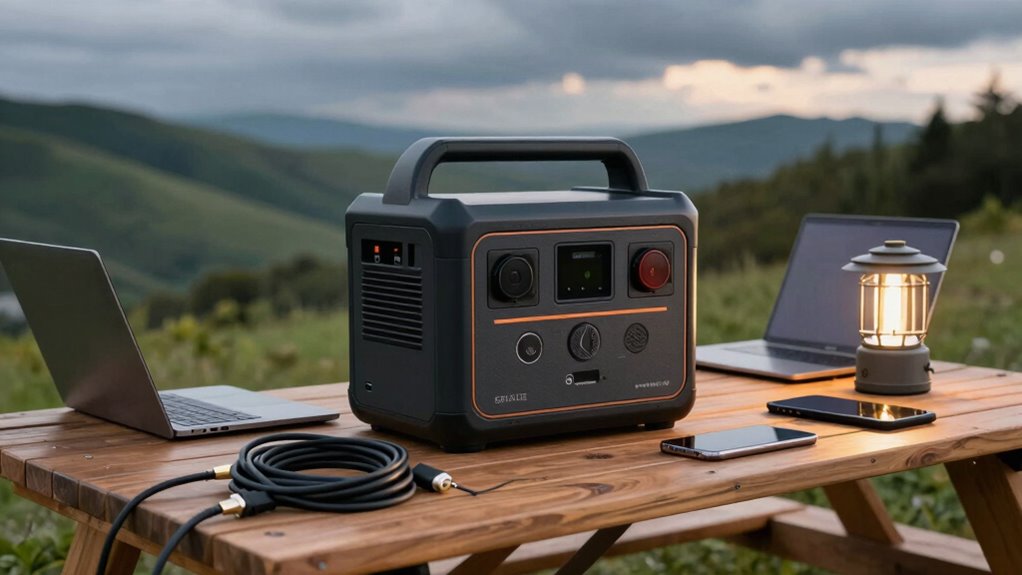
Choosing the right size for a portable power station is vital to guarantee it meets your energy needs without being bulky or underpowered. To do that effectively, you need to consider the battery capacity and how well it aligns with the devices you plan to run during outages. Battery capacity, measured in watt-hours (Wh), determines how long your power station can supply energy before needing a recharge. A larger capacity means longer runtimes, but it also adds weight and size, so you want to find a balance that fits your specific needs. Think about the essential devices you’ll need to power—laptops, smartphones, small appliances—and calculate their total power consumption. This will give you a baseline for the minimum battery capacity required to keep everything running during outages.
Device compatibility plays a vital role in sizing your power station. Not all devices draw the same amount of power, and some might require special connectors or voltage levels. For example, a laptop might need a 60W power supply, while a mini fridge could demand 100W or more. Ensuring your power station provides the right output for your devices is key to efficient and safe operation. Check the wattage and voltage specifications of each device, and compare those with the power station’s outputs. If your devices have higher power needs, look for a station with higher continuous wattage and surge capacity to handle startup spikes. This way, you prevent overloads and guarantee compatibility, avoiding damage or interruptions. Additionally, understanding the power management features of your portable station can help optimize runtime and safety during use.
When sizing your power station, also think about future needs. If you plan to add more devices later, it’s wise to choose a model with a higher capacity than your current requirements. This provides flexibility and reduces the need for frequent upgrades. Additionally, consider whether you want features like fast charging or multiple ports, which can enhance usability during outages. Remember, a power station that’s too small will leave you frustrated with insufficient runtime, while one that’s too large might be unnecessarily heavy and expensive. Focus on matching its battery capacity with your typical energy consumption and device compatibility to find that perfect fit.

Jackery Explorer 1000 v2 Portable Power Station,1070Wh LiFePO4 Battery,1500W AC/100W USB-C Output, 1 Hr Fast Charge, Solar Generator for Camping,Emergency, RV, Off-Grid Living(Solar Panel Optional)
Powerful yet Compact: Boasting a 1,500W AC output and a 3,000W surge peak, the Solar Generator 1000 V2…
As an affiliate, we earn on qualifying purchases.
As an affiliate, we earn on qualifying purchases.
Frequently Asked Questions
Can I Charge My Power Station With Solar Panels?
Yes, you can charge your power station with solar panels. Just guarantee they are compatible regarding solar panel compatibility, meaning the panels match the voltage and wattage your station requires. This setup can boost your charging efficiency, especially during outages or outdoor activities. Make sure to select high-quality panels and use the right connectors for safe, effective charging, maximizing your power station’s longevity and performance.
How Long Does a Typical Portable Power Station Last?
Imagine a battery capacity that’s your lifeline—your portable power station’s lifespan varies with usage. Typically, it lasts between 5 to 15 hours, depending on what you power and its runtime estimation. Higher capacity units, around 500Wh or more, tend to last longer, providing reliable backup power during outages. Keep in mind, battery health and power draw influence how long your station will serve you when you need it most.
Are Portable Power Stations Safe for Indoor Use?
Yes, portable power stations are generally safe for indoor use when they have proper safety certifications and use reliable battery chemistry like Li-ion or LiFePO4. These certifications guarantee they meet safety standards, preventing hazards like overheating or fires. Always follow the manufacturer’s instructions, guarantee proper ventilation, and avoid overloading the unit to maximize safety. With these precautions, you can confidently use your power station indoors during outages.
What Is the Weight Range of Most Portable Power Stations?
Most portable power stations weigh between 10 to 50 pounds, making them easy to carry thanks to their battery capacity and portability features. Your choice depends on how much power you need and how often you’ll move it around. Lighter models often have smaller batteries, while heavier ones pack more capacity. Consider the weight in relation to your power needs and portability preferences to find the right fit.
Can I Connect Multiple Stations for Extended Power?
Sure, you can connect multiple stations for extended power, but don’t expect a symphony of efficiency. Just guarantee each station has sufficient battery capacity and is compatible with your devices. While daisy-chaining might seem clever, it can lead to overloads or damage. Always check the device compatibility and manufacturer instructions—otherwise, you might end up with a power outage of your own making rather than a solution.
Jackery Explorer 1000 v2 Portable Power Station,1070Wh LiFePO4 Battery,1500W AC/100W USB-C Output, 1 Hr Fast Charge, Solar Generator for Camping,Emergency, RV, Off-Grid Living(Solar Panel Optional)
Powerful yet Compact: Boasting a 1,500W AC output and a 3,000W surge peak, the Solar Generator 1000 V2…
As an affiliate, we earn on qualifying purchases.
As an affiliate, we earn on qualifying purchases.
Conclusion
Now that you know how to size a portable power station, you’re practically a superhero ready to conquer any outage! Remember to calculate your essential devices’ power needs and add some extra capacity for those surprise moments. With the right size, you’ll be powered up longer than you ever imagined—like having a backup generator in your pocket. Stay prepared, stay powered, and never let an outage dim your day again!

Jackery Portable Power Station Explorer 300, 292Wh Backup LiFePO4 Battery, Solar Generator for Outdoors Camping Travel Hunting Blackout (Solar Panel Optional)
Ultra-Lightweight: At only 7.5 lbs, the Explorer 300 delivers a robust 292Wh capacity while remaining 17% lighter than…
As an affiliate, we earn on qualifying purchases.
As an affiliate, we earn on qualifying purchases.

DARAN Portable Power Station 89.6Wh LiFePO4 Battery 100W(200W Peak) Solar Power Bank, Portable Charger Small Generator with AC Outlets & PD Fast Charging for Home/Laptop/Camping(Solar Panel Optional)
【SLIM & POCKETABLE】This portable power bank is about the size of a smartphone (6.5×3.3×4 inches) and weighs only…
As an affiliate, we earn on qualifying purchases.
As an affiliate, we earn on qualifying purchases.