
TL;DR

Prime made for students and young adults
- Fast, free delivery for dorm and study essentials
- Prime Video and Amazon Music included
- Member-only deals
IdeaClyst is a local-first, AI-powered war room that guides you through idea validation, critique, and planning. It helps founders make smarter choices and build better solutions faster, all while keeping your data private.
Ever stare at three open tabs, each representing a different idea, and feel that sinking gut — which one is worth six months of your life? That’s the decision-making nightmare founders face daily. The build part is easy now; it’s the conviction to pick the right idea that’s tough. Enter IdeaClyst, a tool designed to turn your chaotic brainstorm into a war room for your ideas where ideas are tested, critiqued, and refined with razor-sharp focus.
This isn’t just about jotting down ideas — it’s about owning your process. It’s about building a fortress of clarity around what to pursue, and why. That’s what makes IdeaClyst different. It’s a local-first, open-source platform that acts as your personal command center, helping you avoid costly missteps and make decisions grounded in real research and honest critique.
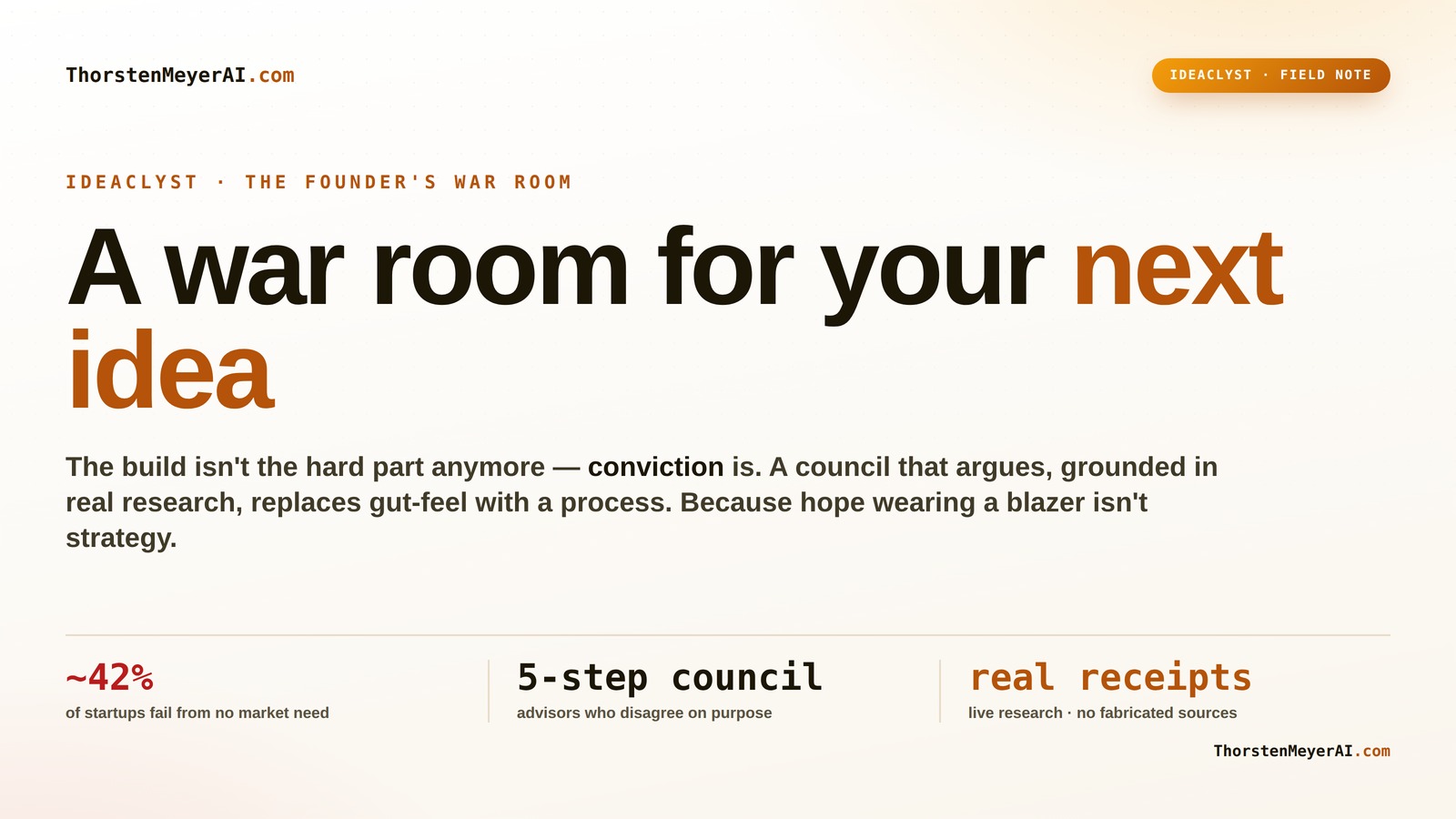
A war room for your next idea
The build isn’t the hard part anymore — conviction is. Knowing which idea deserves the next six months, and being able to defend it. Most founders answer with gut feel and optimistic math. That’s hope wearing a blazer. IdeaClyst replaces it with a process.
The most expensive decision is what to build
The single most valuable thing a tool can do is talk you out of the wrong six months. The numbers make the case better than any pitch.
Three tools in one — on your own machine
Strip away the framing and IdeaClyst is three things at once, all running locally with nothing leaving your laptop.
An AI council
Pressure-tests an idea you bring it — advisors who argue on purpose.
A discovery engine
Finds ideas you didn’t know to look for by hunting real demand signals.
A founder’s workspace
Carries winners from “interesting” all the way to “ready to build.”
Advisors who disagree on purpose
Not one confident, agreeable answer — a structured five-step deliberation where models play different roles and turn on their own work. The disagreement is the feature.
The five-step deliberation
A council that leads with the bad news surfaces the objections you’d otherwise find the expensive way, on month five.
Product strategy
Who’s it for, what’s the wedge, why now, what’s the business model.
Technical architecture
What would it actually take to build — and where’s the risk.
Critique pass
The council turns on its own work. Where’s the hand-waving? What kills this?
Second, independent critique
A different voice, a different angle — so blind spots don’t survive.
Final synthesis
Everything into one coherent founder packet: strategy, architecture, validation, plan.
When IdeaClyst cites a source, it actually fetched it
The hard departure from “ask an AI what it thinks of my startup.” It runs in a strict, real-data-only mode — if it can’t gather genuine evidence, it says so plainly rather than inventing a plausible paragraph.
Confidence with receipts
No fabricated statistics, no imaginary competitors, no made-up citations. The packet survives a skeptical co-founder or a sharp investor because the reasoning has receipts.
Market research first
Scouts the landscape before the council reasons about anything.
Competitor read
Real positioning, pricing signals, feature claims — differentiation vs. reality.
Validation with links
Not “talk to customers” — concrete signals & sources you can click.
From the blank page to build-ready
Evaluation is half the problem; the blank page is the other half. And a plan is worthless if it dies in a tab you never reopen.
Bring a space, not an idea
“AI for accountants,” “tools for indie game studios” — plus your goal and real capacity. It hunts demand signals across HN, Reddit, Product Hunt, GitHub, pricing pages.
- An honest market read — leads with the bad news when a space is hard
- An opportunity map — high pain, thin competition
- Ranked candidates — wedge, who pays, effort, risk, confidence
- each with KILL CRITERIA — when to walk away
A home and a forward path
Every promising idea gets carried forward, with every artifact in plain files on your disk.
- Validation tooling — sprint board, interview list, evidence browser
- Founder profile — a personal-fit lens; same discovery, different advice
- Build workspaces — funnel, personas, landing draft, version history
- “Build this idea” → a PRD + task queue, ready for a coding agent
Key Takeaways
- IdeaClyst turns chaotic idea generation into a disciplined war room with structured critique, debate, and grounded research.
- Using conflict among AI models surfaces blind spots and reduces the risk of building products nobody needs by up to 70%.
- The local-first design keeps your ideas private, secure, and fully owned — no cloud needed.
- Grounding critiques in real-time web data prevents hype from clouding your judgment.
- It’s suitable for solo founders, teams, and nonprofits looking for smarter, faster decision-making.
As an affiliate, we earn on qualifying purchases.
What is IdeaClyst and Why Does It Matter?
IdeaClyst is a local-first platform that functions as your personal war room for ideas. It combines AI-driven critique, discovery, and planning into a single workspace. Imagine having a panel of advisors, each with a different perspective, dissecting your idea — from market fit to technical hurdles — without ever leaving your laptop.
The real magic? It’s designed to prevent the classic founder trap: hearing only what confirms your bias. Instead, you get honest, conflicting opinions that force you to sharpen your thinking. According to research, 42% of startup failures trace back to building something no one needs; IdeaClyst aims to cut that risk by making validation faster, cheaper, and more rigorous.
As an affiliate, we earn on qualifying purchases.
How the War Room Turns Chaos Into Clear Decisions
Think of a war room as your battleground for ideas — where conflicting opinions clash, and only the strongest survive. IdeaClyst builds this environment digitally, orchestrating structured debates among AI models playing different roles. You can learn more about how to foster innovation at creating a war room for your ideas.
- Strategy: Who’s your target? Why now? How will you make money?
- Tech: What’s needed to build it? Where are the risks?
- Critique: Where are the weak spots? What assumptions are unproven?
- Second critique: A fresh set of eyes to catch what was missed.
- Synthesis: The final plan, with clear next steps, ready for action.
This process forces you to confront your blind spots, much like a military strategist analyzing every angle before an attack. It’s a disciplined approach that helps you see the full picture, revealing potential pitfalls and overlooked opportunities. The end result isn’t just a list of ideas but a comprehensive, validated strategy that balances risk, opportunity, and feasibility — turning uncertainty into confidence and enabling faster, smarter execution.
market research tools for startups
As an affiliate, we earn on qualifying purchases.
As an affiliate, we earn on qualifying purchases.
Why Structured Critique Beats Casual Brainstorming Every Time
You might think a quick chat with a teammate or a casual brainstorm is enough. But structured critique, especially when powered by AI, offers something more reliable. IdeaClyst’s council stages disagreements intentionally, surfacing hidden risks and assumptions that would otherwise slip through.
For example, if you pitch a new social app idea, the council might question: Is there truly a market? Are the technical hurdles solvable? What about user retention? These critiques aren’t just noise — they’re the filters that prevent costly missteps. They force you to justify your assumptions and consider alternatives, which often leads to more robust, resilient ideas.
Compared to casual brainstorming, which can be swayed by enthusiasm or bias, structured critique encourages a rigorous examination of your idea’s core viability. It helps you see flaws early, weigh tradeoffs, and make informed decisions — all of which can save months of development time and thousands of dollars by avoiding dead-end paths.
As an affiliate, we earn on qualifying purchases.
Grounding Ideas in Real Research, Not Just Model Vibes
IdeaClyst sets itself apart by anchoring its critique in live web research. Instead of blindly trusting an AI’s confident-sounding but unverified statements, it pulls in current data, trends, and market signals to support or challenge your idea.
This approach matters because ideas often sound promising in theory but fall apart without real-world validation. By integrating live research, IdeaClyst helps you identify whether market conditions support your concept, what competitors are doing, and how user needs are evolving. This data-driven validation reduces the risk of pursuing ideas based on hype or outdated assumptions. It also highlights gaps you might have overlooked, prompting you to refine your approach before investing significant resources.
For instance, if you claim your SaaS targets remote teams, the platform checks recent growth figures, competitor strategies, and user engagement metrics. This real-time, factual grounding ensures your decisions are based on current market realities, not just optimistic projections. The implication? You’re less likely to chase after ideas that are destined to fail and more likely to pursue validated opportunities with higher chances of success.
The Local-First Advantage: Why Privacy Matters
Most AI tools rely on cloud servers, which means your ideas are often uploaded to external platforms. IdeaClyst flips that script, running entirely on your machine. Your raw ideas, critiques, and plans stay local, safe, private, and fully under your control.
This local-first approach isn’t just about privacy; it’s about ownership. Your ideas are yours, plain and simple. You can version control your plans, keep sensitive data secure, and avoid data breaches or leaks.
Imagine working on a secret breakthrough for months, then realizing your cloud-based tool might accidentally share your plans. With IdeaClyst, your innovation stays in your hands. This approach allows you to iterate freely without concerns about privacy breaches or data misuse, which is especially critical when dealing with proprietary or sensitive information. It also ensures compliance with data protection standards, giving you peace of mind while working on high-stakes projects.
From Idea to Action: The Final Step in the War Room
Once your idea has been dissected, critiqued, and grounded in real data, the final step in the war room.e last step is to turn insights into action. IdeaClyst creates a comprehensive plan — strategy, architecture, validation tests, and next steps — all in Markdown. This makes it easy to share, version, and execute.
This step is crucial because many teams struggle to translate insights into concrete actions. By providing a clear, structured plan, IdeaClyst reduces ambiguity and aligns everyone on the next steps. It helps you prioritize tasks based on validated assumptions, risk assessments, and market data, ensuring your efforts are focused and efficient. The plan acts as a blueprint that guides development, testing, and deployment, minimizing wasted effort and increasing the likelihood of successful execution.
For example, a founder working on a new marketplace can export their final plan and immediately start building with clear priorities. The war room doesn’t end with ideas; it primes you for execution with a validated, actionable roadmap. This seamless transition from planning to implementation accelerates your time-to-market and enhances your chances of success.
Who Should Use IdeaClyst and Why It’s a Game-Changer
Whether you’re a solo founder, a startup team, or a nonprofit leader, IdeaClyst adapts to your needs. It’s especially valuable for remote or hybrid teams, because everything happens on your local machine, with no need for constant internet or cloud access.
Imagine a social-impact organization brainstorming a new campaign — the structured process helps align everyone’s thinking and speeds up decision-making. Or a tech startup rapidly vetting ideas for their next product iteration.
Its core strength? Turning fuzzy, uncertain ideas into clear, validated plans that you can confidently move forward with. This process reduces the guesswork and emotional bias often present in early-stage thinking, allowing teams to focus on data-backed, strategic decisions. It ultimately empowers teams to move faster, with greater confidence in their direction, because they’ve rigorously tested and validated their ideas before committing resources.
What Makes IdeaClyst Different from Normal Brainstorming Tools?
Most brainstorming tools are just digital whiteboards or note pads. IdeaClyst combines structured critique, live research, and AI-driven debate into one workspace. It’s like having a panel of advisors with different perspectives, all arguing and debating your idea in a disciplined way.
To illustrate, compare these features:
| Feature | Standard Brainstorming Tools | IdeaClyst |
|---|---|---|
| Structured Critique | Rarely included | Core feature with staged debates |
| Live Web Research | Usually manual, external | Integrated and real-time |
| Disagreement & Debate | Usually absent | Built-in council with conflicting roles |
| Local-First & Privacy | Rarely prioritized | Yes — runs entirely offline |
This combination of features makes IdeaClyst a true war room — much more than just a digital sticky note pad.
Frequently Asked Questions
What exactly is IdeaClyst?
IdeaClyst is a local-first platform that acts as a war room for your ideas, combining AI critique, discovery, and planning to help you validate and refine your concepts before building.How does the war room approach improve idea quality?
It stages structured debates among AI models with different roles, surfacing blind spots and unproven assumptions, leading to more robust, validated plans.Is IdeaClyst suitable for remote teams?
Absolutely. Since it runs entirely on your machine, it’s perfect for remote or hybrid teams wanting private, secure, and fast decision-making without relying on cloud services.Can it help after I’ve picked an idea?
Yes. It not only helps generate and critique ideas but also creates detailed plans with strategy, architecture, and validation steps, ready for execution.Conclusion
Think of IdeaClyst as your personal command center for innovation. It transforms the chaos of idea hunting into a clear, validated blueprint ready to ship. The next time you’re faced with a decision, remember: a well-structured war room beats gut feeling every time.
In a world where speed and clarity win, having a dedicated battle space for ideas could be your secret weapon. So, ask yourself: what idea will you turn into your next success story?
Fall Picks
fall essentials
As an affiliate, we earn on qualifying purchases.