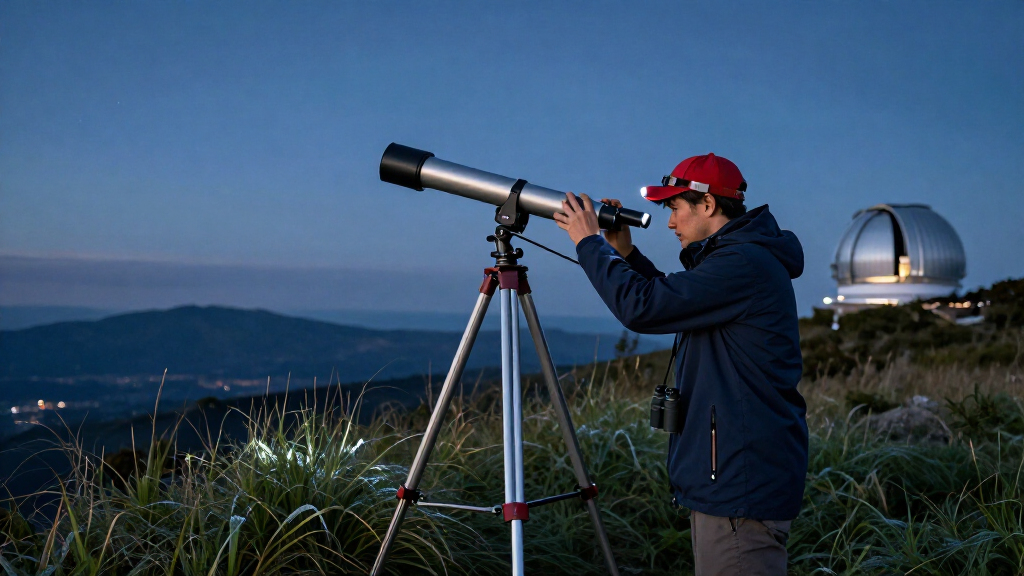
This checklist is for new stargazers who want a practical starting point for observing the night sky, whether they are choosing their first optics or organizing a simple observing setup.

Prime made for students and young adults
- Fast, free delivery for dorm and study essentials
- Prime Video and Amazon Music included
- Member-only deals
It is organized by equipment role: beginner telescopes, astronomy binoculars, planispheres, red light flashlights, moon maps, and star projectors. Each section explains what the item contributes and what to check before choosing one.
Use it to match each pick to your observing habits. Check how you will carry, set up, and use an item, and treat decorative or reference products as complements to observing gear rather than replacements for it.
Beginner Telescopes
A first telescope can make it easier to explore the Moon and brighter objects, but the observing experience depends on more than the telescope itself. The Celestron StarSense Explorer LT 80AZ Smartphone Guided Refractor Telescope is presented as a smartphone-guided refractor. Before choosing it, check what smartphone compatibility and setup the guidance feature requires, and whether the included mount and accessories suit the way you plan to observe.A common mistake is focusing only on magnification claims or assuming a telescope will show every object clearly from any location. Consider where you will set it up, how steady the surface is, and whether you can store and carry the equipment comfortably. Confirm the telescope’s stated specifications and included components against your needs; the product name alone does not establish details such as eyepiece selection, setup time, or phone compatibility. Ease of setup and a stable viewing position matter for a beginner as much as the optical instrument.
What to look for:
- Confirm smartphone compatibility and any app or setup requirements.
- Check the mount type and whether the setup location can support it steadily.
- Review the listed optical specifications and included accessories.
- Consider storage, carrying, and assembly needs before choosing.
- Check whether the seller describes phone-guided use clearly.
Celestron StarSense Explorer LT 80AZ Smartphone Guided Refractor Telescope

The Celestron StarSense Explorer LT 80AZ is a beginner-friendly refractor telescope that uses patented smartphone technology to guide users to celestial objects. By docking a compatible phone and launching the app, users can follow on-screen arrows to locate stars, planets, and deep-sky objects with real-time sky recognition.
Pros:
- Smartphone-guided navigation makes it extremely easy for beginners to locate targets
- Patented StarSense technology provides accurate real-time sky recognition
- Includes a comprehensive kit with tripod, eyepieces, and finderscope
- Compact and lightweight design at 9.2 lbs
Cons:
- Requires a compatible smartphone (Android 12+ or iOS 18+) to function fully
- Manual altazimuth mount lacks automated tracking capabilities
- 80mm aperture limits views of faint deep-sky objects compared to larger telescopes
Best for: Beginners interested in a smartphone-guided refractor telescope.
Not ideal for: Observers who need a setup without smartphone guidance.
Bottom line: Check phone compatibility, mount stability, and included components before choosing this as a first telescope.
Astronomy Binoculars
Binoculars offer a two-eyed way to scan the sky, and the Celestron SkyMaster 25×100 Giant Astronomy Binoculars are identified by a high magnification number and large objective size in their name. Those figures make it especially important to consider how you will support and handle them. Read the product specifications and guidance to understand the mounting requirements and whether a suitable support is included or must be sourced separately.A frequent buying mistake is treating binoculars as automatically easier to use than a telescope. Large astronomy binoculars can be bulky, and sustained viewing may be uncomfortable without appropriate support. Check the dimensions, weight, focus controls, and any stated compatibility with a tripod or mount. Also consider whether you can transport and store them safely. Handling and support should guide the decision alongside the optical details, especially if you expect to observe for extended periods or need equipment that is easy to carry to a viewing location.
What to look for:
- Check listed weight and dimensions for handling and storage.
- Confirm whether a tripod or other support is included or required.
- Review focus controls and any setup guidance.
- Check the stated optical specifications and included accessories.
- Consider how you will transport and secure the binoculars.
Celestron SkyMaster 25×100 Giant Astronomy Binoculars

These large, tripod-mounted binoculars feature 100mm objective lenses and 25x magnification, ideal for deep sky viewing and terrestrial observation. They are durable, water-resistant, and designed for bright, detailed images in low-light conditions.
Pros:
- Powerful 25x magnification for detailed views
- Large 100mm objective lenses for bright images
- Water-resistant and durable construction
- Compatible with standard tripods for stability
Cons:
- Heavy and large, requiring tripod for use
- Not included tripod may be an additional cost
- Designed primarily for astronomy, less portable for casual use
Best for: Observers seeking large astronomy binoculars and able to plan for support.
Not ideal for: People prioritizing a compact, handheld setup.
Bottom line: Verify the mounting needs and handling details before selecting these large binoculars.
Planispheres
A planisphere is a rotating star chart intended to help relate the sky to a date and time. It can be a useful reference alongside observing equipment, but it is only helpful when its coverage and instructions match the observer. Check the latitude range printed on the chart and make sure it includes your observing location; a chart made for a different region may not represent your sky correctly.Common mistakes include setting the date or time incorrectly, overlooking daylight saving time guidance, or expecting a planisphere to identify every object in view. Read how to align the chart before heading outside, and check whether its labels and print are easy for you to read in low light. A planisphere is a paper reference, so consider how you will protect it from moisture and wear. Pair it with a red light source if you need to preserve night adaptation while reading. Clear instructions and suitable sky coverage make this advice-only slot more useful than choosing by appearance alone.
What to look for:
- Choose a chart whose latitude range includes your location.
- Check that date and time alignment instructions are clear.
- Look for labels and printing that are easy for you to read.
- Consider durability and protection from moisture.
- Check whether the chart covers the sky you intend to observe.
Red Light Flashlights
A light can help with setup and reading charts, but using a bright white beam during a session can make it harder to maintain dark-adapted vision. The OLIGHT ArkPro Lite EDC Pocket Flashlight product name includes rechargeable and UV-light features, so check the actual light modes and controls carefully before treating it as an observing light. Confirm whether it offers a usable red-light mode; the name alone does not confirm one.Common mistakes are assuming any colored or low-output light is suitable, overlooking how easily a button can switch to a bright mode, or buying a flashlight that is awkward to operate in the dark. Review the mode sequence, brightness adjustment, charging method, and runtime information supplied by the seller. Consider whether you can operate it without looking directly at the controls and whether it can be secured or carried conveniently. Red mode verification is central for this slot: if the product does not provide a red mode suited to your use, consider a flashlight specifically described for astronomy instead.
What to look for:
- Verify that the flashlight has a red-light mode.
- Check how to switch modes without activating a bright beam accidentally.
- Review brightness controls and stated runtime information.
- Confirm the charging method and included charging accessories.
- Consider pocket carry and ease of operation in the dark.
OLIGHT ArkPro Lite EDC Pocket Flashlight Rechargeable with UV Light, Orange

The OLIGHT ArkPro Lite is a versatile, rechargeable pocket flashlight featuring white, UV, and red lights for various tasks, including night reading, emergency rescue, and stain detection. Its compact design includes dual charging options, a built-in battery, and user-friendly features for easy handling and portability.
Pros:
- Versatile three-in-one lighting functions for various uses
- Rechargeable with dual charging options for convenience
- Compact, lightweight, and easy to carry with user-friendly design
Cons:
- Non-removable battery may limit replacement options
- Limited to 10 days of continuous use in moonlight mode
- Orange color may not appeal to all users
Best for: Observers who confirm the light has a suitable red mode.
Not ideal for: Anyone seeking a dedicated red astronomy light without extra feature checks.
Bottom line: Confirm a usable red mode and intuitive controls before using this flashlight for stargazing.
Moon Maps
A moon map or lunar calendar can serve as a visual reference or a way to follow lunar phases over time. The listed pick, Moon Calendar 2027 Lunar Phases Wall Poster, is described as a hangable wall poster. Check that a 2027 calendar fits your intended use, and review the seller’s description to understand what lunar information it displays and whether it is designed as a reference, decoration, or both.A common mistake is assuming a poster gives the level of detail needed to identify lunar surface features. The product name does not establish whether it includes a labeled surface map, phase dates for a particular location, or observing guidance. Check the size, printing, labeling, and mounting details, and consider where you will display it so the information is readable. If you want to plan observations, verify how dates and phases are presented and whether local time details are provided. Purpose and coverage should determine whether this poster complements your observing routine or whether you need a more detailed lunar chart.
What to look for:
- Confirm the calendar year matches your intended use.
- Check whether the poster includes lunar surface labels or only phases.
- Review poster dimensions, print clarity, and mounting details.
- Check how dates and phase information are presented.
- Consider whether it is for reference, display, or both.
Moon Calendar 2027 Lunar Phases Wall Poster – Hangable Moon Light, Full Moon Tra

This 2027 lunar calendar poster tracks daily moon phases, including eclipses, blue moons, and supermoons. It is a flat, hangable wall art measuring 12" x 24", ideal for astrology enthusiasts, moon lovers, and celestial decor.
Pros:
- Accurately tracks lunar phases and celestial events for 2027
- Large, hangable size suitable for desks or walls
- Ideal gift for astronomy and moon enthusiasts
Cons:
- Limited to 2027, not reusable for other years
- Poster ships folded, which may cause creases
- Only available in black design
Best for: People who want a hangable lunar calendar for 2027.
Not ideal for: Observers who need detailed lunar surface labels or maps.
Bottom line: Check the poster’s year, labeling, and intended use before relying on it as a moon map.
Star Projectors
A star projector can create an indoor display, while an observing checklist is mainly about equipment used to look at the real night sky. The Planetarium 3D Galaxy Projector is described as having a Bluetooth speaker and remote control. Review the product description to understand what it projects, how the controls work, and whether its features fit your intended room and use.A common mistake is treating a projector as a substitute for learning the sky outdoors. Product names do not establish whether projections are astronomically accurate, adjustable, or suitable for educational use. Check for clear information about projection patterns, power needs, control options, and any stated setup constraints. Consider room size, placement, and whether the projected image can be adjusted to your preference. Set expectations around its role: use it as an indoor display or learning companion if its documented features fit, and use a chart or optics for actual sky observation.
What to look for:
- Check what projection patterns and adjustments are documented.
- Review power requirements and setup instructions.
- Confirm how the remote and Bluetooth speaker features work.
- Consider placement and the room where it will be used.
- Check whether the product description supports your educational or display purpose.
Planetarium 3D Galaxy Projector with Bluetooth Speaker & Remote Control

This 2-in-1 galaxy projector features immersive 3D projection with 60 dynamic space scenes, adjustable focus, and a built-in Bluetooth speaker. It creates a relaxing, cosmic atmosphere suitable for bedrooms, nurseries, and entertainment rooms, with timer and lighting controls for convenience.
Pros:
- Immersive 3D galaxy projection with 60 scene modes
- Built-in Bluetooth speaker for music and ambient sounds
- Adjustable focus and projection angle for customization
- Timer function for automatic shut-off
Cons:
- Requires a power source for operation
- Limited to room decoration and ambient lighting use
- Some users may find the projection quality varies with room size
Best for: People looking for an indoor galaxy projection with listed audio and remote features.
Not ideal for: Observers seeking equipment for viewing real celestial objects outdoors.
Bottom line: Choose the projector for its documented indoor features and pair it with outdoor observing tools for stargazing.
Build your kit in a practical order: start with a location-appropriate sky reference and a light with a verified red mode, then choose optics that match your handling and setup needs. Add a lunar calendar or indoor projector according to whether you want a reference or a display.
You do not need every item to begin exploring the sky. Choose what fits your observing routine, confirm compatibility and setup details, and add equipment as you learn what helps you most.
Halloween Picks
halloween
As an affiliate, we earn on qualifying purchases.