
For most students, I’d choose the TOMLOV DM301 Pro as the best overall digital microscope here: its 7-inch screen gives individuals and small groups a more comfortable view than the compact 4.3-inch models. The AmScope B120 Series is a stronger fit for traditional slide work, while the BMDSAE handheld microscope suits younger learners who need a simple, portable option. The main tradeoff is between convenient screen-based viewing and the optics and handling of a compound microscope; magnification claims alone don’t settle that choice. Screen size, specimen type, camera workflow, and classroom durability matter just as much. Read on for how each option fits a different student and where its limitations show.

Get school and study supplies delivered free — and shop member deals
- Fast, free delivery on millions of items
- Access to Prime Big Deal Days deals on October 6–7
- Prime Video, Amazon Music and more included
Key Takeaways
The DM301 Pro’s 7-inch display gives it the strongest all-around case for shared viewing, while the 4.3-inch Elikliv and OOZSTAR models favor a smaller footprint.
Compound microscopes serve a different school task: the Woehrsh and AmScope are the picks for prepared slides, not quick inspection of larger objects on a stage.
The BMDSAE’s 2.0-inch screen and handheld form prioritize portability and approachability over a comfortable group-viewing experience.
The two OOZSTAR entries are the same named model; the roundup treats them as one configuration rather than implying a meaningful difference between duplicate listings.
Magnification ranges are not directly comparable across compound, screen-based, and handheld designs, so students should choose by specimen and viewing method first.
| Elikliv EDM4 Digital Coin Microscope with 4.3-Inch LCD and LED Lights |  | Best for Portable Close-Up Projects | Model: EDM4 | Display: 4.3-inch LCD | Resolution: 720p | VIEW LATEST PRICE | See Our Full Breakdown |
| Woehrsh Trinocular Compound Microscope, 40x–5000x, with Mechanical Stage and USB Camera |  | Best for Traditional Slide-Based Study | Microscope type: Compound trinocular | Magnification: 40x–5000x | Eyepieces: WF10x and WF25x | VIEW LATEST PRICE | See Our Full Breakdown |
| OOZSTAR Digital Microscope with 4.3-Inch Display and 5 MP Camera | 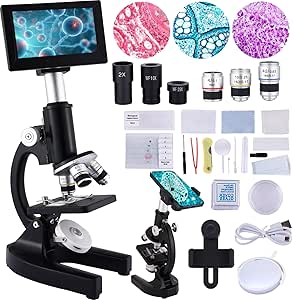 | Best for Beginners | Magnification: Up to 2500x | Display: 4.3-inch | Camera: 5 MP | VIEW LATEST PRICE | See Our Full Breakdown |
| TOMLOV DM301 Pro Digital Microscope with 7-Inch Screen |  | Best for Classroom Sharing | Model: DM301 Pro | Display: 7-inch IPS screen | Magnification: Up to 1200× | VIEW LATEST PRICE | See Our Full Breakdown |
| TOMLOV DM301 Max Digital Microscope with 7-Inch Screen |  | Best for Precise Specimen Positioning | Model: DM301 Max | Screen: 7-inch IPS LCD | Magnification: Up to 1200X | VIEW LATEST PRICE | See Our Full Breakdown |
| OOZSTAR Digital Microscope with 4.3-Inch Display and 5 MP Camera |  | Best for a Ready-to-Use Student Kit | Display: 4.3-inch HD screen | Camera: 5 MP | Listed magnification: 100x, 200x, 250x, 500x, 1000x, and 2000x; maximum also stated as 2500x | VIEW LATEST PRICE | See Our Full Breakdown |
| BMDSAE 1000X Handheld Digital Microscope for Kids with 2.0-Inch Screen |  | Best for Portable, Hands-On Exploration | Magnification: Up to 1000X | Screen: 2.0-inch IPS | Camera: 2 MP | VIEW LATEST PRICE | See Our Full Breakdown |
| AmScope B120 Series Binocular Compound Microscope with 5MP Camera |  | Best for Serious Coursework | Model: B120C-E5 | Microscope type: Binocular compound | Magnification: 40X–2500X | VIEW LATEST PRICE | See Our Full Breakdown |
| digital microscopes for student | Lighting | Magnification | Camera | Model |
|---|---|---|---|---|
| Elikliv EDM4 Digital Coin Micr | 8 adjustable LED lights | — | — | EDM4 |
| Woehrsh Trinocular Compound Mi | LED | 40x–5000x | — | — |
| OOZSTAR Digital Microscope wit | — | Up to 2500x | 5 MP | — |
| TOMLOV DM301 Pro Digital Micro | Adjustable top and bottom LEDs | Up to 1200× | 8MP photos; 1080p video | DM301 Pro |
| TOMLOV DM301 Max Digital Micro | Adjustable top and bottom LED lights | Up to 1200X | — | DM301 Max |
| OOZSTAR Digital Microscope wit | LED | — | 5 MP | — |
| BMDSAE 1000X Handheld Digital | 8 adjustable LEDs with 3 brightness modes | Up to 1000X | 2 MP | — |
| AmScope B120 Series Binocular | — | 40X–2500X | 5 MP USB | B120C-E5 |
More Details on Our Top Picks
Elikliv EDM4 Digital Coin Microscope with 4.3-Inch LCD and LED Lights
The Elikliv EDM4 is the most portable, direct-view option here: its 4.3-inch screen lets students inspect coins, leaves, or small craft details without setting up a computer. Its adjustable LED lights help with unevenly lit objects, and Windows and Mac connectivity provides another way to view observations. Compared with the OOZSTAR Digital Microscope, the EDM4 is less focused on classroom slide work and comes with fewer learning accessories; its practical strength is examining objects on its stand. The rechargeable battery runs for up to three hours, but saved photos and videos require a separately purchased memory card. Magnification also depends on camera distance and screen size, so students who need clearly defined compound-microscope magnification should choose a model such as the Woehrsh instead.
Pros:- 4.3-inch LCD supports direct viewing without a computer
- Eight adjustable LED lights help illuminate different objects
- Connects to Windows and Mac computers
- Rechargeable design runs for up to three hours
Cons:- Memory card for saving photos and videos is not included
- Magnification varies with camera distance and screen size
- Included accessories are less suited to slide-based lessons than the OOZSTAR student kit
Best for: Students doing portable close-up projects with coins, circuit boards, or other solid objects who want a built-in screen and computer connectivity.
Not ideal for: Students mainly studying prepared slides or needing clearly specified optical magnification; this model is geared toward close-up object viewing, and its magnification varies with setup.
- Model:EDM4
- Display:4.3-inch LCD
- Resolution:720p
- Lighting:8 adjustable LED lights
- Battery life:Up to 3 hours
- Computer compatibility:Windows and Mac
- Included accessories:Adjustable bracket, plastic base, USB cable, English user manual
- Memory card:Not included
Our verdict“Choose the EDM4 for portable close-up inspection of solid objects, but pick a compound microscope for more structured slide study.”
Woehrsh Trinocular Compound Microscope, 40x–5000x, with Mechanical Stage and USB Camera
The Woehrsh trinocular compound microscope is the most conventional classroom-style pick in this group, pairing eyepieces with a mechanical stage and coarse and fine focus for moving across prepared slides. That setup gives students a more deliberate slide-study workflow than the stand-based Elikliv EDM4, which is aimed at viewing objects such as coins and circuit boards. The included USB electronic eyepiece and accessory kit add options for demonstrations and basic lab activities, but the camera resolution and software compatibility are not specified. I would also treat the stated 5000x ceiling cautiously: the included optics determine useful detail, and a large magnification figure alone does not promise clearer images. Compared with the screen-first TOMLOV DM301 Pro, this model favors eyepiece-based compound viewing over an integrated large display.
Pros:- Dual mechanical stage supports controlled slide positioning
- Coarse and fine focus offer distinct focusing adjustments
- Includes WF10x and WF25x eyepieces and a USB electronic eyepiece
- LED illumination and educational accessories support slide-based activities
Cons:- USB camera resolution and software compatibility are unspecified
- The stated 5000x maximum may exceed the useful detail of the included optics
- Lacks the integrated large screen offered by the TOMLOV DM301 Pro
Best for: Students and home learners who want a compound microscope with a mechanical stage for examining prepared slides and a USB eyepiece for computer viewing.
Not ideal for: Beginners who want a clearly specified, ready-to-use digital imaging workflow or a large integrated screen; camera resolution and software details are missing.
- Microscope type:Compound trinocular
- Magnification:40x–5000x
- Eyepieces:WF10x and WF25x
- Objective lens:195 achromatic
- Stage:Dual mechanical, double-layer
- Lighting:LED
- Field of view angle:45°
- Voltage:240 V
Our verdict“Pick the Woehrsh for hands-on compound slide study, provided you are comfortable with unclear USB camera specifications.”
OOZSTAR Digital Microscope with 4.3-Inch Display and 5 MP Camera
The OOZSTAR Digital Microscope makes a friendly starting point for students who need a screen, camera, and basic slide materials in one package. Its 4.3-inch display avoids requiring an external computer for viewing, while the 5 MP camera can capture observations and cable or battery power suits different study spaces. The included slides, specimens, coverslips, and basic tools give beginners a path into simple lab activities that the more object-focused Elikliv EDM4 does not emphasize. It is less elaborate than the 7-inch TOMLOV DM301 Pro, though, with a smaller screen and a more basic accessory set. Product details also list differing magnification ranges, so I would not choose it based on the advertised maximum alone. Its strongest case is accessible, self-contained exploration rather than advanced imaging.
Pros:- 4.3-inch display supports direct viewing
- Built-in 5 MP camera can capture observations
- Can run from a data cable or batteries
- Includes slides, specimens, coverslips, and basic lab tools
Cons:- Product details give differing magnification ranges
- Included accessories may be basic for extended lab work
- Smaller display than the 7-inch TOMLOV DM301 Pro
Best for: Beginning student microscopists who want a built-in display, image capture, and starter materials for introductory slide activities.
Not ideal for: Students who need a clearly documented magnification range, a large group-viewing screen, or a more precise positioning stage.
- Magnification:Up to 2500x
- Display:4.3-inch
- Camera:5 MP
- Eyepieces:WF10x and WF16x
- Objective lenses:4x, 10x, and 40x achromatic
- Light source:LED
- Power:Data cable or batteries
- Weight:1.66 kg
- Included accessories:Cell phone holder, specimens, slides, coverslips, and lab tools
Our verdict“Choose OOZSTAR as a straightforward starter kit for screen-based viewing and basic specimen activities, not for demanding magnification needs.”
TOMLOV DM301 Pro Digital Microscope with 7-Inch Screen
The TOMLOV DM301 Pro is the clearest fit for students who want several people to follow an observation at once: its 7-inch adjustable-angle IPS screen is much roomier than the 4.3-inch displays on the OOZSTAR and Elikliv. It also records 8MP photos and 1080p video, and Wi-Fi app viewing plus USB and HD output provide routes to phones or larger displays. That combination makes sharing work easier than with the more traditional eyepiece-first Woehrsh microscope. The three achromatic lenses, adjustable top and bottom LEDs, and included prepared and blank slides support varied class activities. The tradeoff is that magnification tops out at 1200×, below the listed maximum for OOZSTAR, and battery life is up to three hours. Its microSD card and carrying case make it a more ready-to-start package than the EDM4.
Pros:- Large adjustable-angle 7-inch IPS screen is suited to shared viewing
- Captures 8MP photos and 1080p video
- Wi-Fi app support plus USB and HD output
- Includes microSD card, prepared slides, and blank slides
Cons:- Battery life is limited to up to three hours
- Maximum magnification is 1200×, lower than OOZSTAR’s stated maximum
- Digital screen viewing differs from the eyepiece-based approach of the Woehrsh
Best for: Students, families, or small groups who want a large shared viewing screen, photo and video capture, and ways to connect to other displays.
Not ideal for: Learners who prioritize a traditional compound microscope’s stated high magnification or need to work unplugged for long sessions.
- Model:DM301 Pro
- Display:7-inch IPS screen
- Magnification:Up to 1200×
- Lenses:Three achromatic lenses
- Camera:8MP photos; 1080p video
- Connectivity:Wi-Fi app support; USB and HD output
- Lighting:Adjustable top and bottom LEDs
- Battery life:Up to 3 hours
- Included accessories:Carrying case, microSD card, power cable, TV cable, power adapter, 5 prepared slides, 5 blank slides
Our verdict“Choose the DM301 Pro for group-friendly screen viewing and connected image sharing, rather than maximum stated magnification.”
TOMLOV DM301 Max Digital Microscope with 7-Inch Screen
The TOMLOV DM301 Max earns a distinct place over the DM301 Pro with its metal X-Y stage, which lets students position a specimen more deliberately instead of relying on freehand movement. Its 1.0 mm scale divisions add a reference for controlled adjustments, a useful distinction for repeatable classroom observations. Like the Pro, it has a 7-inch IPS screen, 8MP photos, 1080p video, Wi-Fi app viewing, and USB and HD connections; both also include prepared and blank slides. The Max is therefore a better match for careful positioning, while the Pro already covers shared viewing without the stated scaled stage. Neither is a traditional eyepiece-first compound microscope like the Woehrsh, and both are limited to up to three hours on battery. The included 8GB Micro SD card and carrying case help students start documenting work.
Pros:- Metal X-Y stage supports controlled specimen positioning
- Stage has 1.0 mm scale divisions for reference
- 7-inch IPS screen, 8MP image capture, and 1080P video
- Wi-Fi, USB, and HD connections plus an included 8GB Micro SD card
Cons:- Battery life is limited to up to three hours
- Maximum magnification is 1200X, below OOZSTAR’s stated maximum
- Digital viewing does not provide the eyepiece-based workflow of the Woehrsh
Best for: Students who want a large digital display and more controlled specimen movement for repeatable observations or image capture.
Not ideal for: Students seeking a traditional compound microscope, longer battery sessions, or magnification above the stated 1200X.
- Model:DM301 Max
- Screen:7-inch IPS LCD
- Magnification:Up to 1200X
- Lenses:3 achromatic lenses
- Image and video resolution:8MP images; 1080P video
- Stage:Metal X-Y stage with 1.0 mm scale divisions
- Connectivity:Wi-Fi, USB, HD; Android and iOS app compatibility
- Lighting:Adjustable top and bottom LED lights
- Battery life and included storage:Up to 3 hours; 8GB Micro SD card included
Our verdict“Choose the DM301 Max over the DM301 Pro when controlled X-Y specimen positioning matters more than a basic large-screen setup.”
OOZSTAR Digital Microscope with 4.3-Inch Display and 5 MP Camera
For students who want a viewing screen and starter supplies together, this OOZSTAR pairs a 4.3-inch display and 5 MP camera with slides, coverslips, specimens, and laboratory tools. Battery or cable power gives it more flexibility around a classroom or home than a microscope that depends on a fixed workstation. Its WF10x and WF16x eyepieces and three achromatic objectives offer several listed magnification settings, though the claimed settings and stated 2500x maximum do not line up cleanly, so I would not choose it on the highest number alone. Compared with the BMDSAE handheld, it is better suited to desk-based activities and comes with more lab materials; the BMDSAE is lighter to carry. The tradeoff is limited detail about image quality and construction.
Pros:- Built-in 4.3-inch screen supports group viewing without requiring a separate computer.
- 5 MP camera can capture observations for later study.
- Runs from a data cable or batteries for flexible placement.
- Includes specimens, slides, coverslips, a phone holder, and assorted lab tools.
Cons:- Listed magnification settings conflict with the stated 2500x maximum.
- Product information gives little detail about image quality or build construction.
- Less portable than the compact BMDSAE handheld microscope.
Best for: Students and families who want a tabletop digital microscope with a screen, camera, and basic slide-making supplies in one package.
Not ideal for: Buyers who need clearly documented magnification performance or detailed image-quality information before choosing a microscope.
- Display:4.3-inch HD screen
- Camera:5 MP
- Listed magnification:100x, 200x, 250x, 500x, 1000x, and 2000x; maximum also stated as 2500x
- Eyepieces:WF10x and WF16x
- Objective lenses:4x, 10x, and 40x achromatic
- Lighting:LED
- Power:Data cable or batteries
- Included accessories:Phone holder, 5 specimens, 5 slides, 100 coverslips, and assorted laboratory tools
Our verdict“Choose this OOZSTAR for a screen-equipped student setup with starter lab supplies, but look elsewhere if verified magnification details are a priority.”
BMDSAE 1000X Handheld Digital Microscope for Kids with 2.0-Inch Screen
The BMDSAE is the most portable choice in this group: at 200g, it is built for students who want to inspect objects around the house or take a microscope on an outing rather than stay at a desk. Its manual focus asks the learner to adjust the image directly, which can make viewing more active but may frustrate younger children who expect instant focus. Eight adjustable LEDs with three brightness modes help adapt the light to different subjects, and saved photos or AVI videos can be transferred to a Windows or Mac computer. Compared with the OOZSTAR’s 4.3-inch display and included specimen kit, this model has a much smaller 2.0-inch screen and no listed slides or lab tools. Its two-hour maximum battery life also favors short sessions over extended class use.
Pros:- Lightweight 200g design is easy to carry and handle.
- Eight LEDs offer three brightness modes for adjusting specimen illumination.
- Stores photos and AVI videos for transfer to Windows or Mac computers.
- Includes USB-C cable, lanyard, and a one-year warranty.
Cons:- Battery life is listed at up to two hours, limiting longer sessions away from power.
- Manual focusing can be difficult for children expecting a quick, automatic image.
- The 2.0-inch screen is less suited to shared viewing than the OOZSTAR’s 4.3-inch display.
Best for: Students over age three who want a lightweight handheld microscope for short explorations and the option to save images to a computer.
Not ideal for: Students who need a larger screen for shared classroom viewing, long battery sessions, or a supplied set of slides and specimens.
- Magnification:Up to 1000X
- Screen:2.0-inch IPS
- Camera:2 MP
- Lighting:8 adjustable LEDs with 3 brightness modes
- Battery:600mAh; up to 2 hours
- Storage:32M; supports 200+ photos or AVI videos
- Connectivity and compatibility:USB-C; Windows XP/Vista/7/8/10/11 and Mac 11.0+
- Weight and material:200g; ABS plastic
- Warranty:1 year
Our verdict“Pick the BMDSAE for portable, short-session exploration, not as a substitute for a larger-screen tabletop microscope.”
AmScope B120 Series Binocular Compound Microscope with 5MP Camera
For students whose microscope needs extend beyond casual exploration, the AmScope is the most lab-oriented option here. Its binocular compound design, adjustable Siedentopf head, and stated 40X–2500X range suit structured observation, while the 5 MP USB camera and image-capture and analysis software connect microscope work to computer-based assignments. Daylight-balanced LED illumination is another fit for repeatable study. Compared with the OOZSTAR, which offers a built-in screen and bundled specimen supplies, the AmScope favors a more conventional binocular instrument and computer workflow; unlike the BMDSAE, it is not a grab-and-go handheld. The main buying uncertainty is that the provided description does not identify the included objectives or eyepieces, details students may need when matching it to coursework. Its larger, more formal setup may be excessive for casual use.
Pros:- Binocular head supports viewing through both eyes during longer study sessions.
- 5 MP USB camera and software support digital capture and analysis.
- Daylight-balanced LED illumination is suited to classroom and lab observation.
- Five-year warranty offers longer stated coverage than the BMDSAE’s one-year warranty.
Cons:- The product description does not specify the included objectives or eyepieces.
- USB-camera workflow depends on a compatible computer rather than a built-in viewing screen.
- Its lab-oriented format is less portable and may be more involved than the OOZSTAR or BMDSAE for casual student use.
Best for: High school, college, or laboratory students who need a binocular compound microscope with computer capture and analysis tools.
Not ideal for: Younger beginners or students who want a portable microscope with a built-in display and a clearly listed starter set of slides and specimens.
- Model:B120C-E5
- Microscope type:Binocular compound
- Magnification:40X–2500X
- Camera:5 MP USB
- Head:Adjustable Siedentopf binocular
- Illumination:LED with fly-eye lens; daylight-balanced
- Software:Image-capture and analysis software included
- Warranty:5 years
Our verdict“Choose the AmScope for coursework that calls for binocular viewing and computer-based image work, provided its unspecified optics match your class needs.”

How We Picked
I ranked these microscopes by how well their design supports common student work: viewing prepared slides, inspecting everyday objects, sharing observations, and capturing images. I weighed screen size and controls alongside the microscope’s viewing format, camera setup, stated magnification, and the practical demands of focusing and positioning specimens. A high magnification number did not earn a model a higher place on its own, since the lineup mixes compound microscopes with digital inspection scopes and a handheld unit.
The TOMLOV DM301 Pro leads as the broadest fit for students who want an integrated display and room for shared viewing. The AmScope B120 and Woehrsh trinocular rank higher for slide-based study, but their conventional microscope format is less convenient for casual object inspection. Compact display models and the BMDSAE remain useful for narrower needs, though their smaller screens or handheld setup bring clearer limits. The duplicate OOZSTAR listing is counted as one distinct model, not a separate competing design.
| digital microscopes for student | Model | Included accessories |
|---|---|---|
| Elikliv EDM4 Digital Coin Micr | EDM4 | Adjustable bracket, plastic base, USB cable, English user manual |
| Woehrsh Trinocular Compound Mi | — | — |
| OOZSTAR Digital Microscope wit | — | Cell phone holder, specimens, slides, coverslips, and lab tools |
| TOMLOV DM301 Pro Digital Micro | DM301 Pro | Carrying case, microSD card, power cable, TV cable, power adapter, 5 prepared slides, 5 blank slides |
| TOMLOV DM301 Max Digital Micro | DM301 Max | — |
| OOZSTAR Digital Microscope wit | — | Phone holder, 5 specimens, 5 slides, 100 coverslips, and assorted laboratory tools |
| BMDSAE 1000X Handheld Digital | — | — |
| AmScope B120 Series Binocular | B120C-E5 | — |
Factors to Consider When Choosing Digital Microscopes For Students
Before choosing, I’d match the microscope to the specimens and the way a student will use it. A digital screen can make group observation easier, but it does not automatically replace the optics or slide handling of a compound microscope.
Match the Viewing Format to the Assignment
Start with what the student will actually examine, not the largest magnification printed on a listing. Prepared plant, cell, or tissue slides call for a compound microscope such as the Woehrsh or AmScope style. Coins, fabric, insects, and electronic parts are often easier to position under a screen-based inspection microscope. A handheld model can be handy for outdoor observations, but keeping it steady and centered takes practice. Buying a single tool for both slide science and general object inspection can mean compromises in each task. If assignments vary, ask whether the school expects transmitted-light slide work or reflected-light surface viewing.
Treat Magnification Claims as a Starting Point
Magnification figures across these product types may describe different optical and digital steps, so they are not a fair one-number comparison. Digital enlargement can make a picture larger without revealing additional detail, while useful resolution also depends on focus, lighting, optics, and the specimen. For schoolwork, a clear view at a practical magnification is more helpful than an extreme setting that is difficult to focus. Check whether the stated range refers to eyepiece optics, screen zoom, or a combination. Students who need to identify fine structures should favor a suitable compound setup and careful slide preparation over chasing the highest advertised figure. A teacher’s lesson requirements can narrow the choice quickly.
Choose Screen Size for Solo or Shared Work
A built-in display changes how a microscope works in a classroom: several students can discuss one image instead of taking turns at an eyepiece. Larger screens, such as the 7-inch displays in the TOMLOV options, are easier to share than a compact 2.0-inch handheld screen. A smaller screen can still make sense for individual exploration or storage in a crowded desk drawer. Do not assume that a large display guarantees sharp images; screen resolution and camera quality also affect what students can interpret. Consider viewing distance, glare, and whether the microscope will sit at a fixed station. For group instruction, screen placement and stable framing matter as much as diagonal size.
Check the Camera Workflow Before Buying
Students may need to save images for a lab report, present them to classmates, or simply view specimens live. Those are different needs, so verify how a model captures or transfers images rather than assuming every digital microscope handles files the same way. The Woehrsh and AmScope listings include camera components, but a camera-based compound setup may involve more assembly or computer dependence than an integrated-screen unit. An all-in-one display can be simpler for quick observation, while a computer-connected camera may suit longer documentation sessions. Check compatibility with the devices and software a school actually uses. Avoid paying for a camera workflow that the student cannot access or does not need.
Account for Setup, Stability, and Student Age
Ease of use includes more than switching on a screen. Fine focusing, stage movement, specimen placement, and keeping a handheld microscope steady can each frustrate a new learner. Younger students may benefit from a portable design with fewer setup steps, while older students doing slide work may be ready for a mechanical stage and a more traditional instrument. A stable base helps prevent the image from shifting during focusing, especially when students take turns. Check the space available for the microscope and whether it needs to move between home and school. When possible, choose controls that match the student’s coordination and patience rather than buying on age labels alone.
Pay for Capabilities the Student Will Use
A higher-spec configuration is worthwhile when it solves a real classroom problem, such as providing a more shareable display or supporting detailed slide work. It is less useful if the student mainly wants to inspect leaves and coins at home. Compare the DM301 Pro and Max by their actual feature differences before deciding that the Max is the better fit; the product names alone do not establish what the upgrade adds. Similarly, avoid treating two listings of the same OOZSTAR model as separate levels of performance. Factor in any accessories, computer requirements, and storage needs that affect day-to-day use. A simpler model can be the better school purchase when it covers the assignments without adding setup burden.
Frequently Asked Questions
Should I choose a digital screen microscope or a compound microscope for school biology?
I’d base this on the specimens and assignment format. For prepared slides and lessons focused on cells or thin samples, a compound microscope such as the AmScope B120 or Woehrsh is the more natural match. A screen-based scope is easier for shared viewing and everyday objects, but it is not automatically a substitute for slide-focused optics. Ask the teacher whether students need transmitted-light observation, camera documentation, or both. If the class uses conventional slides, prioritize that workflow over screen size.
Is a 7-inch screen worth choosing over a 4.3-inch display?
A larger screen is most useful when a student shares observations with a partner or class, or needs to inspect details without crowding around a small display. That makes the TOMLOV 7-inch models more appealing for group demonstrations than the compact Elikliv and OOZSTAR options. For one student working at a desk, a 4.3-inch screen may be adequate and easier to store. Screen size alone does not tell you image clarity, so check camera and display specifications too. Choose based on viewing distance and audience, not the diagonal measurement by itself.
Can one microscope handle both prepared slides and coins or insects?
Some microscopes can cover more than one kind of specimen, but the viewing format still shapes what feels practical. Compound models are designed around slides, while digital inspection scopes make it simpler to place larger objects beneath a camera. Moving between both tasks may involve changing lighting, specimen holders, or focus habits. If a student regularly studies cells and surface details, a single multipurpose choice may involve a noticeable compromise. Confirm the required school work before choosing versatility over a better fit for the main task.
How much should I trust a microscope’s advertised magnification?
Use the number as a rough guide, not as proof that one model reveals more detail than another. Listings may combine optical magnification with digital zoom, and digital enlargement can increase image size without adding information. Clarity also depends on optics, focus, lighting, and the specimen itself. This matters especially when comparing compound microscopes with handheld or screen-based models, since their figures may describe different systems. For student work, a sharp, usable image at the magnification needed for the lesson is the more relevant goal.
What should I check before buying a microscope with a camera for school assignments?
First, find out whether the student must save still images, record video, show a live image, or transfer files to a school computer. Then check how the camera connects and whether its software works with the available devices. A built-in display can make live viewing straightforward, but it may not provide the file workflow a report requires. Camera-equipped compound models can suit documentation, though setup may be more involved than with an integrated-screen scope. Confirm the school’s device and file requirements before treating a camera as a useful feature.
Conclusion
For the broadest student use, I’d pick the TOMLOV DM301 Pro for its integrated 7-inch screen and easier shared viewing. The best value-style choice depends on the student’s main task: the compact OOZSTAR is a sensible screen-based option, while the duplicate listing does not add a second distinct model to compare. For traditional slide study and a more advanced setup, consider the AmScope B120 or Woehrsh trinocular; I’d favor the AmScope for a binocular compound format with a listed 5MP camera, and the Woehrsh for its mechanical stage and broad stated range. The BMDSAE is the most approachable portable pick for younger beginners, with the clear compromise of its small display. Choose the Elikliv if a compact 4.3-inch scope suits the student’s workspace, and compare the DM301 Max with the Pro only after confirming the Max’s specific added features meet a real need.
Fall Picks
fall essentials
As an affiliate, we earn on qualifying purchases.