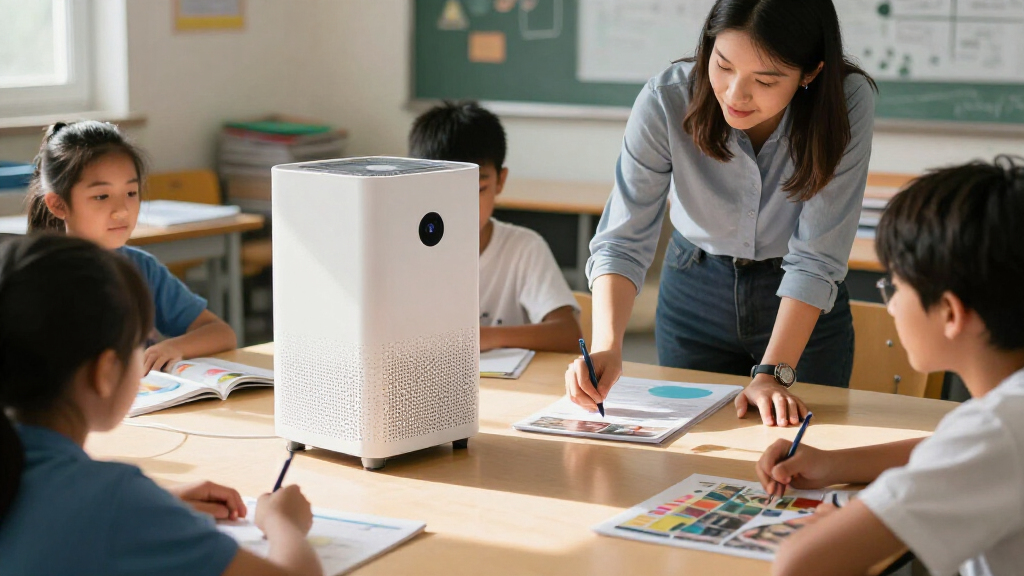

For most classrooms, I’d start with the DREO 338: its particle monitor and automatic mode make it easier to respond to changing air conditions than a basic purifier. The Dreo Large Room is a standout for bigger spaces, while the Levoit Core 300-P suits smaller rooms where a compact footprint matters. The main tradeoffs are coverage claims versus real room needs, quiet operation versus stronger fan settings, and purchase cost versus replacement-filter upkeep. A purifier can support cleaner indoor air, but it does not replace ventilation or follow school health guidance. Read on for my full comparison of all 14 classroom air purifiers and how to choose among them.

Prime made for students and young adults
- Fast, free delivery for dorm and study essentials
- Prime Video and Amazon Music included
- Member-only deals
Complete the kit


Key Takeaways
- The DREO 338 earns the lead for classroom usability: its PM2.5 monitor and auto mode add practical feedback and reduce the need for constant manual adjustment.
- Large-room labels do not settle the coverage question: compare a model’s clean-air delivery information and recommended room size at a meaningful air-change rate, not only its biggest advertised area.
- The Levoit Core 300-P is a more room-specific choice than the large-room models: its compact design may fit a small classroom or learning nook, but it is not the first pick for a crowded, open space.
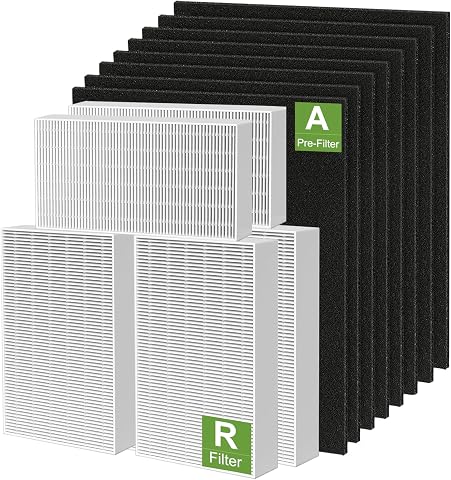
- Filter access and upkeep separate everyday classroom options: the Jafanda JA280’s washable pre-filter can catch larger debris before it reaches the main filter, while washable parts do not remove the need to replace the particle filter when required.
- Quiet performance and placement matter as much as headline coverage: the Levoit Core Mini-P may suit a desk or small corner, but a small unit should not be expected to clean an entire classroom on its own.
| MOOKA B-D02L Air Purifier for Large Rooms |  | Best for Flexible Classroom Placement | Model: B-D02L | Maximum coverage: Up to 1,076 sq. ft. at 1 air change per hour | Air changes: 6 per hour in 215 sq. ft.; 1 per hour in 1,076 sq. ft. | VIEW LATEST PRICE | See Our Full Breakdown |
| DREO 338 Air Purifier with HEPA Filter, PM2.5 Monitor, Auto and Sleep Modes |  | Best for Air-Quality Feedback | Model: DR-HAP008 (Dreo 338) | Clean Air Delivery Rate: 115 CFM | Recommended room size: Up to 178 sq. ft. at 4.8 air changes per hour | VIEW LATEST PRICE | See Our Full Breakdown |
| GermGuardian Tower HEPA Air Purifier for Large Rooms |  | Best for Optional UV-C | Filtration: True HEPA 3-layer filter, activated carbon filter, and pre-filter | Particle capture: 99.97% of particles as small as 0.1 microns | Room circulation: 153 sq. ft. in 12.5 minutes | VIEW LATEST PRICE | See Our Full Breakdown |
| Levoit Core 300-P Air Purifier for Home |  | Best for Simple, Portable Operation | Model: Core 300-P | Filtration: 3-in-1; 99.97% efficiency for 0.1–0.3 μm airborne particles | CADR: 143 CFM smoke; 153 CFM dust; 167 CFM pollen | VIEW LATEST PRICE | See Our Full Breakdown |
| Honeyuan H13 HEPA Air Purifier for Bedroom, White |  | Best for Compact, Flexible Placement | Filter: Three-stage H13 True HEPA composite filter | Air intake: 360-degree | Coverage area: Up to 1,095 sq. ft. | VIEW LATEST PRICE | See Our Full Breakdown |
| Dreo Air Purifier for Large Rooms, 1,176 sq. ft., with HEPA Filter and PM2.5 Monitor |  | Best for Sensor-Guided Classroom Use | Model: DR-HAP009 | Coverage: Up to 1,176 sq. ft. at 1 ACH; 245 sq. ft. at 4.8 ACH | CADR: 158 CFM | VIEW LATEST PRICE | See Our Full Breakdown |
| FreAire KN6391RGB Air Purifier, Black, for Rooms up to 1,086 sq ft |  | Best for Quiet, Flexible Placement | Model: KN6391RGB | Room coverage: Up to 1,086 sq. ft. | Filtration: Three-level filtration system | VIEW LATEST PRICE | See Our Full Breakdown |
| ECOSELF HEPA Air Purifier for Large Rooms up to 1,800 sq. ft. |  | Best for Quiet Set-and-Forget Operation | Coverage area: Up to 1,800 sq. ft. | Air intake: 360-degree intake | Filtration: Pre-filter, HEPA filter, and activated carbon layer | VIEW LATEST PRICE | See Our Full Breakdown |
| Levoit Core Mini-P Air Purifier |  | Best Compact Pick for Small Learning Spaces | CADR: Smoke: 34 CFM; dust: 39 CFM; pollen: 44 CFM | Room coverage: 53 sq. ft. at 4.8 air changes per hour; 257 sq. ft. at 1 air change per hour | Filter layers: Pre-filter and main filter | VIEW LATEST PRICE | See Our Full Breakdown |
| Jafanda JA280 Air Purifier with Washable Pre-Filter |  | Best for Classrooms with Dust and Pet-Hair Loads | CADR: Smoke: 135 CFM; dust: 143 CFM; pollen: 164 CFM | Coverage: Up to 209 sq. ft. at 4.8 air changes per hour; up to 1,015 sq. ft. at 1 air change per hour | Filtration: 3-stage HEPA; filters up to 99.97% of particles as small as 0.3 microns | VIEW LATEST PRICE | See Our Full Breakdown |
| VOOPNU Air Purifier with H13 Filter, 1,076 sq ft, Black |  | Best Compact Desk-Side Pick | Coverage area: Up to 1,076 sq ft | Dimensions: 6.69 x 6.69 x 9.84 inches | Filtration: H13 three-layer filter | VIEW LATEST PRICE | See Our Full Breakdown |
| FreAire HAP605 Air Purifier for Large Rooms, White |  | Best for Large Classrooms | Model: HAP605 | Coverage: Up to 2,600 sq ft | Air intake: Triple intake | VIEW LATEST PRICE | See Our Full Breakdown |
| VOOPNU Air Purifier for Home, 360° Airflow, White |  | Best for Simple, Quiet Operation | Coverage: Up to 1,076 ft² | Dimensions: 6.69 x 6.69 x 9.84 inches | Filtration: Triple-layer filtration; captures 99.97% of airborne pollutants | VIEW LATEST PRICE | See Our Full Breakdown |
| FULMINARE H13 True HEPA Air Purifier for Rooms up to 1,086 sq ft |  | Best for Timed, Low-Noise Use | Filtration: Pre-filter, H13 HEPA filter, activated carbon layer | Particle filtration: 99.97% of airborne particles as small as 0.3 microns | Coverage area: Up to 1,086 sq ft | VIEW LATEST PRICE | See Our Full Breakdown |
| classroom air purifier | Filtration |
|---|---|
| MOOKA B-D02L Air Purifier for | Pre-filter, True HEPA filter, and activated carbon filter |
| DREO 338 Air Purifier with HEP | — |
| GermGuardian Tower HEPA Air Pu | True HEPA 3-layer filter, activated carbon filter, and pre-filter |
| Levoit Core 300-P Air Purifier | 3-in-1; 99.97% efficiency for 0.1–0.3 μm airborne particles |
| Honeyuan H13 HEPA Air Purifier | — |
| Dreo Air Purifier for Large Ro | — |
| FreAire KN6391RGB Air Purifier | Three-level filtration system |
| ECOSELF HEPA Air Purifier for | Pre-filter, HEPA filter, and activated carbon layer |
| Levoit Core Mini-P Air Purifie | — |
| Jafanda JA280 Air Purifier wit | 3-stage HEPA; filters up to 99.97% of particles as small as 0.3 microns |
| VOOPNU Air Purifier with H13 F | H13 three-layer filter |
| FreAire HAP605 Air Purifier fo | — |
| VOOPNU Air Purifier for Home | Triple-layer filtration; captures 99.97% of airborne pollutants |
| FULMINARE H13 True HEPA Air Pu | Pre-filter, H13 HEPA filter, activated carbon layer |
More Details on Our Top Picks
MOOKA B-D02L Air Purifier for Large Rooms
The MOOKA B-D02L suits classrooms where the purifier may need to run quietly during lessons and change settings around breaks. Its pre-filter, True HEPA filter, and activated carbon layer target particles and odors, while four fan modes and timed operation give staff more control than the Levoit Core 300-P, which relies on manual speed selection and has no child lock. The MOOKA also lists 20 dB operation, though the supplied coverage figures put its fastest stated air exchange at six changes per hour in a much smaller 215-square-foot room; at its maximum 1,076-square-foot coverage, that falls to one change per hour. That distinction matters when matching it to a real classroom. The child lock is useful around curious students, but the filter may need replacement every three to six months, and the aroma pad is optional rather than a classroom air-cleaning advantage.
Pros:- Three-stage filtration combines a pre-filter, True HEPA filter, and activated carbon layer.
- Four fan modes and four timer options allow settings to be adjusted around lessons and room use.
- Stated 20 dB operation and a night light that can be turned off.
- Child lock can help prevent students from changing settings.
Cons:- At the maximum 1,076-square-foot coverage, the stated rate is only one air change per hour.
- Filter replacement is recommended every three to six months, depending on use and conditions.
- Essential oils for the fragrance pad are not included, and fragrance may not suit every classroom.
Best for: Teachers or administrators seeking adjustable fan and timer settings, quiet operation, and a child lock for a classroom sized to its stated air-change rate.
Not ideal for: Buyers who need frequent air exchanges across a very large classroom, or schools that prefer not to manage filter changes as often as every three months.
- Model:B-D02L
- Maximum coverage:Up to 1,076 sq. ft. at 1 air change per hour
- Air changes:6 per hour in 215 sq. ft.; 1 per hour in 1,076 sq. ft.
- Filtration:Pre-filter, True HEPA filter, and activated carbon filter
- Particle capture:As small as 0.3 microns
- Noise level:20 dB
- Modes and timer:Sleep, Low, Medium, and High; 1, 2, 4, and 8 hours
- Filter replacement:Every 3–6 months
Our verdict“Choose the MOOKA for a classroom that benefits from quiet, lockable controls, but size it by its six-air-changes-per-hour area rather than its maximum coverage claim.”
DREO 338 Air Purifier with HEPA Filter, PM2.5 Monitor, Auto and Sleep Modes
The DREO 338 is the clearest choice here for staff who want visible air-quality feedback rather than relying only on a fan setting. Its PM2.5 sensor and AQI display show changing readings, and Auto mode adjusts purification speed; the MOOKA B-D02L offers more timer choices and a child lock but lacks that monitoring and automatic response. That makes it better suited to a small room or a defined teaching area than a full-size classroom. Sleep mode turns off display lights, while Turbo adds a stronger setting, but the compact 14-inch unit’s 115 CFM CADR limits its role in larger, busy spaces.
Pros:- PM2.5 sensor provides a real-time reading through an AQI display.
- Auto mode adjusts purification speed in response to sensed air quality.
- AHAM Verified and ENERGY STAR certified.
- Sleep mode switches off display lights.
Cons:- Recommended sizing is up to 178 sq. ft. at 4.8 air changes per hour.
- The 856-square-foot maximum is based on only one air change per hour.
- A 115 CFM CADR is less suited to larger classrooms than a purifier sized for higher room turnover.
Best for: Teachers in smaller classrooms or enclosed teaching rooms who want an AQI readout and automatic fan adjustment.
Not ideal for: Schools seeking one purifier for a large classroom at frequent air-change rates; its 856-square-foot figure represents only one air change per hour.
- Model:DR-HAP008 (Dreo 338)
- Clean Air Delivery Rate:115 CFM
- Recommended room size:Up to 178 sq. ft. at 4.8 air changes per hour
- Maximum coverage:Up to 856 sq. ft. at 1 air change per hour
- Filter:3-in-1 pre-filter, high-efficiency filter, and activated carbon layer
- Air-quality monitoring:PM2.5 sensor; AQI display range 1–999
- Modes:Auto, Turbo, Sleep, and Normal
- Certifications:AHAM Verified; ENERGY STAR certified
- Height:14 inches
Our verdict“Pick the DREO 338 for a smaller classroom where automatic operation and visible PM2.5 readings matter more than broad room coverage.”
GermGuardian Tower HEPA Air Purifier for Large Rooms
The GermGuardian Tower stands apart for classrooms where buyers want optional UV-C alongside particle and odor filtration. Its True HEPA, activated carbon, and pre-filter setup is paired with a UV-C bulb intended to help reduce airborne germs, bacteria, and mold spores; that added feature is not part of the Levoit Core 300-P’s listed setup. The tradeoff is a smaller useful room rating: the GermGuardian circulates air in 153 square feet every 12.5 minutes, so it is a more specific fit than models advertising much larger maximum areas. Its low setting is listed at 40 dB, louder than the MOOKA B-D02L’s stated 20 dB, which may matter during quiet instruction. Maintenance is also more involved, with separate schedules for the HEPA filter, carbon filter, pre-filter, and UV-C bulb. I’d shortlist it for a modest classroom that values the optional feature and can support the upkeep.
Pros:- Combines True HEPA, activated carbon, and pre-filter layers.
- Optional UV-C light adds a separate treatment feature.
- Zero Ozone Verified, CARB-certified, and ETL-certified.
- Three fan speeds provide a choice of operating levels.
Cons:- The stated circulation rate is for a 153-square-foot room, limiting its fit for larger classrooms.
- Low-speed noise is listed at 40 dB, higher than the MOOKA B-D02L’s stated 20 dB.
- Separate HEPA, carbon, pre-filter, and UV-C bulb maintenance adds ongoing upkeep.
Best for: School staff seeking a tower-style purifier with optional UV-C and a defined use area around 153 square feet.
Not ideal for: Large classrooms needing frequent air turnover, or quiet teaching spaces where a 40 dB low setting and multiple replacement schedules are unwelcome.
- Filtration:True HEPA 3-layer filter, activated carbon filter, and pre-filter
- Particle capture:99.97% of particles as small as 0.1 microns
- Room circulation:153 sq. ft. in 12.5 minutes
- One-hour coverage:743 sq. ft.
- Fan speeds:3
- Lowest-speed noise:40 dB
- UV-C bulb schedule:Replace every 10–12 months
- Filter schedule:HEPA every 6 months; carbon every 3 months; vacuum pre-filter monthly
- Certifications:Zero Ozone Verified, CARB-certified, and ETL-certified
Our verdict“Choose the GermGuardian for a smaller classroom where optional UV-C is a priority and staff can keep up with its separate filter and bulb schedules.”
Levoit Core 300-P Air Purifier for Home
The Levoit Core 300-P is a practical classroom pick for staff who want a compact unit with straightforward manual controls rather than sensors or app-linked features. At 7.9 pounds and 8.7 inches wide, it is easier to reposition between rooms than the GermGuardian Tower, while its touch controls, timer, and filter-change indicator keep routine operation simple. Its stated CADR varies by particle type—143 CFM for smoke, 153 for dust, and 167 for pollen—so buyers can compare performance against a classroom’s specific concern. The large 1,073-square-foot coverage figure should not be treated as equivalent to a frequent air-change rating; the supplied data gives no air-change rate for that maximum. Sleep mode is listed at 24 dB, but there is no Auto mode, so staff must select fan speed themselves. Filter replacement is recommended every six to eight months.
Pros:- Portable 7.9-pound design is easier to move between classrooms than the GermGuardian Tower.
- Sleep mode is listed at 24 dB, with an option to turn off display lights.
- Separate CADR figures are provided for smoke, dust, and pollen.
- Timer and filter-change indicator support straightforward scheduled use.
Cons:- No Auto mode or smart connectivity; fan speed must be set manually.
- The 1,073-square-foot coverage figure has no air-change rate specified in the supplied data.
- Replacement filters are recommended every six to eight months.
Best for: Teachers who need a lightweight purifier they can move between small rooms and want uncomplicated manual controls and a filter reminder.
Not ideal for: Classrooms where staff need automatic fan adjustment or a clearly stated high air-change rate across a large area.
- Model:Core 300-P
- Filtration:3-in-1; 99.97% efficiency for 0.1–0.3 μm airborne particles
- CADR:143 CFM smoke; 153 CFM dust; 167 CFM pollen
- Room coverage:Up to 1,073 sq. ft.
- Sleep-mode noise:24 dB
- Power:56 W
- Dimensions and weight:8.7 × 8.7 × 14.2 in; 7.9 lb
- Controls and timer:Touch controls with manual fan speed; 2, 4, 6, or 8 hours
- Certifications:AHAM Verified, FCC Certified, ETL Listed, and CARB Compliant
Our verdict“Choose the Core 300-P for a portable, easy-to-operate classroom unit, but skip it if you need automatic response or a clearly stated air-change rate for a large room.”
Honeyuan H13 HEPA Air Purifier for Bedroom, White
The Honeyuan H13 is the most straightforward fit in this group for buyers prioritizing portable placement and simple timed operation over detailed room-performance data. Its 360-degree air intake, three fan speeds, sleep mode, touch display, and one-to-nine-hour timer offer a useful set of basic controls. By comparison, the DREO 338 adds a PM2.5 sensor and Auto mode, making it the stronger choice when staff want feedback and automatic adjustment; Honeyuan’s appeal is a simpler interface and a listed 100–240 V input. The main caution is its air-delivery figure of 90–120 m³/h, which is modest beside the stated large coverage claim of up to 1,095 square feet. The supplied data does not give an air-change rate to clarify that coverage, so I would not select it for a busy classroom based on the maximum area alone. Replacement filters are sold separately.
Pros:- 360-degree air intake supports placement without needing to face one direction.
- Three fan speeds, sleep mode, and a one-to-nine-hour timer provide basic operating flexibility.
- Touch display includes a filter replacement reminder.
- 100–240 V voltage range is broader than the Levoit Core 300-P’s 120 V specification.
Cons:- Air delivery is listed as 90–120 m³/h, with no air-change rate provided for classroom sizing.
- The 1,095-square-foot coverage claim is not paired with a stated air-change rate.
- Replacement filters must be purchased separately.
Best for: Teachers seeking a portable purifier with 360-degree intake, a simple touch display, flexible timer settings, and broad voltage compatibility.
Not ideal for: Administrators choosing for a large, occupied classroom who need a verified air-change rate or stronger documented delivery capacity.
- Filter:Three-stage H13 True HEPA composite filter
- Air intake:360-degree
- Coverage area:Up to 1,095 sq. ft.
- Air delivery:90–120 m³/h
- Noise level:As low as 24 dB
- Fan speeds:3
- Timer:1–9 hours
- Voltage:100–240 V
- Warranty:One year
Our verdict“Choose the Honeyuan for portable, simple operation in a modest space, but look elsewhere when classroom sizing depends on a documented air-change rate.”
Dreo Air Purifier for Large Rooms, 1,176 sq. ft., with HEPA Filter and PM2.5 Monitor
The Dreo DR-HAP009 earns this role for classrooms where staff want a live air-quality reading and an automatic response, rather than relying only on a timer or fixed fan speed. Its PM2.5 sensor and AQI display make changes in measured particle levels visible, while Auto, Turbo, Sleep, and Normal modes give teachers options for busy periods and quieter lessons. The headline coverage needs context: 1,176 square feet is rated at one air change per hour, while the more classroom-relevant 4.8-air-change figure covers 245 square feet. That makes it a better fit for a single moderate room than its large-area claim may suggest. Compared with the Jafanda JA280, it offers more operating modes and ENERGY STAR certification, but Jafanda lists a washable pre-filter and detailed CADR figures.
Pros:- PM2.5 sensor and AQI display make measured air-quality changes easy to see.
- Auto, Turbo, Sleep, and Normal modes suit different classroom conditions.
- Three-layer filter combines particle capture with an activated carbon layer for odors.
- ENERGY STAR certification and approximately 162 kWh annual energy use provide useful efficiency context.
Cons:- Coverage at 4.8 air changes per hour is 245 square feet, far below the headline area.
- The provided specifications do not give separate smoke, dust, or pollen CADR figures.
- Four fan speeds and multiple modes may be more controls than a classroom needs.
Best for: Teachers or school staff who want visible PM2.5 readings and automatic fan adjustment in a classroom around 245 square feet at 4.8 air changes per hour.
Not ideal for: Schools expecting frequent high-rate air cleaning across a large classroom; its 1,176-square-foot figure is based on just one air change per hour.
- Model:DR-HAP009
- Coverage:Up to 1,176 sq. ft. at 1 ACH; 245 sq. ft. at 4.8 ACH
- CADR:158 CFM
- Filter:3-in-1 pre-filter, high-efficiency filter, and activated carbon
- Air-quality sensor:PM2.5 sensor with AQI display from 1–999
- Modes and speeds:Auto, Turbo, Sleep, and Normal; 4 fan speeds
- Certification and energy use:ENERGY STAR; approximately 162 kWh annually
Our verdict“Choose the Dreo when live PM2.5 monitoring and automatic control matter more than high-rate coverage of a large classroom.”
FreAire KN6391RGB Air Purifier, Black, for Rooms up to 1,086 sq ft
The FreAire KN6391RGB is the style-and-quiet pick for a classroom where low-noise operation and a 360-degree outlet are attractive, but its published room coverage is not enough to judge high-rate classroom cleaning. The maker lists filtration of particles as small as 0.3 microns and sleep-mode noise as low as 20 dB; it does not provide a CADR or air-change rate in the supplied data. That leaves less performance detail to compare than the Dreo DR-HAP009, which states both a CADR and coverage at 4.8 air changes per hour. FreAire’s ambient lights and aroma pad may suit a quiet room, though they are secondary features in a school and essential oil is not included. I would favor it for a smaller classroom with modest noise priorities, not as a proven large-room workhorse.
Pros:- Sleep mode is specified at as little as 20 dB.
- Dual-channel intake and 360-degree outlet allow air to enter and leave from multiple directions.
- Three-level filtration is described as capturing particles down to 0.3 microns.
- Three ambient-light options and an aroma pad provide optional room features.
Cons:- No CADR or air-change rate is provided for comparing classroom cleaning performance.
- Replacement-filter details are not specified in the supplied product information.
- Essential oils for the aroma pad are not included, and fragrance features may be unnecessary in classrooms.
Best for: Teachers seeking a quieter purifier for a smaller classroom or learning space who value flexible placement and can verify room performance before purchase.
Not ideal for: Facilities teams selecting by documented classroom air-change performance; the supplied details omit CADR and an air-change rate.
- Model:KN6391RGB
- Room coverage:Up to 1,086 sq. ft.
- Filtration:Three-level filtration system
- Particle filtration:Particles as small as 0.3 microns
- Airflow design:Dual-channel air inlet and 360-degree air outlet
- Sleep-mode noise:As low as 20 dB
- Additional features:Three ambient-light options and an aroma pad; essential oils not included
Our verdict“Pick the FreAire for a quieter, feature-rich smaller room only if its unspecified CADR is acceptable for your classroom.”
ECOSELF HEPA Air Purifier for Large Rooms up to 1,800 sq. ft.
The ECOSELF HEPA Air Purifier suits classrooms where staff want straightforward automatic operation and a sleep mode that dims distractions. Its PM2.5 sensor adjusts the fan in Auto Mode, and Sleep Mode runs at 20 dB with the display and indicator lights off—a more classroom-friendly approach to quiet operation than simply listing a low noise figure. The 1,800-square-foot coverage claim, however, comes without an air-change rate or CADR in the supplied data, so I would not compare it directly with the Dreo DR-HAP009, which specifies 245 square feet at 4.8 air changes per hour. ECOSELF adds practical safeguards—a child and pet lock, timer, and filter reminder—but its recommended filter interval of three to six months could mean regular upkeep in dusty rooms.
Pros:- Auto Mode uses a PM2.5 sensor to adjust fan speed as readings change.
- Sleep Mode runs at 20 dB and switches off the display and indicator lights.
- Timer, child and pet lock, and filter reminder support routine classroom operation.
- 360-degree intake and a three-stage filter combine particle capture with odor reduction.
Cons:- No CADR or air-change rate is supplied to clarify performance in a classroom.
- Filter replacement is recommended every three to six months, depending on conditions.
- The manufacturer recommends genuine ECOSELF replacement filters.
Best for: Teachers who want sensor-based automatic fan control, a dark and quiet sleep setting, and a timer for a classroom where the stated coverage has been independently checked against room needs.
Not ideal for: Buyers who need a clear CADR or verified high air-change coverage to size a purifier for a large occupied classroom.
- Coverage area:Up to 1,800 sq. ft.
- Air intake:360-degree intake
- Filtration:Pre-filter, HEPA filter, and activated carbon layer
- Air-quality sensor:PM2.5 sensor with Auto Mode
- Fan speeds:3
- Sleep Mode:20 dB; display and indicator lights off
- Timer and upkeep:1–24-hour timer; filter replacement every 3–6 months; genuine ECOSELF filter ASIN B0FWQZ4RBC
Our verdict“Choose ECOSELF for convenient, quiet controls, but verify its actual air-change performance before assigning it to a large classroom.”
Levoit Core Mini-P Air Purifier
The Levoit Core Mini-P has a different job from the larger classroom-focused options: it is a compact purifier for a small support room, reading nook, or enclosed office—not a main classroom unit. Its listed CADR figures are modest, and its strongest stated high-rate coverage is just 53 square feet at 4.8 air changes per hour. That makes it easier to place on a desk or shelf than the Jafanda JA280, but a poor substitute when a full classroom needs faster air turnover. The pre-filter and main filter target lint, hair, dander, and smoke particles, while Sleep Mode and an auto-off display reduce nighttime or quiet-room distractions. Aromatherapy is optional, but the specified two-to-three-drop limit calls for care around school equipment and materials.
Pros:- Compact 6.5-by-6.5-inch footprint is easier to place than larger room purifiers.
- Published smoke, dust, and pollen CADR figures offer specific performance data.
- Sleep Mode and an auto-off display can reduce interruptions in quiet spaces.
- Pre-filter and main filter target hair, lint, dander, smoke particles, and odors.
Cons:- High-rate coverage is limited to 53 square feet at 4.8 air changes per hour.
- Its CADR is far below the Jafanda JA280’s listed particle-specific figures.
- Aromatherapy use is limited to two or three drops to avoid overflow and possible plastic damage.
Best for: Staff who need a compact purifier for a small reading nook, private office, or support room with a footprint-sensitive setup.
Not ideal for: Teachers seeking one purifier to serve an occupied classroom; its 53-square-foot rating at 4.8 air changes per hour is limited.
- CADR:Smoke: 34 CFM; dust: 39 CFM; pollen: 44 CFM
- Room coverage:53 sq. ft. at 4.8 air changes per hour; 257 sq. ft. at 1 air change per hour
- Filter layers:Pre-filter and main filter
- Noise level:27–45 dB
- Dimensions:6.5 × 6.5 × 10.4 in
- Power input:100–240 V, 50/60 Hz
- Aromatherapy:Use 2–3 drops of essential oil
Our verdict“Buy the Core Mini-P for a small classroom-adjacent space, not as the primary purifier for a full classroom.”
Jafanda JA280 Air Purifier with Washable Pre-Filter
The Jafanda JA280 is a practical classroom choice when a washable pre-filter and published particle-specific CADR figures matter more than an expansive headline coverage claim. Its 135 CFM smoke CADR and stated 209-square-foot coverage at 4.8 air changes per hour give buyers more useful sizing information than the FreAire KN6391RGB or ECOSELF, whose supplied details omit CADR and high-rate coverage. The washable pre-filter can catch hair and larger debris before they reach the main filter, a helpful feature in rooms with pets, fabric lint, or frequent foot traffic; it does not eliminate the need to replace the main filter every four to six months. A PM2.5 monitor and Auto Mode add responsive control, while the 20 dB Sleep Mode is suited to quiet periods. Its stated 1,015-square-foot coverage is only for one air change per hour.
Pros:- Washable pre-filter helps capture hair and larger debris before they reach the main filter.
- Smoke, dust, and pollen CADR figures support more informed room sizing.
- PM2.5 monitoring and Auto Mode adjust operation to changing air readings.
- Sleep Mode is rated as low as 20 dB, and dual-sided intake supports airflow from two directions.
Cons:- Coverage at 4.8 air changes per hour is limited to 209 square feet.
- The main filter is recommended for replacement every four to six months.
- The manufacturer recommends genuine Jafanda replacement filters.
Best for: Classrooms with pet hair, lint, or heavy dust where staff want a washable first-stage filter and documented CADR figures for room planning.
Not ideal for: Buyers expecting high-rate purification across a large classroom; its 4.8-air-change coverage is 209 square feet, despite the larger one-hour coverage claim.
- CADR:Smoke: 135 CFM; dust: 143 CFM; pollen: 164 CFM
- Coverage:Up to 209 sq. ft. at 4.8 air changes per hour; up to 1,015 sq. ft. at 1 air change per hour
- Filtration:3-stage HEPA; filters up to 99.97% of particles as small as 0.3 microns
- Pre-filter:Washable
- Sensor and speeds:PM2.5 monitor; 3 fan speeds
- Sleep-mode noise:As low as 20 dB
- Certifications and filter interval:AHAM, CARB, CE, FCC, and RoHS 2.0; replace main filter every 4–6 months
Our verdict“Choose the JA280 for a modest-size classroom where washable pre-filtration and clear CADR data matter more than large-area claims.”
VOOPNU Air Purifier with H13 Filter, 1,076 sq ft, Black
For a classroom that needs a small purifier near a teacher’s desk or in a tight corner, this compact 360° design is easier to place than the larger FreAire HAP605. Its three-layer H13 filter is specified to capture 99.97% of airborne pollutants, while operation as low as 22 dB is suited to quieter work periods. The stated coverage reaches 1,076 sq ft, but a compact unit’s broad coverage claim should not be mistaken for the stronger circulation approach of the HAP605’s triple intake in a large, busy room. The optional oil tray may appeal in a classroom where scent use is permitted, though fragrance is not a substitute for filtration and may bother sensitive occupants. I’d choose it for supplemental, close-range placement, not as the sole purifier for a crowded classroom.
Pros:- Small footprint fits on a desk or in a classroom corner
- 360° airflow draws air from around the unit
- H13 three-layer filtration is specified to capture 99.97% of airborne pollutants
- Low operating noise suits quiet instruction and work periods
Cons:- The manufacturer recommends continuous operation for optimal performance
- The manufacturer recommends official replacement filters
- The essential oil tray may not suit scent-sensitive students or school policies
Best for: Teachers who need a compact purifier for a desk area, small classroom zone, or corner with limited floor space
Not ideal for: Schools seeking one unit to circulate air across a large, crowded classroom or buyers who want to avoid manufacturer-recommended continuous operation and official replacement filters
- Coverage area:Up to 1,076 sq ft
- Dimensions:6.69 x 6.69 x 9.84 inches
- Filtration:H13 three-layer filter
- Pollutant capture:99.97%
- Airflow:360°
- Noise level:As low as 22 dB
- Essential oil tray:Add 3–5 drops
- Certifications:DOE, ETL, FCC, CARB, CE, RoHS
Our verdict“Choose this compact VOOPNU for quiet, close-range classroom support, but favor the FreAire HAP605 when broad room circulation is the priority.”
FreAire HAP605 Air Purifier for Large Rooms, White
The HAP605 is the strongest fit here for a large classroom where air movement across a broad space matters more than a tiny footprint. Its triple intake pulls from the front and both sides, and Turbo Pet Mode provides a higher-airflow option; that layout is a more classroom-oriented choice than the compact VOOPNU units, whose small size is easier to place but offers less evidence of broad intake. A PM2.5 sensor and Auto Mode can adjust operation as readings change, while Sleep Mode runs at 20 dB with the display lights off—useful for quiet rooms, though less central during lessons. The washable pre-filter cuts routine filter waste, but the main filter still needs replacement every 3–6 months. I’d favor this model for larger rooms, provided the school can keep up with filter changes and accepts the one-year warranty.
Pros:- Triple intake draws air from the front and both sides
- PM2.5 sensor with Auto Mode supports responsive operation
- Washable pre-filter makes routine upkeep more convenient
- Sleep Mode runs at 20 dB and turns off display lights
Cons:- Main filter replacement is recommended every 3–6 months, depending on use and indoor conditions
- Sensor indicator flashes for 30 seconds while initializing at startup
- Manufacturer recommends genuine replacement filters
Best for: Teachers or school staff outfitting a large classroom who want sensor-guided operation, broad intake, and a washable pre-filter
Not ideal for: Small classrooms with limited space, or schools that want to avoid recurring main-filter replacement and routine maintenance
- Model:HAP605
- Coverage:Up to 2,600 sq ft
- Air intake:Triple intake
- Sleep Mode noise:20 dB
- Sensor:PM2.5
- Pre-filter:Reusable, washable
- Main filter replacement interval:Every 3–6 months
- Warranty:1 year
Our verdict“Pick the HAP605 for a large classroom that benefits from broad intake and sensor-led control, if scheduled filter changes are manageable.”
VOOPNU Air Purifier for Home, 360° Airflow, White
This white VOOPNU suits a classroom where controls need to stay simple: its one-touch panel reduces setup friction, and the compact body can sit on a desk or in a corner. Like the black VOOPNU in this roundup, it offers 360° intake, filtration specified to capture 99.97% of airborne pollutants, and noise as low as 22 dB. Its stated cleaning rate—250 sq ft every 15 minutes—gives a more useful scale for planning than the broad coverage figure alone, but it still lacks the PM2.5 sensor and Auto Mode found on the larger FreAire HAP605. The oil tray is optional, though classroom scent sensitivities and school rules may make it best left unused. Continuous operation is recommended, and the manufacturer warns that off-brand filters may reduce efficiency or damage the unit.
Pros:- One-touch control panel keeps operation simple
- Compact body and 360° intake allow flexible placement
- Quiet operation is specified at as low as 22 dB
- Air cleaning rate is stated as 250 sq ft every 15 minutes
Cons:- Manufacturer recommends continuous operation for optimal performance
- Off-brand replacement filters may reduce efficiency or damage the unit
- No PM2.5 sensor or Auto Mode is listed, unlike the FreAire HAP605
Best for: Teachers who prefer straightforward one-touch controls and need a compact, quiet purifier for a classroom zone
Not ideal for: Schools that need sensor-based automatic adjustment, want to use third-party filters, or need a single unit for a large, busy classroom
- Coverage:Up to 1,076 ft²
- Dimensions:6.69 x 6.69 x 9.84 inches
- Filtration:Triple-layer filtration; captures 99.97% of airborne pollutants
- Airflow:360° air intake
- Noise level:As low as 22 dB
- Air cleaning rate:250 ft² every 15 minutes; up to 1,076 ft² per hour
- Controls:One-touch control panel
- Replacement filters:Standard Edition and Pet-Care Edition
Our verdict“Choose this white VOOPNU for simple, quiet zone-level use, but choose the FreAire HAP605 if automatic sensing and large-room circulation matter more.”
FULMINARE H13 True HEPA Air Purifier for Rooms up to 1,086 sq ft
The FULMINARE stands apart from the VOOPNU models by pairing H13 HEPA filtration with activated carbon, giving it a stated role in capturing fine particles and helping reduce light odors. For classrooms that need scheduled operation, its five timer settings plus continuous mode offer more control than the VOOPNU’s simpler one-touch approach. The about 20 dB lowest-speed setting is also quieter on paper than the VOOPNU units’ 22 dB minimum, while a night light and one-button controls add convenience. Its stated coverage is similar to the compact VOOPNU, but the listed five air changes per hour is more relevant to room turnover than coverage alone. The tradeoff is filter upkeep: replacement is normally recommended every three months, and the plug-in design offers no cordless placement.
Pros:- Pre-filter, H13 HEPA, and activated carbon layer address particles and light odors
- Lowest fan speed is specified at about 20 dB
- Five timer settings plus continuous mode support scheduled use
- One-button controls and a night light keep operation straightforward
Cons:- Filter replacement is normally recommended every three months
- Plug-in design requires a nearby outlet and has no battery
- No PM2.5 sensor or Auto Mode is listed, unlike the FreAire HAP605
Best for: Classroom staff who want timed operation, low-noise running, and filtration that includes an activated carbon layer for light odors
Not ideal for: Schools that need cordless placement, want to minimize recurring filter changes, or prefer a purifier with a listed PM2.5 sensor and Auto Mode like the FreAire HAP605
- Filtration:Pre-filter, H13 HEPA filter, activated carbon layer
- Particle filtration:99.97% of airborne particles as small as 0.3 microns
- Coverage area:Up to 1,086 sq ft
- Air changes:5 per hour
- Noise level:About 20 dB on lowest fan speed
- Timer settings:2, 4, 8, 10, and 12 hours; continuous mode
- Airflow:Dual-channel airflow with 360° air outlet
- Filter replacement:Normally every 3 months
Our verdict“Choose the FULMINARE for quiet, scheduled classroom operation and carbon-layer filtration, provided regular filter replacement and outlet placement fit your routine.”
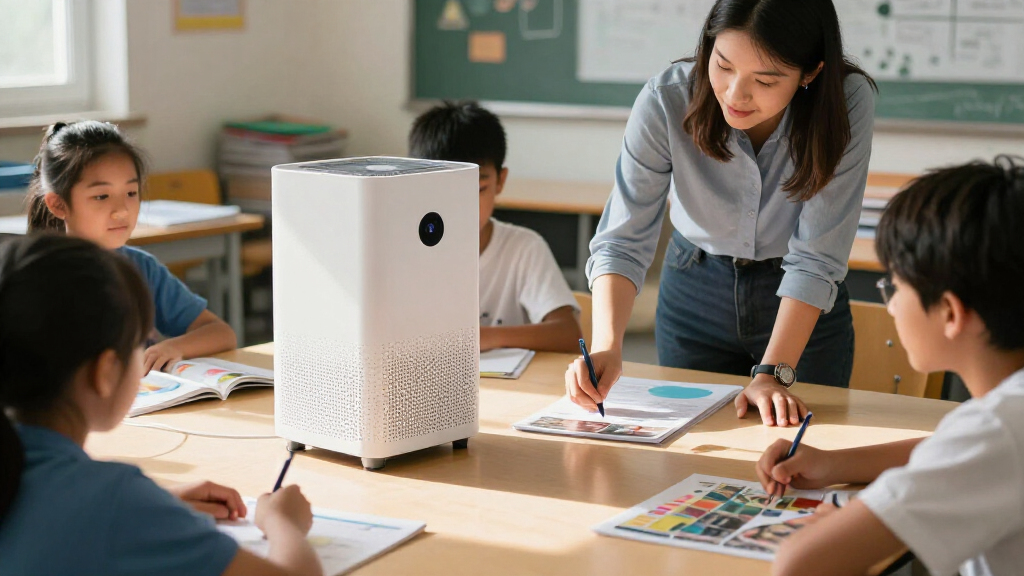
How We Picked
I ranked these classroom air purifiers around the job they need to do in a shared learning space: move enough filtered air for the room, operate without disrupting lessons, and remain practical for staff to run and maintain. I gave weight to clearly stated coverage, particle filtration, useful controls such as particle monitoring and auto mode, and maintenance details such as pre-filter access. A large coverage figure alone was not enough to lead the list, since advertised area can depend on airflow settings and may not reflect repeated air cleaning in a busy classroom.
The DREO 338 leads because its monitor and auto mode give it a more classroom-ready combination of feedback and ease of use than simpler models. Large-room alternatives such as the Dreo Large Room and ECOSELF suit spaces where capacity is the priority, while compact options rank better for small rooms or supplemental use. I also treated product naming and model differences carefully: similar brand names do not guarantee identical controls, capacity, or filter systems. Where comparable independent performance data or operating details are not supplied, I avoid treating marketing claims as direct proof of classroom cleaning results.
Factors to Consider When Choosing Classroom Air Purifiers
Choosing a classroom air purifier starts with the room and the way it is used, not the biggest number on a box. I’d check these factors before deciding whether a large-room tower, a compact unit, or more than one purifier makes sense.
Match Clean-Air Output to the Actual Classroom
Measure the room’s floor area and ceiling height, then account for how many students and adults occupy it and for how long. Coverage figures can describe very different operating conditions, so look for a clean-air delivery rate or a stated air-change target rather than relying on square footage alone. A purifier that reaches a large area only at its loudest setting may be a poor match for instruction time. Open-plan rooms, adjoining spaces, and frequent door opening can also make a single unit less effective than its label suggests. For an unusually large or crowded classroom, ask facilities staff whether several appropriately sized units would distribute filtered air better than one oversized device. Keep ventilation and source control in the plan; a portable purifier is an added layer, not a substitute for fresh air.
Choose Filtration for the Particles You Want to Reduce
For airborne particles, check that the unit uses a clearly described HEPA-grade filter and confirm which filter the exact model takes. Some models combine particle filtration with an activated-carbon layer, which can help with certain odors, but carbon does not make a purifier a general solution for gases or chemical exposure. Do not assume that words such as “H13” or “True HEPA” settle every performance question; the whole unit’s airflow and filter fit matter too. Avoid devices that depend on ozone generation or make broad claims about removing every classroom contaminant. If the school has a specific allergy, smoke, or odor concern, match the filter design to that need and follow relevant health or facilities guidance. Verify replacement-filter availability before choosing a model for regular school use.
Plan for Lesson-Time Noise and Controls
A purifier’s highest fan setting may move more air but can compete with speech, group work, and recorded lessons. Check whether the unit has several fan speeds, a sleep or low-noise setting, and controls that are simple enough for staff to use consistently. Auto mode can reduce manual adjustments, though its behavior depends on the sensor and should not be treated as a substitute for choosing a suitable operating speed. A particle monitor is useful as feedback, but it does not measure every indoor-air concern or guarantee a particular health outcome. Think about where the display and buttons will sit: bright lights or easy-to-reach controls may be distracting in a classroom. If possible, select a unit that can run continuously at a tolerable setting rather than one that is only comfortable when switched off.
Check Filter Upkeep Before Buying for a School
Filter replacement is part of the total ownership burden, even when a unit’s initial setup seems simple. Look up the exact replacement filter, the recommended service interval, and whether staff can change it without tools or special training. A washable pre-filter, such as the feature on the Jafanda JA280, can catch larger lint and dust and may make routine care easier, but it does not mean the main HEPA filter is washable. In a classroom with heavy use, clogged filters can reduce airflow, so a maintenance schedule and a named staff owner are practical necessities. Check whether the unit gives a clear filter reminder and whether that reminder is based on elapsed time or measured use. A model with modest controls but easy-to-source filters may be a better school purchase than one with more features and uncertain replacement supplies.
Place the Unit for Airflow, Safety, and Access
Leave the manufacturer’s required clearance around the intake and outlet; pushing a purifier into a corner or behind a shelf can restrict airflow. Keep cords out of walkways and position the unit where students are less likely to bump it, block it, or tamper with controls. Noise and airflow direction matter too, so avoid aiming a strong outlet directly at desks where it could distract students or move loose papers. A tower may use floor space differently from a compact tabletop model, but compact size does not make it suitable for treating a whole room. Consider cleaning access around the unit, since dust on the intake and nearby floor may require routine attention. If several units are used, spread them through the space in line with facilities guidance rather than clustering them together.
Decide When More Features or More Units Are Worth It
Paying for a monitor, auto mode, or a washable pre-filter makes sense when those features solve a real classroom management problem. They add less value if staff will not check the display, the unit will run at one fixed setting, or replacement parts are difficult to obtain. For a large room, compare the cost and placement of multiple smaller purifiers with one large model, focusing on airflow distribution and tolerable noise rather than unit count alone. For a small tutoring room or reading corner, a compact purifier can be a sensible fit, but avoid assigning it a job beyond its capacity. A more expensive model is justified when it provides useful coverage, manageable sound, and reliable maintenance—not simply a longer feature list. School purchasing teams should also confirm electrical, safety, and maintenance requirements with the relevant facilities staff.
Frequently Asked Questions
Can one classroom air purifier cover a whole classroom?
It can, if the purifier’s clean-air output matches the room’s size, ceiling height, occupancy, and desired air-change rate. Check performance information rather than relying only on a maximum square-foot claim, since those figures can be based on different conditions. A crowded room or an open-plan layout may need more than one unit for useful air distribution. Place units with clear space around their intake and outlet, and follow school facilities guidance. Keep ventilation practices in place alongside filtration.
Is a purifier with a PM2.5 monitor better for a classroom?
A PM2.5 monitor can show changes in fine-particle readings and may help staff see how a unit responds to activity or indoor particle sources. The DREO 338 pairs that feedback with auto mode, which is why it stands out for hands-off operation in this group. A particle reading does not measure all pollutants, and a low reading does not confirm that ventilation is adequate. Sensor placement and calibration can affect what the display shows. Treat the monitor as an aid, not a complete indoor-air assessment.
Should I buy one large purifier or several smaller ones?
That depends on the room layout, the available floor space, and how well air can circulate from one location. One large unit may be simpler to manage, while multiple units can distribute airflow across a long or divided room. Compare their combined clean-air output and noise at the settings staff can realistically use during lessons. Account for the added filter checks and power connections if you choose several units. Facilities staff can help determine placement and electrical suitability.
How much noise is acceptable during lessons?
There is no single setting that works for every classroom, since a quiet reading period and a group activity have different sound needs. Check whether the purifier offers a lower fan speed that can run continuously without competing with speech. The highest setting may provide more airflow but can make teaching harder to hear, so do not judge noise only from a sleep-mode label. If a unit includes auto mode, confirm that fan changes will not be distracting. A steady, tolerable operating level is often more useful than a powerful setting that staff frequently turn off.
Do washable pre-filters mean I will not need replacement filters?
No. A washable pre-filter is generally intended to catch larger debris and protect the main filter; it does not replace the particle filter’s maintenance schedule. The Jafanda JA280 includes a washable pre-filter, but buyers should still verify the main filter type, replacement interval, and availability. Clean washable parts only as the manufacturer directs and let them dry fully before reinstalling. In a classroom, heavy use may make regular inspection more important than the suggested calendar interval alone. Plan for replacement filters as part of ongoing school maintenance.
Conclusion
Best overall: I’d choose the DREO 338 for a classroom that benefits from particle feedback and automatic adjustment. Best for larger rooms: the Dreo Large Room is the more fitting direction when coverage is the priority, though I’d verify its performance at the intended setting. Best value-minded pick: the Levoit Core 300-P makes more sense for a smaller room where a large-room unit would be unnecessary. Best for beginners: the Levoit Core Mini-P offers a simpler, compact route for a desk area or small learning nook, not a whole-classroom solution. Best for specific maintenance needs: consider the Jafanda JA280 if a washable pre-filter is useful to your routine. Match the model to room size, acceptable sound, and filter availability before making the final call.