
Searching for the best telescope can feel overwhelming with so many options available. The ideal pick depends on your experience level, budget, and what you want to observe. The Gskyer 70mm Aperture 400mm AZ Mount stands out as a top choice for beginners, thanks to its ease of use and portability. For more advanced stargazers, the Celestron NexStar 8SE offers powerful optics and computerized tracking, though it comes at a higher price. Many models trade off between simplicity and capability, so understanding your needs is key. Keep reading for a detailed breakdown of the best options and what makes each one unique.
Key Takeaways
- The top picks balance optical quality with ease of use, catering to different skill levels.
- Portable models often sacrifice some aperture size for convenience, making them ideal for travel.
- Computerized and app-controlled telescopes provide better tracking but tend to be more expensive.
- Budget options deliver good initial experiences but may lack long-term versatility.
- Choosing the right mount type (alt-az vs. equatorial) significantly impacts usability depending on the observer’s goals.




More Details on Our Top Picks
Gskyer 70mm Aperture 400mm AZ Mount Astronomical Refracting Telescope for Kids and Beginners – Travel Kit with Carry Bag, Phone Adapter, Wireless Remote
The Gskyer 70mm stands out for its portability and beginner-friendly features, making it an excellent choice for those new to astronomy or looking to take their observations on the go. Compared with the Celestron AstroMaster 70AZ, it offers a more compact, travel-ready setup, with a wireless remote and phone adapter that enhance casual astrophotography. However, its manual focus and limited magnification mean it’s less suited for detailed deep-sky exploration. The included accessories like the Barlow lens and carry bag add value, but the overall image quality and tracking are basic, which might frustrate more serious users. This pick makes the most sense for families and casual stargazers who prioritize mobility and ease of use over advanced features.
Pros:- Highly portable and travel-friendly design
- Includes smartphone adapter and wireless remote for astrophotography
- Fully coated optics provide clear, bright images
- Adjustable tripod enhances viewing stability
Cons:- Limited to basic astronomical observations, not suitable for deep-sky imaging
- Manual focus may require fine-tuning for sharp images
- Magnification depends heavily on accessories, which might need upgrades
Best for: Beginners and kids seeking a portable, easy-to-use telescope for casual astronomy and travel.
Not ideal for: Experienced amateur astronomers or deep-sky enthusiasts who need high magnification and precise tracking.
- Aperture:70mm
- Focal Length:400mm
- Mount Type:AZ Mount
- Eyepieces:Two replaceable
- Barlow Lens:3x
- Finder Scope:5×24
- Magnification:Variable with accessories
- Field of View:5.8 degrees
Bottom line: Ideal for beginners and families who want an affordable, portable telescope for casual star gazing and moon viewing.
Celestron AstroMaster 70AZ Refractor Telescope with Adjustable Tripod and Software
The Celestron AstroMaster 70AZ excels as an entry-level telescope that balances ease of use with decent viewing capabilities. Its 70mm fully coated glass optics provide bright images of the Moon and planets, making it suitable for beginners and kids. Compared to the Gskyer 70mm, it offers a more traditional alt-azimuth mount with an adjustable tripod, which is straightforward but less stable at higher magnifications. Its included software and star pointer make initial setup accessible, but the build quality is basic, and it’s limited to brighter objects, excluding deep-sky targets. The manual mount demands some patience for precise tracking, but overall, it’s a reliable choice for casual daytime and nighttime viewing. It’s best for those just starting out and wanting a versatile, no-fuss telescope.
Pros:- Simple to set up and operate
- Includes astronomy software and red dot finderscope
- Versatile for daytime and nighttime viewing
- Affordable entry-level price
Cons:- Limited to bright objects and moon details
- Basic build quality may affect long-term durability
- Manual mount requires adjustment for stable tracking
Best for: Beginners interested in both terrestrial and lunar observations with easy setup and software support.
Not ideal for: Advanced users or those aiming for astrophotography or deep-sky exploration due to limited mount stability.
- Optics:70mm fully coated glass
- Mount:Alt-azimuth
- Eyepieces:20mm and 10mm
- Finderscope:StarPointer red dot
- Tripod:Adjustable height
- Software:Included astronomy software
Bottom line: A practical choice for beginners seeking an easy-to-use, all-around telescope for casual observing.
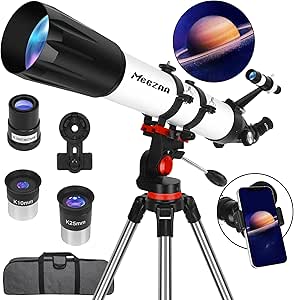
MEEZAA 90mm Aperture 800mm Refractor Telescope for Adults and Beginners
The MEEZAA 90mm offers a notable upgrade in aperture and focal length, making it suitable for both adults and beginners who want brighter, sharper images of the Moon and planets. Its 90mm fully coated lenses outperform smaller models like the Gskyer 70mm in brightness and detail, with a longer 800mm focal length that supports higher magnifications. Compared with the HUGERSTAR 90mm, it provides similar optical quality but with slightly more stable construction and better focusing controls. Its included phone adapter and adjustable tripod make it versatile for casual astrophotography, but the manual focus can be a bit finicky at high magnifications. This is a good choice for those seeking a blend of ease of use and improved image quality, especially for lunar and planetary views.
Pros:- Bright, detailed images thanks to 90mm aperture
- Easy to assemble, typically in under 10 minutes
- Versatile with phone adapter and adjustable tripod
- Good optical quality for the price
Cons:- Manual focus can be challenging at higher magnifications
- Magnification range may be limited for deep-sky objects
- Tripod stability could improve at high zoom levels
Best for: Beginner and casual astronomers who want brighter images and some astrophotography capability.
Not ideal for: Advanced astronomers or deep-sky astrophotographers needing motorized tracking or extensive accessories.
- Aperture:90mm
- Focal Length:800mm
- Magnification:32X-240X
- Eyepieces:10mm and 25mm
- Barlow Lens:3X
- Mount:Altazimuth
- Included Accessories:Phone adapter, carry bag
Bottom line: A solid choice for beginners wanting a brighter, more detailed viewing experience with basic astrophotography options.
HUGERSTAR 90mm Aperture 550mm Refractor Telescope for Adults & Beginners
The HUGERSTAR 90mm combines a compact 550mm focal length with a 90mm aperture, making it a portable yet capable option for beginners and casual astronomers. Its zoom range from 22X to 165X, paired with multiple accessories like a moon filter and phone adapter, offers flexibility for observing both lunar features and planetary details. Compared with the MEEZAA 90mm, it provides a slightly shorter focal length, which can be easier for quick setup and terrestrial viewing. However, its manual focus and tripod stability at high magnifications could limit detailed observations. This telescope suits those who want a lightweight, travel-friendly device with decent optical performance and useful accessories, but it’s not designed for advanced astrophotography or deep-sky work.
Pros:- Bright, clear images with high-quality optics
- Good zoom range for various celestial objects
- Includes moon filter, phone adapter, and carrying bag
- Compact and lightweight for travel
Cons:- Manual focus may need frequent adjustment
- Tripod stability can be an issue at higher magnifications
- Limited to casual astronomy, not advanced imaging
Best for: Beginners and enthusiasts seeking a portable, versatile telescope for daytime and nighttime use.
Not ideal for: Experienced astronomers requiring motorized tracking or high-magnification deep-sky observing.
- Aperture:90mm
- Focal Length:550mm
- Magnification:22X – 165X
- Eyepieces:25mm & 10mm
- Included Accessories:Moon filter, phone adapter, tripod
- Mount:Altazimuth
Bottom line: Perfect for beginners who want a portable, feature-rich telescope for casual star gazing and terrestrial viewing.
High Powered 90mm Aperture Refractor Telescope for Adults and Beginners
This 90mm refractor stands out for its impressive magnification range, reaching up to 450X, making it ideal for detailed lunar and planetary observation. Compared with the MEEZAA 90mm, it offers a more robust tripod and a phone adapter for astrophotography, but it requires some assembly and can be tricky to focus manually for newcomers. The fully multi-coated optics deliver brighter images, and the manual altazimuth mount provides flexible viewing angles. However, its lack of electronic tracking means users need to manually follow objects, which can be challenging at high magnifications. This model is best suited for amateur astronomers who want high detail without the complexity of computerized mounts, but less ideal for those seeking quick setup or automated tracking.
Pros:- High magnification range up to 450X for detailed lunar and planetary views
- Sturdy, adjustable tripod for flexible viewing angles
- Includes phone adapter for easy astrophotography and sharing
Cons:- Requires assembly and setup time, which may frustrate beginners
- Manual focus can be difficult at high magnifications
- No electronic tracking limits ease of object tracking
Best for: Beginners and hobbyists eager to explore detailed lunar and planetary views with the option for astrophotography.
Not ideal for: Those seeking a fully automated telescope with tracking capabilities or quick setup, as this model requires manual operation and assembly.
- Aperture:90 mm
- Focal Length:900 mm
- Magnification:36X-450X
- Eyepieces:25 mm, 10 mm, 6 mm
- Barlow Lens:3x
- Mount:Altazimuth, manual focus
- Tripod Height Range:29 to 46 inches
- Optical Coating:Fully multi-coated
Bottom line: This telescope is a solid choice for serious amateur astronomers wanting high detail and astrophotography capability, but less suited for quick, automated observations.
Celestron NexStar 8SE Computerized Telescope – 8-Inch Schmidt-Cassegrain
The Celestron NexStar 8SE offers a powerful 8-inch Schmidt-Cassegrain optical tube, ideal for serious astronomers interested in detailed lunar, planetary, and deep-sky views. Its fully automated GoTo mount, with a large database of over 40,000 objects, outperforms manual scopes like the High Powered 90mm by drastically reducing setup time and simplifying object location. While its portability is limited due to weight, the quick SkyAlign technology makes it accessible for newcomers willing to learn computerized controls. The higher price reflects its advanced capabilities, making it less suitable for beginners on a tight budget or those who prefer lightweight, manual scopes for casual use. This telescope makes the most sense for users ready to invest in a versatile, high-performance instrument with upgrade potential.
Pros:- Large 8-inch aperture for bright, detailed images
- Fully automated GoTo mount with extensive object database
- Quick and easy SkyAlign setup technology
Cons:- Relatively heavy and less portable for travel
- Requires some learning to operate the computerized system
- Higher price point compared to manual telescopes
Best for: Intermediate to advanced astronomers seeking detailed, deep-sky and planetary observation with automated tracking.
Not ideal for: Beginners or casual stargazers who prefer lightweight, manual telescopes or are not comfortable with computerized controls due to its weight and learning curve.
- Aperture:8 inches
- Optical Design:Schmidt-Cassegrain
- Mount Type:Computerized GoTo
- Object Database:40,000+ objects
- Alignment Technology:SkyAlign
- Warranty:2 years
Bottom line: This scope is perfect for enthusiasts who want high-detail views and automated tracking, but it’s less suitable for casual or portable observing needs.
Odyssey PRO UNISTELLAR Smart Telescope with Eyepiece, 85mm f/3.9, Digital & Computerized, App-Controlled Motorized Alt-Az, RAW/FITS Export, 64GB, 5h Battery
The Odyssey PRO UNISTELLAR combines a compact design with advanced digital features, making it suitable for city and dark-sky observations. Its app-controlled, motorized alt-az mount offers automatic alignment and GoTo capabilities, putting it ahead of more manual models like the 80mm Aperture 600mm Refractor. The extensive 64GB onboard storage and RAW/FITS export options cater to astrophotographers and citizen scientists, but the limited 5-hour battery life can be restrictive for longer sessions. Its reliance on a smartphone or tablet for operation might be a barrier for some users, though it simplifies control and data management. This model suits tech-savvy users who want an all-in-one digital experience, but less so for those seeking a purely standalone telescope with longer autonomy.
Pros:- Easy setup with automatic alignment and app control
- High-quality digital imaging and RAW/FITS export
- Extensive object catalog and citizen science features
Cons:- Battery life limited to around 5 hours
- Requires smartphone or tablet for full functionality
- Higher price due to advanced digital features
Best for: Astrophotographers and citizen science enthusiasts interested in digital imaging and app-controlled operation.
Not ideal for: Users seeking long session autonomy or those uncomfortable with smartphone-dependent operation, due to limited battery life and reliance on external devices.
- Mount:Motorized Alt-Az
- Focal Length:320 mm
- Aperture:85 mm
- F/Number:f/3.9
- Field of View:33.6 × 45 arcmin
- Limiting Magnitude:17.2
- Connectivity:Wi-Fi
- Battery Life:up to 5 hours
Bottom line: Ideal for digitally inclined astronomers wanting integrated astrophotography and citizen science, though limited by shorter battery life.
80mm Aperture 600mm Refracting Telescope with Mount, Phone Adapter, Wireless Control, and Carrying Bag
This 80mm refractor combines portability with ease of use, making it a fitting choice for newcomers and outdoor enthusiasts. The fully multi-coated optics produce bright, clear images of the Moon and planets, comparable to the MEEZAA 90mm but in a more travel-friendly package. Its wireless remote control simplifies operation, and the included phone adapter allows for quick photo captures. Unlike the high-powered 90mm, it offers a more modest magnification range, which limits detailed planetary views but enhances ease of setup and transport. Its lightweight design and tool-free assembly make it perfect for spontaneous outings or beginner stargazing without sacrificing image quality. It’s less suited for advanced astronomers who seek high magnification or extensive deep-sky observation, where larger apertures excel.
Pros:- Portable and easy to assemble without tools
- Includes phone adapter and wireless remote for quick imaging
- Bright, clear images with fully multi-coated optics
Cons:- Limited to beginner and intermediate use, with modest magnification
- Lacks the high aperture for detailed deep-sky viewing
- No detailed weight specification, which could affect portability expectations
Best for: Beginners and outdoor enthusiasts looking for an easy-to-carry, straightforward telescope for casual observing.
Not ideal for: Experienced astronomers requiring high magnification or deep-sky exploration, as its aperture and magnification are limited.
- Aperture:80 mm
- Focal Length:600 mm
- Mount:AZ
- Eyepieces:25 mm, 10 mm
- Magnification:24X-180X with Barlow
- Finder Scope:5×24
- Coatings:Fully Multi-Coated
- Focus Type:Manual
Bottom line: This telescope excels for beginners and outdoor users seeking simple, portable stargazing with decent image quality, but not for advanced deep-sky observing.
MEEZAA 90mm Aperture 550mm Refractor Telescope for Adults & Beginners with Tripod, Phone Adapter, Carry Bag & Moon Filter
This MEEZAA model stands out for its combination of high-quality optics and user-friendly features, making it an ideal choice for newcomers to astronomy. Compared to the Gskyer 70mm, this telescope offers a larger aperture (90mm versus 70mm), translating into brighter, more detailed lunar and planetary views. Its 550mm focal length provides a modest magnification range of 22X to 165X, suitable for casual observing but less ideal for deep-sky exploration. The included accessories, like the phone adapter and moon filter, simplify setup and enhance viewing, especially for family or educational use. However, the manual focus and somewhat limited stability of the tripod may frustrate those seeking more precise or extended observations. This pick makes the most sense for beginners, kids, and casual stargazers who value portability and ease of use over advanced features.
Pros:- Bright, sharp images thanks to multi-coated lenses
- Lightweight, portable design with included carry bag
- Easy setup suitable for beginners and family outings
- Adjustable tripod for comfortable viewing angles
Cons:- Limited magnification range may not satisfy advanced users
- Manual focusing requires some practice
- Tripod stability might be insufficient for detailed observations
Best for: Beginners, kids, and families wanting an easy-to-use, portable telescope for casual astronomy.
Not ideal for: Advanced astronomers or deep-sky enthusiasts who need higher magnification and more stable mounts.
- Aperture:90mm
- Focal Length:550mm
- Eyepieces:25mm & 10mm
- Magnification:22X to 165X
- Mount:Altazimuth
- Focus Type:Manual
Bottom line: This telescope is best suited for beginners and families seeking simple, portable stargazing fun.
Celestron StarSense Explorer DX 5-inch App-Enabled Telescope – 130mm Schmidt-Cassegrain with Smartphone Dock & StarSense App
The Celestron StarSense Explorer DX offers a highly intuitive experience for newcomers, especially those who want to learn the night sky with minimal hassle. Its 130mm Schmidt-Cassegrain optical tube produces sharper, more detailed images than smaller refractors like the Gskyer 70mm, making planetary and lunar views particularly satisfying. Unlike the MEEZAA 90mm, which relies solely on manual operation, this model’s app-guided navigation simplifies locating celestial objects, which can otherwise be a challenge for inexperienced users. The smartphone dock and compatible app mean you don’t need extensive prior knowledge, but the reliance on a phone limits use if your device isn’t charged or compatible. This pick is ideal for beginners eager for guided exploration but less suited for those wanting to pursue astrophotography or deep-sky imaging.
Pros:- Intuitive app-guided navigation simplifies sky locating
- High-quality 130mm optical tube for clear, detailed views
- Includes multiple eyepieces and a full-height tripod
- Smartphone dock compatible with most devices
Cons:- Dependent on smartphone for navigation limits standalone use
- Manual mount may be less stable for precise tracking
- Limited to visual observation, not suitable for astrophotography
Best for: Beginners interested in guided, interactive sky viewing using their smartphones.
Not ideal for: Users without smartphones or those seeking advanced astrophotography capabilities.
- Optical Diameter:130mm
- Optical Type:Schmidt-Cassegrain
- Coatings:StarBright XLT
- Eyepieces Included:10mm and 25mm
- Mount Type:Manual altazimuth
- Compatibility:Android 12+, iOS 18+
Bottom line: This telescope is perfect for beginners who want guided, smartphone-assisted sky exploration without the complexity of advanced setups.
Celestron NexStar 130SLT Computerized Telescope – 130mm Aperture, Portable Newtonian Reflector
The Celestron NexStar 130SLT combines portability with advanced features, making it a compelling choice for those who want more than just manual observation. Its 130mm aperture delivers bright, detailed images comparable to the StarSense Explorer, but with the added benefit of automated object tracking via SkyAlign technology. This makes locating planets, the Moon, and even some deep-sky objects easier than manual telescopes like the Gskyer 70mm or the MEEZAA 90mm. The included Starry Night software enhances the experience, providing interactive sky simulations. However, the need for batteries or an external power source adds some logistical considerations, and the learning curve might be steeper for complete beginners unfamiliar with telescope operation. This model suits those ready to move beyond basic stargazing into more guided, automated viewing.
Pros:- Portable and easy to transport for outdoor use
- Automatic object locating and tracking with SkyAlign
- Bright 130mm aperture for detailed views
- Includes interactive sky software for enhanced learning
Cons:- Requires batteries or external power supply
- Somewhat complex setup for absolute beginners
- Limited to sky objects within its database, not for astrophotography
Best for: Beginners and intermediate users seeking a portable, computer-controlled telescope with automated tracking.
Not ideal for: Those looking for astrophotography or a telescope with a larger aperture for deep-sky imaging.
- Optical Design:Newtonian Reflector
- Aperture:130mm
- Mount Type:Computerized Altazimuth (NexStar+)
- Tripod:Adjustable Steel
- Software Included:Starry Night Basic Edition
- Object Database:Over 4,000 objects
Bottom line: This telescope is ideal for users wanting automated, guided sky viewing with a portable design and solid optical performance.

How We Picked
The selections in this roundup are based on a combination of optical performance, build quality, ease of setup, and value for money. We prioritized models that serve different user levels—from beginners to advanced enthusiasts—and evaluated how well each telescope balances features with affordability. Additional factors included portability, tracking capabilities, and included accessories. Our ranking aims to guide buyers toward options that deliver reliable performance and good durability, avoiding overly complex or cheaply made models that could hinder the viewing experience.Factors to Consider When Choosing Best Telescope
Choosing the best telescope requires understanding several key factors that influence your observing experience. Beyond specs, consider how easy it is to set up, whether the telescope suits your intended targets, and how much maintenance it needs. Making the right choice depends on your goals—whether casual stargazing or detailed planetary observation—and your willingness to invest time and money. Here are some critical aspects to keep in mind:Optical Size and Type
The aperture size determines how much light the telescope gathers, directly affecting image brightness and clarity. Larger apertures reveal fainter objects and finer detail but tend to be bulkier and more expensive. Refractors are typically better for planetary viewing and are easier to maintain, while reflectors often offer larger apertures at lower costs but require occasional collimation. Match your choice to your observing interests and portability needs.
Mount Type and Stability
The mount is the foundation of any telescope. Alt-azimuth mounts are straightforward and intuitive, ideal for beginners or casual use. Equatorial mounts support tracking celestial objects as they move across the sky, which is more complex but essential for astrophotography. A stable, vibration-free mount enhances viewing quality and reduces frustration, especially at higher magnifications.
Ease of Use and Setup
If you’re new to astronomy, look for models with simple assembly and straightforward controls. Computerized or go-to mounts can save time locating objects but add complexity and cost. Consider how much time you’re willing to dedicate to setup and calibration, as this influences your overall enjoyment and whether the telescope feels more like a tool or a toy.
Portability and Size
Think about where you’ll use the telescope most often. Travel-friendly models are lighter and come with carry cases, perfect for outdoor trips or quick setups. Larger, more powerful telescopes tend to be heavier and require more space, making them less ideal for frequent transport but better suited for dedicated viewing spots.
Budget and Long-Term Value
While entry-level models are tempting, investing a bit more can vastly improve your experience and extend the telescope’s longevity. Beware of very cheap options that may lack optical quality or durability. Assess what features are truly necessary for your goals, and consider whether investing in a mid-range or premium model offers better long-term satisfaction.
Frequently Asked Questions
Can I use a beginner telescope for astrophotography?
Most beginner telescopes are not designed for astrophotography, especially those with simple mounts. To capture detailed images, you’ll need a model with a sturdy, motorized mount that supports tracking, and space for a camera attachment. While some entry-level telescopes can support basic smartphone astrophotography, serious imaging typically requires more advanced equipment and experience.
What is the best telescope for a child or beginner?
For young users or absolute beginners, models like the Gskyer 70mm or MEEZAA 90mm refractors offer straightforward setup, manageable size, and good optical performance. These are designed to be easy to operate and durable, making them suitable first telescopes that can foster a lasting interest without overwhelming complexity.
Should I prioritize aperture or features when choosing a telescope?
Aperture size is the most critical factor for image brightness and detail, especially if you want to observe faint deep-sky objects. However, features like computerized tracking and accessories can enhance usability and convenience. For casual observing, a smaller aperture with good features might be preferable, but serious astronomy enthusiasts should lean toward larger apertures for better performance.
How important is the mount type for my observing experience?
The mount significantly affects how easily you can find and track objects. An alt-azimuth mount is simple and good for quick views, while an equatorial mount supports precise tracking, which is essential for detailed planetary observation or astrophotography. Choose based on your interest level—if you’re just starting, a stable alt-azimuth might be best; for more advanced use, investing in a good equatorial mount pays off.
Are computerized telescopes worth the extra cost?
Computerized or go-to telescopes can dramatically reduce the time spent locating objects, especially for beginners or casual observers. They are particularly useful for exploring many objects quickly and for those with limited sky knowledge. However, they tend to be more expensive and require batteries or power sources, so weigh the convenience against your budget and interest in manual astronomy skills.