
TL;DR

Get school and study supplies delivered free — and shop member deals
- Fast, free delivery on millions of items
- Access to Prime Big Deal Days deals on October 6–7
- Prime Video, Amazon Music and more included
Moving your rig into a closet or another room often beats adding foam. Proper placement and ventilation are key. Sealing gaps and using targeted treatments can turn a closet into a quiet, effective space for recording or high-power work.
Imagine a tiny, cluttered closet stuffed with gear. It’s cramped, noisy, but surprisingly useful. The secret isn’t just about stuffing foam everywhere—it’s about where to place your gear, how to dampen sound efficiently, and understanding the magic of the ‘rig in the closet’ setup.
Many folks assume that lining their closet walls with foam will solve all their noise issues. But in reality, the biggest wins come from moving the rig far away from your ears and making sure hot air can escape. Want a quiet workspace? Here’s what you need to know about acoustic dampening, placement, and turning that closet into a sound sanctuary.
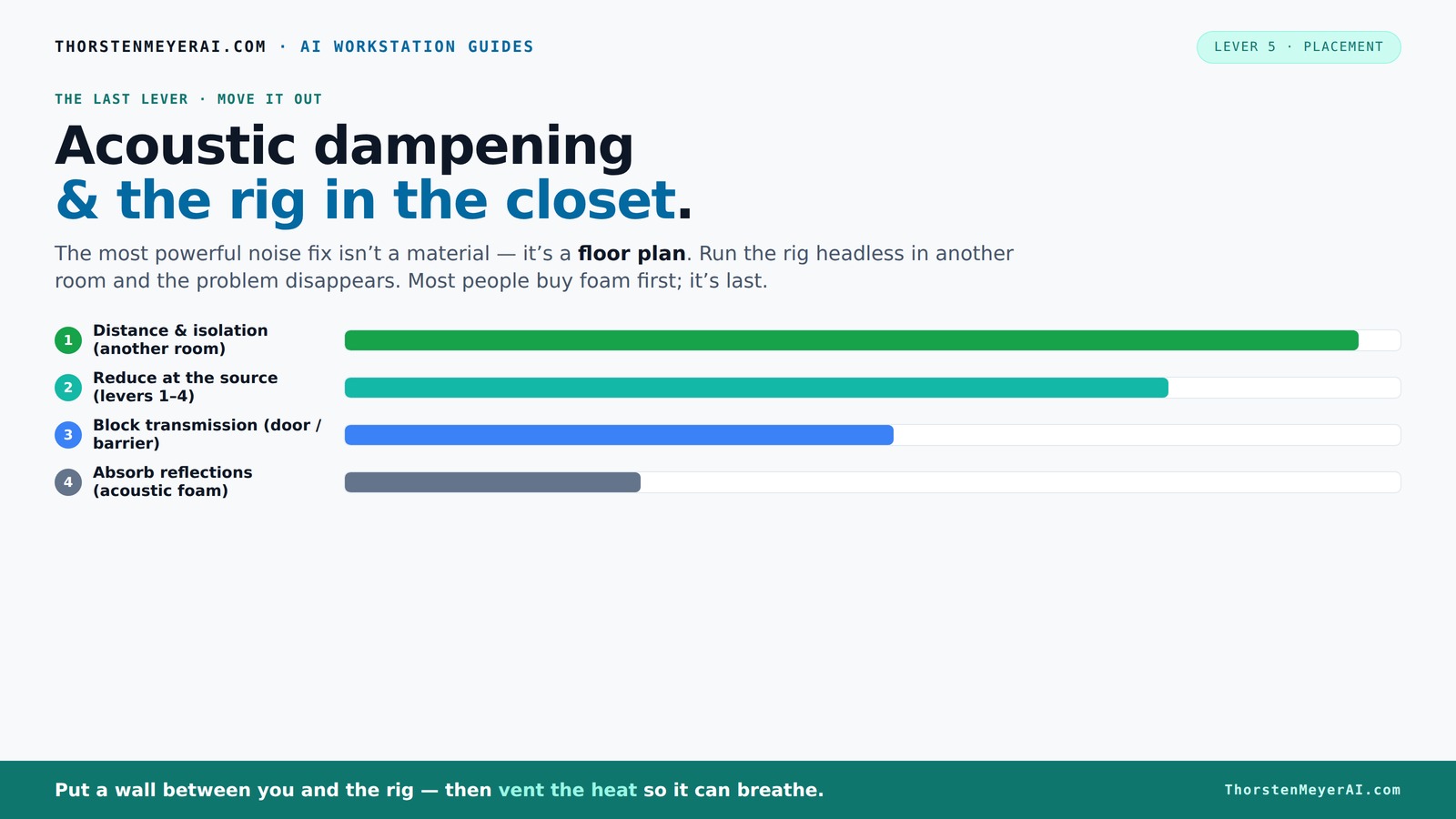
Acoustic dampening
& the rig in the closet.
The most powerful noise fix isn’t a material — it’s a floor plan. A rig you can’t hear because it’s in another room beats any amount of foam. Tap the approaches in Part 1 to see what actually works.
(another room)
(levers 1–4)
(door / barrier)
(acoustic foam)
Contain the noise, not the heat
Key Takeaways
- Moving your rig into another room or closet drastically reduces noise, often more than foam treatments.
- Ventilation is critical in enclosed spaces—without airflow, heat will build and throttle your rig’s performance.
- Targeted acoustic treatment at reflection points boosts sound clarity without overdoing it.
- Sealing gaps around doors, outlets, and vents cuts noise leaks dramatically.
- Balance absorption to avoid dead, unnatural sound—partial coverage with foam or blankets works best.
soundproofing foam panels for recording studio
As an affiliate, we earn on qualifying purchases.
As an affiliate, we earn on qualifying purchases.
Why Distance and Isolation Trump Foam Every Time
The most effective way to quiet your rig isn’t adding more foam—it’s putting space between you and the noise. When sound waves travel, they diminish as they spread out; this is why distance is so powerful. The closer the source, the louder it sounds to you. Moving your setup into a closet or basement creates physical separation, which greatly reduces the perceived volume and unwanted reflections.
This isn’t just about volume reduction—distance also minimizes direct sound pressure on your ears, which can make the noise seem less intrusive. Additionally, isolation prevents vibrations from transmitting through furniture or walls, which can cause echo or amplify certain frequencies. The tradeoff is that you might need to consider ventilation and accessibility, but the sound benefits are often worth it. For network-dependent work, such as SSHing into a high-power AI rig, proximity isn’t necessary—what matters is stable connection and airflow.
A practical example: a researcher moved her GPU tower into the basement, which is far from her main workspace. The result? The noise level at her desk dropped significantly, and her recordings and work environment became more peaceful. This illustrates that strategic placement often yields more dramatic results than extensive foam coverage, which can be costly and less effective in small enclosed spaces.
acoustic isolation pads for speakers
As an affiliate, we earn on qualifying purchases.
As an affiliate, we earn on qualifying purchases.
The 'Rig in the Closet' Setup: How to Make It Work Without Overheating
Placing a high-power rig inside a closet is an attractive idea because it keeps noise contained. However, heat management is the critical factor that can make or break this setup. Without proper ventilation, your rig will trap hot air, leading to thermal throttling, reduced lifespan, and potentially damaging components.
Effective ventilation involves creating a pathway for heat to escape. This can mean installing a vent, using an exhaust fan, or ducting hot air outside. The key is to balance noise reduction with airflow—fans are noisy, so choosing quiet, variable-speed models and integrating them with soundproofing measures is essential. Some advanced solutions include custom soundproof cabinets that incorporate active airflow systems, which use insulated chambers and ducting to minimize noise while maintaining cooling.
Imagine attaching a small, quiet exhaust fan with a thermostat. When the temperature surpasses a safe threshold, the fan activates, venting hot air outside. This prevents heat buildup without adding significant noise, preserving the quiet environment you desire. The tradeoff is initial complexity and cost, but this approach ensures your rig remains cool and silent. For detailed guidance, check out resources like reduce heat and noise in your AI workstation.
As an affiliate, we earn on qualifying purchases.
Targeted Placement of Acoustic Panels for Maximum Impact
Acoustic dampening isn’t about covering every inch of your closet with foam; it’s about strategic placement at the key reflection points where sound bounces and creates echoes. These are the spots where sound waves are most likely to reflect back into your microphone or speakers, causing muddiness and reducing clarity.
Using the mirror trick, you can locate these reflection points effortlessly. Have a friend move a mirror along the surfaces behind your microphone or speakers while you listen or record. Wherever you see the reflection of the sound source, place an acoustic panel there. This targeted approach ensures that sound reflections are absorbed precisely where they originate, making your recordings clearer and more natural.
For example, placing broadband panels at the wall behind your microphone and on side walls near reflection points can significantly reduce harsh echoes. Thicker panels (around 2 inches) are especially effective at absorbing lower frequencies, which tend to resonate in small, enclosed spaces like closets. Proper placement minimizes the need for excessive coverage, saving cost and space while maximizing acoustic benefits.
If you’re in a hurry, moveable foam panels or blankets can be temporarily positioned at these reflection points. Although less permanent, they can still dramatically improve sound quality during critical recordings or sessions.
room acoustic treatment for home studio
As an affiliate, we earn on qualifying purchases.
As an affiliate, we earn on qualifying purchases.
Sealing Gaps and Blocking Sound Leaks—Why It’s Critical
Sound leaks through cracks and gaps are often underestimated but are among the most significant factors undermining your soundproofing efforts. Even tiny openings around the door, outlets, or vents can act like tiny speakers, allowing noise to escape or external noise to infiltrate your space.
Sealing these leaks is crucial because it prevents sound from leaking out and external noise from sneaking in, effectively creating a more controlled environment. Using weatherstripping around the door frame, door sweeps, and outlet gaskets can dramatically reduce sound transmission. These materials are inexpensive but highly effective, especially when combined with other treatments.
For instance, sealing the closet door with weatherstripping and adding a draft stopper can cut noise leakage by over 50%. This simple step makes a noticeable difference in the overall noise level and quality of your environment. Additionally, placing a thick rug or blanket over the door can absorb residual sound and further block leaks. These measures are simple, cost-effective, and essential for achieving a quiet, professional-sounding space.
Are Bass Traps Worth It in a Small Closet?
Bass traps are specialized acoustic panels designed specifically to tame low-frequency buildup, which can cause boomy, muddy, or uneven sound in small spaces. In a tiny closet, bass traps can be valuable if you notice that your recordings have excessive rumble or if you hear flutter echoes that distort low-end clarity.
However, in most small rooms, bass traps are not strictly necessary unless you have significant low-frequency issues. They are most effective when placed in corners, where standing waves tend to form. If you’re experiencing a consistent boomy sound, adding bass traps can help smooth out the low end, resulting in tighter, more balanced recordings.
For example, a home studio in a closet saw a 20% improvement in clarity after installing bass traps in the corners. But if your primary concern is mid and high frequencies, broadband panels and reflection point treatments will be more impactful. Bass traps are a valuable tool but should be used selectively based on your specific acoustic environment.
Learn more about their role in small spaces at bass traps and their role in small spaces.
How Much Absorption Is Too Much? Finding the Sweet Spot
Over-treating a small space with excessive acoustic absorption can make the environment sound unnatural and deaden the natural resonance that gives recordings their liveliness. While it might seem intuitive to cover every surface with foam, this approach can backfire, leading to a dull, echo-free box that hampers your ability to judge sound accurately.
The goal is to achieve a balanced acoustic environment — enough absorption to control harsh reflections and standing waves, but not so much that the space becomes overly dead. Typically, covering around 20–40% of the surfaces with absorption materials strikes this balance. This includes strategically placed panels at reflection points, combined with soft furnishings like rugs or blankets to further diffuse sound.
For instance, lining the walls with thick foam panels and adding a rug or blanket on the door can substantially reduce unwanted reflections while maintaining a natural sound. Regularly test your environment by recording and listening critically—if your recordings sound muffled or lifeless, reduce the amount of treatment. Fine-tuning your setup ensures clarity without sacrificing the natural ambiance.
DIY Fixes vs. Permanent Upgrades — What’s Worth It?
On a budget? Quick fixes like sealing gaps, throwing in a thick blanket, or adding foam panels can significantly improve your space. These methods are inexpensive, portable, and easy to implement, making them ideal for immediate improvements or temporary setups.
For a more permanent solution, consider installing soundproof drywall, adding insulation within walls, or building a custom cabinet with active ventilation. These options involve more time, effort, and cost but provide long-lasting results, especially if you plan to use the space extensively.
For example, sealing all cracks and adding a door gasket can reduce noise leaks by over 50%, providing immediate benefits. Upgrading to a purpose-built soundproof cabinet with active airflow can keep your equipment cool and quiet over the long term but requires upfront investment. The best approach is a combination: start with quick, inexpensive fixes to improve immediate conditions, then gradually upgrade with more permanent solutions as needed.
Common Mistakes That Sabotage Your Closet Soundproofing
Many DIY enthusiasts make simple yet impactful errors that diminish their soundproofing efforts. Leaving gaps around the door, neglecting reflection points, or choosing foam that’s too thin to absorb low frequencies can all undermine your progress. These oversights can result in persistent noise leaks and poor sound quality.
Another common mistake is over-treating the space with foam everywhere. Excessive coverage can deaden the sound unnaturally, making recordings sound muffled or sterile. The key is balance: target reflection points, seal gaps thoroughly, and use absorption materials judiciously.
For example, a hobbyist installed foam panels on all walls but forgot to seal the gaps around the door. The noise continued to leak out, and reflections bounced around, muddying his recordings. When he sealed the gaps and moved panels to reflection points, the sound improved dramatically. Recognizing and correcting these mistakes is essential for a successful soundproofing setup in a small closet.
Frequently Asked Questions
Where should I put acoustic panels in a closet?
Place panels at reflection points—behind the mic, on side walls near the mic, and on the ceiling if reflections bounce downward. Use the mirror trick to find the exact spots for maximum effect.Do I need soundproofing or acoustic treatment?
Soundproofing blocks noise from escaping and entering; acoustic treatment improves sound quality inside the space. In a closet, sealing gaps and adding absorption can do both, but often you need a combination.How many panels do I need?
For small spaces like closets, partial coverage—around 20–40% of surfaces—usually suffices. Focus on reflection points first, then add more if needed based on sound quality.Are bass traps necessary in a closet?
Only if you notice boomy low-end or standing waves. In most small closets, broadband panels and proper placement will handle most issues without bass traps.Will a moving blanket be enough?
Moving blankets help reduce reflections and some bleed, but they’re a stopgap. For serious soundproofing, sealing gaps and targeted absorption deliver better results.Conclusion
Sometimes, the best way to quiet your rig is to hide it where you can’t hear it. A well-placed closet or room, combined with smart ventilation and targeted absorption, transforms noisy equipment into a silent partner in your work or recordings.
Remember: don’t just foam everything. Focus on where sound bounces, seal every crack, and give your heat a way out. That’s how you turn a closet into a quiet, effective workspace — a simple move that makes all the difference.
Halloween Picks
halloween
As an affiliate, we earn on qualifying purchases.