
TL;DR

Prime made for students and young adults
- Fast, free delivery for dorm and study essentials
- Prime Video and Amazon Music included
- Member-only deals
Vesuvius Challenge awarded Liam Warner and Nicola Bodill its $50,000 First Letters Prize for recovering a readable Greek sequence in the Herculaneum scroll PHerc. 306B. Their reading, τὸ δι᾽ αὑτὸ αἱρετόν, is interpreted as “that which is in itself desirable”; the fragment’s broader contents remain unknown.
Two researchers have recovered readable Greek writing from PHerc. 306B, a carbonized scroll buried in the eruption of Mount Vesuvius in AD 79, earning a $50,000 Vesuvius Challenge prize. The reading by Liam Warner and Nicola Bodill is the first reported readable text from this portion of the scroll, which had remained unread since its excavation in the 1750s.
The Vesuvius Challenge said it awarded Warner and Bodill its First Letters Prize after reviewing 25 submissions focused on PHerc. 306. The prize required contestants to identify at least 10 readable characters within a four-square-centimeter area. Several submissions examining the same area came close, identifying sequences of seven, eight or nine characters, the organizers said.
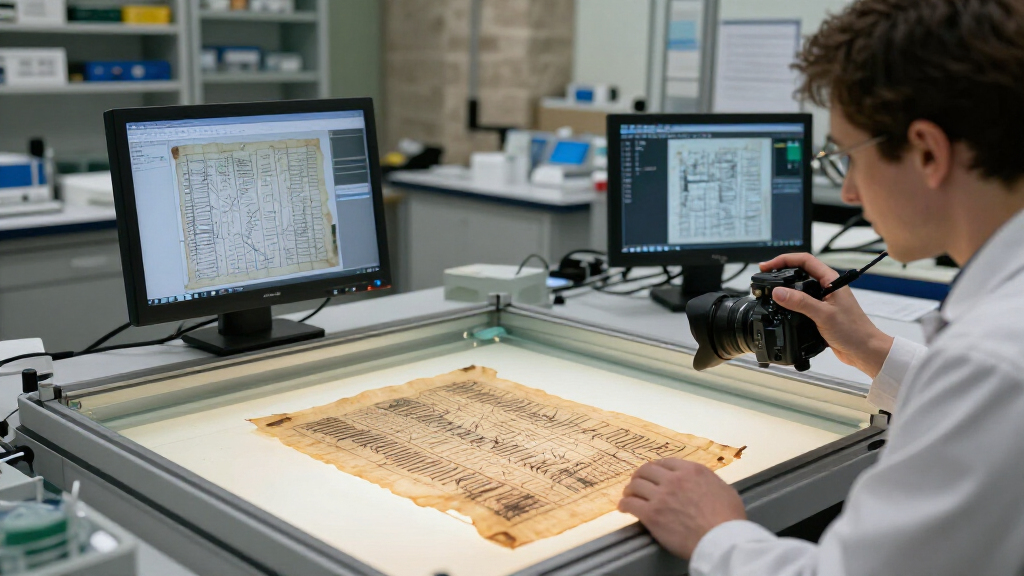
The successful work isolated a papyrus sheet deep within the scroll’s compressed windings using micro-CT scans and virtual analysis. The readable sequence is reported as τὸ δι᾽ αὑτὸ αἱρετόν, which the organizers translate as “that which is in itself desirable.” The team’s papyrology reviewers agreed on the reading of the letters αι after an improved image made a diagonal middle stroke visible.
The scroll is divided into two portions, designated PHerc. 306A and PHerc. 306B. The challenge organizers said the script’s orientation and the identified ink indicate that 306B is the upper section of the original roll and 306A the lower, smaller portion. The roll is held at the Biblioteca Nazionale di Napoli.
A New Route Into a Buried Library
The result shows that the writing in a badly distorted Herculaneum scroll can be recovered without physically opening it, using imaging, computational methods and specialist reading. Carbonized papyrus is fragile, and attempts to unroll such rolls physically can damage or destroy them. A readable sequence therefore offers evidence that non-invasive analysis may help researchers study texts otherwise inaccessible.
The phrase may also provide a clue to the text’s subject. The organizers say it has parallels in philosophical writing by Aristotle, Sextus Empiricus and Philodemus. In an Epicurean setting, they note, the expression would refer to something good and pleasurable in itself. That connection is suggestive, but a short fragment does not identify the work or establish what argument the surrounding passage makes.
Popular right now

LG 55-Inch OLED evo G2 Series 4K Smart TV (OLED55G2PUA, 2022)

Dyson Cyclone V10 Origin Cordless Vacuum

Ninja DualBrew Pro Specialty Coffee Maker, Black, CFP301
As an affiliate, we earn on qualifying purchases.
From Herculaneum Excavation to CT Scans
PHerc. 306 was buried during the AD 79 eruption of Vesuvius and excavated in the 1750s. The intense heat carbonized the papyrus, while pressure and the passage of time left the roll tightly compressed and distorted. Its appearance makes direct reading difficult, and the challenge’s report describes the recovered sheet as lying deep inside the windings.
The Vesuvius Challenge team micro-CT scanned the scroll the year before announcing the prize, with scans taken at the European Synchrotron Radiation Facility in Grenoble. Researchers can use such scans to map the papyrus’s layers and search for ink without unrolling the physical object. The prize marks a step beyond identifying traces: the organizers say the team’s image enabled a reading on which the papyrology reviewers could agree.
“The target was 10 readable characters within a 4 cm² area.”
— Vesuvius Challenge
A Phrase, Not Yet a Full Text
The identified words do not establish which work PHerc. 306B contains, who wrote it, or what the full passage says. The organizers describe the phrase as plausible and cite philosophical parallels, but the available fragment is too limited to settle its broader meaning or attribution. The report also does not provide a complete transcription of the scroll.
Some uncertainty remains in the surrounding traces. Before Warner and Bodill’s image, readers had identified τοδιαυτο, but the letters that followed were too faint for agreement; interpretations included mu or nu. The team reported consensus on αι after the improved image revealed the relevant stroke. Whether further portions will yield continuous text is still unknown.
Scanning the Scroll’s Lower Portion
The discovery makes PHerc. 306A, the smaller portion identified as the lower section of the roll, a more valuable target for scanning and virtual unrolling, according to the Vesuvius Challenge. The source report does not give a timetable for that work or announce a next prize deadline.
Further analysis will need to test whether additional ink can be mapped and read, and whether longer passages can clarify the phrase’s setting. For now, the confirmed development is a short, reviewer-approved reading from PHerc. 306B—not a complete recovery of the scroll.
Key Questions
What was found in PHerc. 306B?
Researchers recovered the Greek sequence τὸ δι᾽ αὑτὸ αἱρετόν, translated by the challenge organizers as “that which is in itself desirable.”
Who read the text?
Liam Warner and Nicola Bodill produced the successful submission, which the Vesuvius Challenge recognized with its $50,000 First Letters Prize.
How was the writing read without opening the scroll?
The team used micro-CT scans and virtual analysis to isolate a papyrus sheet inside the compressed scroll and make traces of ink visible.
No. The organizers cite parallels in philosophical texts, but the short reading does not identify the work, author or full argument.
What is the next step?
The Vesuvius Challenge says PHerc. 306A, the scroll’s lower portion, is now a more valuable candidate for scanning and virtual unrolling. No schedule was announced.
Source: scrollprize.substack.com