
TL;DR

Prime made for students and young adults
- Fast, free delivery for dorm and study essentials
- Prime Video and Amazon Music included
- Member-only deals
Science experiment kits give children hands-on science experiences that boost curiosity and understanding. Picking the right kit depends on safety, age, and educational quality, with trends moving toward STEM integration and sustainability.
Imagine a box filled with colorful liquids, small magnets, and tiny crystals—ready to turn a curious kid into a mini scientist. That’s what a good science experiment kit can do. But not all kits are created equal. Some spark genuine curiosity, while others are just toys with a science label.
The trick is knowing what makes a kit both safe and truly educational. Whether you’re shopping for a gift or looking to boost your child’s science skills, understanding what to look for can make a big difference. Here’s your guide to choosing, using, and understanding science experiment kits for kids.
Choose kits that promote real scientific thinking—predicting, observing, and explaining—rather than just following steps.
Prioritize safety by checking age labels, chemical warnings, and supervision needs before buying.
Look for reusable tools and materials to get lasting value and encourage ongoing experiments.
Stay updated on trends like STEM integration, digital content, and sustainability to keep science exciting.
Engage children actively by asking questions, changing variables, and documenting findings to deepen learning.
How to Pick a Science Kit That Actually Teaches
Not all kits are equal—some just entertain, others educate. The best ones focus on real science. They ask questions, predict outcomes, and explain what’s happening. For example, a chemistry kit that shows how acids and bases react, then explains the molecular changes, turns a simple fizzing reaction into a real learning moment.
Look for kits that include clear explanations, encourage observation, and push kids to record results. Reusable tools like measuring cylinders or microscopes add long-term value. And avoid kits that just follow a step-by-step without explaining why—those are more like fancy toys than educational tools.
Here’s a quick checklist:
- Age-appropriate content
- Clear safety warnings and supervision tips
- Science explanations included
- Room for experimentation and modification
- Tools or materials that can be reused
kids science experiment kits educational
As an affiliate, we earn on qualifying purchases.
As an affiliate, we earn on qualifying purchases.
The Most Popular Types of Science Kits and What They Do
Science kits come in many flavors, each targeting different interests. Let’s look at the most common and what they teach:
| Type | What it Covers | Example Activity | Why It’s Great |
|---|---|---|---|
| Chemistry | Reactions, acids, crystals, polymers | Growing colorful crystals or making slime | Shows cause-and-effect with fun visuals |
| Physics | Forces, motion, magnets, light | Building a simple catapult or exploring reflection | Turns abstract ideas into hands-on play |
| Electronics | Circuits, sensors, coding | Creating a blinking LED circuit | Bridges science and tech skills |
| Biology | Plant growth, anatomy, microscopy | Observing pond water under a microscope | Connects kids to living things around them |
Choosing the right type depends on your child’s interests—do they love gadgets, plants, or explosions? A kit that aligns with their fascination keeps them engaged longer.
As an affiliate, we earn on qualifying purchases.
Trends Shaping Kids’ Science Kits Today
Modern science kits are evolving fast. They’re not just about chemicals or circuits—they’re blending art, coding, and sustainability. For example, some kits teach kids to build robotic arms using recycled materials, or grow plants using solar-powered lights.
Another trend is digital integration. Many kits now include apps or AR (augmented reality) features to explain concepts visually. This digital enhancement can deepen understanding and make abstract ideas more tangible, but it’s important to recognize that over-reliance on screens can sometimes detract from hands-on learning. The best approach balances digital tools with physical experimentation, ensuring kids develop practical skills alongside digital literacy.
Plus, there’s a push toward inclusivity. Kits now feature multilingual instructions, adaptable activities for different learning styles, and designs that encourage participation from all children—regardless of gender or background. This not only broadens access but also fosters a more diverse future generation of scientists.
safe chemistry experiment kits for kids
As an affiliate, we earn on qualifying purchases.
As an affiliate, we earn on qualifying purchases.
How to Choose a Safe and Practical Science Kit
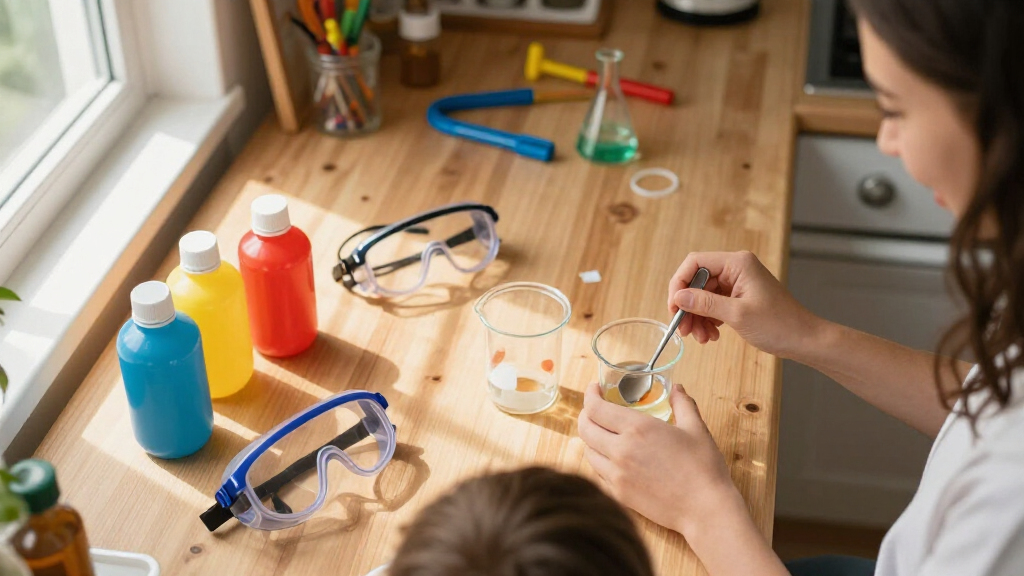
Safety is king when it comes to kids’ science kits. Always check the age recommendations—what’s safe for a 4-year-old isn’t for a 12-year-old. Look for clear warnings about chemicals, magnets, or electrical parts.
For example, a chemistry set that includes acids should specify adult supervision and protective gear. Also, verify that the kit’s materials are non-toxic and that small parts are kept away from younger children to prevent choking.
Beyond safety, consider the practicality of the kit. Does it include durable tools that can withstand repeated use? Are the instructions clear enough for kids to follow independently or with minimal guidance? A practical kit should also be adaptable, encouraging kids to modify experiments or try new variations, which deepens understanding and keeps the activity engaging over time.
Here’s a quick step-by-step:
- Read the age label and safety warnings.
- Check the ingredients and materials list.
- Ensure adult supervision is recommended for hazardous activities.
- Look for customer reviews mentioning safety and build quality.
- Assess whether the included tools are durable and reusable.
reusable science experiment tools for kids
As an affiliate, we earn on qualifying purchases.
As an affiliate, we earn on qualifying purchases.
How to Keep Science Fun and Keep Kids Coming Back for More
The secret isn’t just in the kit but in how you use it. Encourage kids to ask questions. What do they think will happen? Why? Let them make predictions before starting, then see if results match. Celebrate surprises—those often lead to the best learning moments.
Try changing one thing in each experiment: use different materials, alter amounts, or try at different times of day. Document results in a notebook or make a video. This turns a one-time activity into a scientific investigation.
For example, a simple plant-growing experiment can become a series—first with different soil types, then with varied light exposure. It’s about fostering curiosity beyond the original instructions. This approach helps children understand scientific concepts more deeply, develop critical thinking skills, and see experimentation as an ongoing process rather than a one-off task.
Conclusion
Great science kits do more than entertain—they ignite curiosity and develop skills that last a lifetime. When choosing one, focus on safety, educational quality, and your child’s interests. A well-selected kit transforms a simple box into a portal for discovery.
Remember: the real magic happens when kids ask questions and explore. The right kit is just the start—your encouragement makes the science stick.
Halloween Picks
halloween
As an affiliate, we earn on qualifying purchases.