
TL;DR

Prime made for students and young adults
- Fast, free delivery for dorm and study essentials
- Prime Video and Amazon Music included
- Member-only deals
NASA’s KREPE-3 experiment sent 12 instrumented capsules aboard a departing cargo spacecraft to test heat shield materials and designs during its return through Earth’s atmosphere. Researchers expect the capsules to transmit data by satellite, but the source report does not provide results or a schedule for their analysis.
NASA and its partners have sent 12 experimental capsules aboard Northrop Grumman’s 24th cargo resupply mission to test heat shield materials and designs as the spacecraft returns through Earth’s atmosphere. The Kentucky Reentry Probe Experiment 3 (KREPE-3) will use the cargo vehicle’s planned re-entry to collect measurements that may help researchers develop protection for future spacecraft and missions to the Moon, Mars and other destinations.
Astronauts loaded the capsules into the Cygnus XL spacecraft along with station waste and activated them before the vehicle departed the International Space Station. During its planned atmospheric re-entry, the spacecraft is expected to break apart. The capsules will eject and measure conditions including temperature, pressure, motion, magnetic field and light. NASA says satellite signals will relay data to researchers during the experiment.
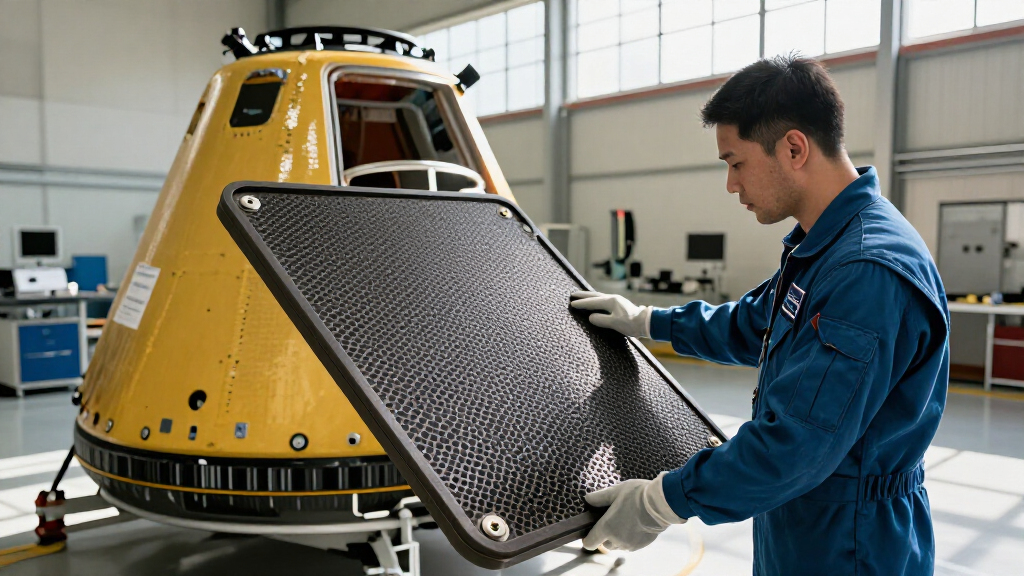
The test includes both established and developmental technologies. One capsule will carry a 3D-printed heat shield developed through a NASA Johnson Space Center and Oak Ridge National Laboratory project. Two will test NASA Ames’s MERINO material, made from layers of carbon and phenolic fibers stitched together. NASA describes it as a flexible covering that is quicker and less expensive to produce than traditional protective materials; its suitability for future missions remains a matter for testing.
Other capsules will examine designs as well as materials. These include a dual-cone vehicle intended to help compare computer models with flight measurements, a shape modeled on the aeroshell planned for the Dragonfly mission to Saturn’s moon Titan, and an umbrella-like deployable shield. Additional capsules from domestic and international partners will test other materials and instrumentation, including a heat-flux sensor developed at the University of Stuttgart.
Flight Data for Future Heat Shields
Spacecraft returning from the Moon, Mars or other destinations encounter intense heating as they pass through an atmosphere. The protective system has to manage that heat while meeting constraints on mass, size and construction. The performance of a material in a laboratory does not by itself establish how it will behave in an actual re-entry, so measurements from flight tests can help researchers check designs under real conditions.
KREPE-3 also makes use of a cargo vehicle already scheduled to return from the station. NASA materials engineer Keith Peterson said this provides a way to obtain flight data on materials still in development. Using small capsules can let teams test several concepts in one experiment, though the source does not report costs or compare the approach’s price with other flight testing.
The results could inform work on future cargo or crew protection, but the experiment does not itself establish that any tested material is ready for operational missions. Researchers will need to interpret the data and assess each design’s performance before it can be considered for a specific spacecraft.
heat shield materials for spacecraft
As an affiliate, we earn on qualifying purchases.
As an affiliate, we earn on qualifying purchases.
A Third KREPE Flight Test
KREPE-3 is the third experiment in a series of low-cost re-entry tests. The collaboration includes the University of Kentucky, the state of Kentucky, NASA’s Established Program to Stimulate Competitive Research, several NASA centers, and federal and commercial partners. University of Kentucky students designed the capsules, which carry instruments as well as thermal protection samples.
The tested technologies serve different purposes. NASA says the thinner atmosphere on Mars permits lower heat loads than some other re-entry settings, which can make lighter protection possible. The MERINO coverings are being considered in that context. By contrast, the Dragonfly-shaped capsule is meant to test the stability of an aeroshell design associated with a mission to Titan. A separate capsule will evaluate an umbrella-shaped deployable shield, which could expand during flight to increase surface area and slow descent.
Some capsules carry materials with flight heritage. The source identifies Phenolic Impregnated Carbon Ablator, or PICA, as a NASA Ames-developed material that flew on Stardust, Mars Science Laboratory and Mars 2020. KREPE-3 also includes ceramic tile material of the type used on the space shuttle, alongside newer concepts. The mix allows the experiment to gather data across different approaches rather than test a single proposed shield.
As an affiliate, we earn on qualifying purchases.
Results Await Capsule Data
The source report describes the planned measurements and the materials aboard but does not provide re-entry results, capsule-by-capsule performance, or confirmation that every capsule transmitted usable data. It also does not give a date for completion of data collection or publication of findings.
It remains unclear how the tested technologies will compare with one another under flight conditions, how closely the results will match laboratory tests or computer models, and which materials or shapes may advance to later testing. The report presents potential applications for future missions, not selections or approvals for operational spacecraft.
thermal protection system for space missions
As an affiliate, we earn on qualifying purchases.
As an affiliate, we earn on qualifying purchases.
Researchers Will Review Re-entry Measurements
During the planned return, the capsules are expected to collect measurements and send them to researchers by satellite. NASA and its partners will then need to examine the flight data, including how the different materials and geometries performed and whether measurements can help validate computer models.
The NASA report does not specify a timetable for analysis, a release date for results, or a follow-on flight. Any decision to use a tested material in a future mission would require further evaluation and mission-specific development. The next public milestone is expected to be information from the re-entry and subsequent analysis, but NASA has not stated when that information will be available.
As an affiliate, we earn on qualifying purchases.
Key Questions
What is NASA testing in KREPE-3?
The experiment is testing heat shield materials, shapes and sensors in 12 small capsules. The capsules include established materials and newer concepts, including MERINO coverings and a 3D-printed shield.
How will the capsules collect data?
They are designed to eject from the Cygnus XL cargo spacecraft during its planned atmospheric re-entry. Sensors will measure temperature, pressure, motion, magnetic field and light, with data expected to be sent to researchers by satellite.
Does the experiment prove a new heat shield is ready for a mission?
No. KREPE-3 is a flight test intended to gather measurements. NASA has not reported results or said that any tested material has been approved for operational use.
Why use a cargo spacecraft that is returning from the station?
The Cygnus XL is already scheduled to return to Earth and break apart during re-entry. NASA materials engineer Keith Peterson said the experiment uses that return as an opportunity to collect flight data.
When will NASA publish the results?
The source report does not provide a timetable for data analysis or publication. It says the capsules are expected to transmit data during re-entry, but the results and their release date are not yet stated.
Source: primary
Halloween Picks
halloween
As an affiliate, we earn on qualifying purchases.