Watts tell you how much power a device uses at any moment, while watt-hours show the total energy consumed over time. To plan backup power, you need to know both: watts help size devices, and watt-hours tell you how long they can run during an outage. Focusing on watt-hours guarantees your system provides enough energy when you need it most. Keep going to uncover how to balance these for effective backup solutions.
Key Takeaways
- Watts measure the instant power output, while watt-hours indicate total energy generated or consumed over time.
- To determine backup needs, multiply device wattage by usage hours to find required watt-hours.
- Battery capacity should exceed daily watt-hour needs for reliable backup during poor sunlight or outages.
- Efficient solar panels produce more watt-hours per size, affecting total energy available for backup.
- Proper backup planning balances wattage, watt-hours, efficiency, and storage to ensure sufficient power duration.
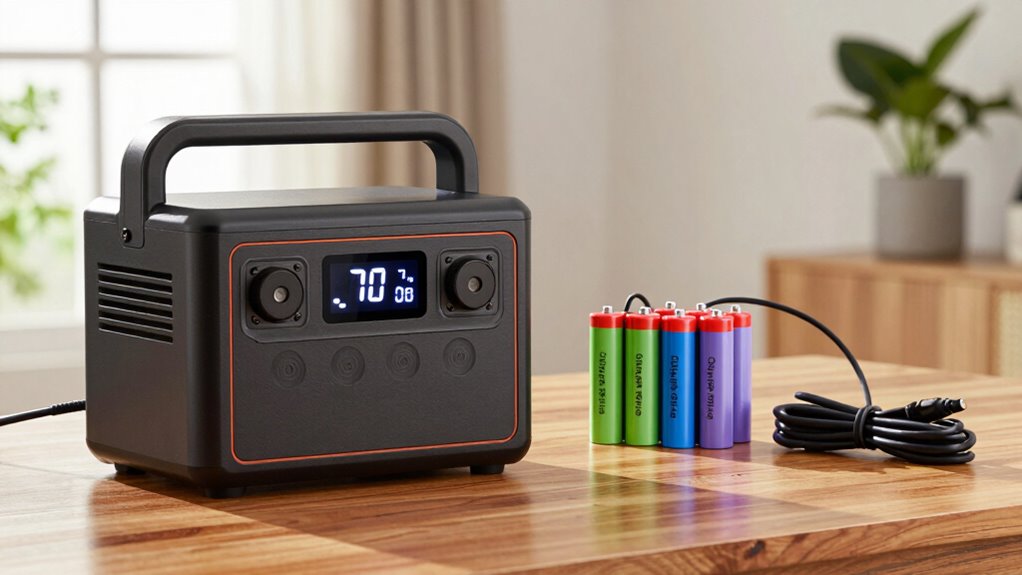
Understanding the difference between watts and watt-hours is essential when dealing with electrical devices and energy usage. Watts measure the rate at which electricity is used or produced, while watt-hours quantify the total amount of energy consumed or stored over time. This distinction becomes especially important when you’re planning backup power solutions or evaluating solar panel efficiency and battery capacity measurement. When you look at a solar panel’s wattage, you’re seeing its power output, which indicates how much energy it can generate at any given moment. However, to understand how much energy it can produce over a day or a specific period, you need to consider watt-hours, which factor in the panel’s efficiency and sunlight exposure.
Imagine you’re evaluating a solar panel for backup power; knowing its wattage alone isn’t enough. You need to understand the solar panel efficiency, which determines how well it converts sunlight into usable electricity. A panel with high efficiency will produce more energy in less space, meaning you’ll get more watt-hours from the same panel compared to a less efficient one. This directly impacts your ability to store sufficient backup power, especially if you’re relying on battery capacity measurement to determine how long your system can run during outages.
High-efficiency panels produce more watt-hours, maximizing backup power and battery storage during outages.
When planning your backup power setup, focus on matching the solar panel’s output with your battery capacity measurement. If your panel can generate 300 watts under ideal conditions and the sunlight lasts for about 5 hours, you’ll produce roughly 1,500 watt-hours of energy that day. But remember, real-world factors like shading, weather, and panel orientation can reduce this output, so factoring in solar panel efficiency ensures your estimates are realistic. Additionally, understanding solar panel efficiency helps you select the most suitable panels for your space and energy goals. Recognizing the impact of weather conditions on solar energy production allows you to set more accurate expectations for your system’s performance.
Similarly, selecting a battery with a capacity that exceeds your daily energy needs provides a buffer, so you’re not left in the dark if conditions aren’t perfect. Being aware of energy storage capacity and how it influences your backup system’s performance can help prevent underestimating your needs and ensures you have enough stored energy for longer outages. In short, understanding watts versus watt-hours helps you make smarter decisions in backup power planning. It allows you to evaluate how much energy your solar panels can produce and how long your batteries can sustain your devices. This knowledge ensures you’re not just chasing high wattage numbers but aligning your system’s actual energy capacity with your everyday needs. By paying attention to solar panel efficiency and battery capacity measurement, you’ll be better equipped to design a reliable, efficient backup power system that keeps you powered during outages.

Renogy Solar Panels 200 Watt N-Type, 200W Solar Panel 16BB 25% High-Efficiency Solar Cell for 12V/24V Systems,PV Module Power Charger for Class B Van RV Marine Cabin Roof Home Farm
【Perfect Size for Class B Vans】This 200W N-Type solar panels are 7.5% smaller and 11.7% lighter than previous…
As an affiliate, we earn on qualifying purchases.
As an affiliate, we earn on qualifying purchases.
Frequently Asked Questions
How Do I Convert Watt-Hours to Joules?
To convert watt-hours to joules, you use the basic energy units conversion method. Since 1 watt-hour equals 3,600 joules, you simply multiply the number of watt-hours by 3,600. For example, if you have 5 watt-hours, multiply 5 by 3,600, giving you 18,000 joules. This straightforward conversion helps you switch between energy units easily for various calculations and applications.
Can Watt-Hours Measure Power Consumption Over Time?
Imagine revealing the secret to understanding your home’s energy flow—you can measure power consumption over time with watt-hours. Yes, watt-hours gauge how much energy you’ve used, reflecting your power efficiency and energy storage needs. This measurement helps you see how your devices drain energy, allowing you to optimize usage and extend backup power. By tracking watt-hours, you gain control and peace of mind over your energy management.
Is a Higher Wattage Always Better for Backup Power?
A higher wattage isn’t always better for backup power because it doesn’t guarantee better energy efficiency or power reliability. Instead, focus on matching the wattage to your device’s needs to ensure efficient use of energy and consistent performance. Overestimating wattage can lead to wasted energy, while underestimating may compromise power reliability. Choose a backup power source that provides sufficient wattage without excess, ensuring maximum efficiency and dependable backup during outages.
How Do I Determine the Right Backup Power Size?
Think of sizing your backup power like packing a backpack—only bring what you need. To do this, determine your essential devices’ wattage, then multiply by their runtime to find the required watt-hours. Check your battery capacity to guarantee it can handle this load, and prioritize power efficiency to maximize runtime. This way, you get just enough backup power without overloading your system or wasting energy.
Do Watt and Watt-Hour Ratings Affect Battery Lifespan?
Watt and watt-hour ratings do influence battery lifespan, as they relate to battery chemistry and power efficiency. Higher watt ratings can generate more heat, potentially reducing lifespan if not managed properly. Watt-hours indicate capacity, affecting how often you need to recharge, which impacts battery wear over time. Choosing batteries with good chemistry and optimized power efficiency helps extend lifespan by reducing stress and heat buildup during use.

Weize Deep Cycle AGM 12 Volt 100Ah Battery, Maintenance-Free, 3% Self-Discharge Rate, 1150A Max Discharge Current, Perfect for RV, Solar, Trolling Motor, Wind, Marine, Camping and Off-Grid System
MAINTENANCE FREE: 12.99x 6.73x 8.43 inches. Weize 12v 100Ah sealed lead acid battery is manufactured with absorbent glass…
As an affiliate, we earn on qualifying purchases.
As an affiliate, we earn on qualifying purchases.
Conclusion
Understanding watts versus watt-hours helps you choose the right backup power solution. For example, if your fridge uses 100 watts and runs for 10 hours during an outage, you’ll need a battery with at least 1,000 watt-hours. By grasping this difference, you make certain your devices stay powered when it matters most. So, next time you plan your backup system, remember: watts tell you how much power you need at once, and watt-hours reveal how long it lasts.

Jackery Portable Power Station Explorer 300, 292Wh Backup LiFePO4 Battery, Solar Generator for Outdoors Camping Travel Hunting Blackout (Solar Panel Optional)
Ultra-Lightweight: At only 7.5 lbs, the Explorer 300 delivers a robust 292Wh capacity while remaining 17% lighter than…
As an affiliate, we earn on qualifying purchases.
As an affiliate, we earn on qualifying purchases.

Amp Watt Meter Power Analyzer For Solar Panels Or Wind Turbines System, 150A 200A Aircraft Power Meter Tester Backlight Digital LCD Screen for RC Solar Voltage Current Power (200A)
Comprehensive Measurement Capabilities: This multi-functional watt meter power analyzer accurately measures voltage, current (amp meter), power, discharge capacity,…
As an affiliate, we earn on qualifying purchases.
As an affiliate, we earn on qualifying purchases.