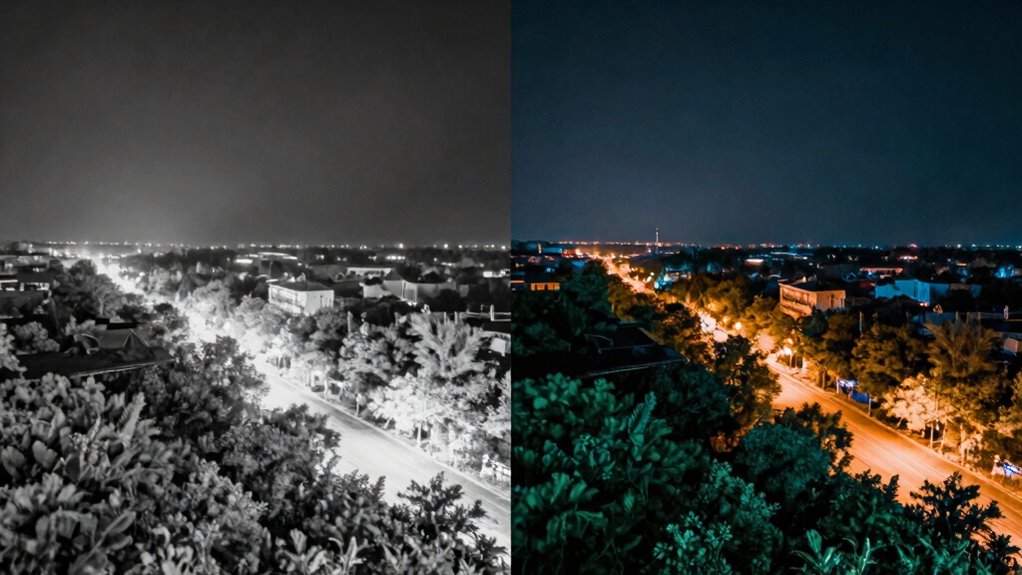

IR night vision uses infrared light to create monochrome images in complete darkness, making it ideal for stealth or wildlife observation. Color night vision, on the other hand, enhances ambient light to produce clearer, color-rich images, even in low-light conditions. IR is best in total darkness, while color vision excels with some natural light. If you want to understand which suits your needs better and explore the differences further, there’s more to discover below.
Key Takeaways
- IR night vision uses infrared light for monochrome images in complete darkness, ideal for stealth and wildlife observation.
- Color night vision provides natural, detailed images by amplifying ambient light, suitable for object identification and surveillance.
- IR devices rely on IR illumination in total darkness, while color night vision works best with some natural light or additional IR support.
- IR night vision images are green-tinted, lacking color detail, whereas color night vision displays realistic, full-color images.
- Choice depends on the environment; IR is better for total darkness and stealth, while color night vision offers clearer, more natural visuals in low-light conditions.

Have you ever wondered how some devices help you see clearly in the dark? It all comes down to the technology they use. When it comes to night vision, two main types stand out: infrared (IR) night vision and color night vision. Each has its unique way of helping you see in low-light conditions, and understanding how they work can make a big difference in choosing the right device.
Infrared illumination plays a vital role in IR night vision. These devices use infrared light, which is invisible to the naked eye, to illuminate the scene. An IR illuminator emits this infrared light, bouncing off objects and returning to the device’s sensor. This process creates a monochrome, often green-tinted image, allowing you to see in complete darkness. Because IR illumination is invisible, it doesn’t alert others to your presence, making it ideal for covert operations or wildlife observation. The technology relies heavily on the infrared spectrum, making it highly effective in total darkness or low-light conditions where natural light isn’t available.
On the other hand, color night vision aims to replicate how you see during the day. These devices employ advanced image intensification technology combined with color enhancement features. Unlike IR night vision, they do not necessarily need infrared illumination because they amplify ambient light, including moonlight or starlight. The key to their visual appeal is color enhancement, which provides a more natural, detailed view of the environment. With color night vision, you can distinguish between different objects more easily, such as identifying a friend from a stranger or spotting the color of a vehicle from a distance. This makes them particularly useful for surveillance, navigation, or any activity where color detail matters. However, in pitch-black conditions where no ambient light exists, color night vision devices might rely on added infrared illumination to improve visibility, blending elements of both technologies. Additionally, advancements in night vision technology continue to improve their clarity and effectiveness in various lighting conditions.
While IR night vision excels in darkness due to its reliance on infrared illumination, color night vision offers a more realistic view, which can be essential for certain applications. If you need to operate in complete darkness and prioritize stealth, IR night vision is often the better choice. Conversely, if you want to navigate or identify objects in low-light environments with more clarity, color night vision with enhanced color capabilities will serve you better. Both types have their advantages, and understanding their differences helps you pick the right device for your needs. Whether you’re hunting, security monitoring, or exploring wildlife, knowing how infrared illumination and color enhancement work will guarantee you make an informed decision and see clearly, no matter how dark it gets.
Frequently Asked Questions
Can IR Night Vision Work in Complete Darkness?
Yes, IR night vision can work in complete darkness because it uses infrared illumination to enhance your vision. When there’s no ambient light, the device emits infrared light, which is invisible to the naked eye but helps your night vision system detect and display images. This infrared illumination provides night vision enhancement, allowing you to see clearly even in total darkness. Just guarantee your IR illuminator is functioning properly for ideal results.
Do Color Night Vision Devices Require More Power?
Think of color night vision devices as power-hungry beasts—they typically require more power than IR devices. This increased power consumption can markedly shorten your device’s battery life, especially during extended use. So, if you’re out all night, a color device might leave you stranded sooner. To keep going longer, you’ll need batteries with more capacity or carry spares, because your device’s power demands are definitely higher.
Are IR Night Vision Devices Legal Everywhere?
IR night vision devices aren’t legal everywhere, so you should check local laws first. Some regions have legal restrictions due to privacy concerns, especially if used for surveillance or intrusive observation. Using IR devices where prohibited can lead to fines or legal trouble. Always verify you’re compliant with regulations in your area before operating IR night vision gear, respecting others’ privacy and avoiding unnecessary legal issues.
How Do Weather Conditions Affect Night Vision Performance?
Weather impact can really influence your night vision experience. Fog interference softens your view, making it harder to spot details, while rain or snow can cause glare or distortions. These conditions reduce clarity, so you might find yourself needing to rely more on other senses or alternative lighting. Keep in mind, staying aware of weather changes helps you adapt and get the most out of your night vision gear.
Can I Switch Between IR and Color Night Vision Easily?
You can usually switch between IR and color night vision easily, but it depends on your device compatibility and user interface. Many modern night vision devices have a simple mode toggle or settings menu that lets you switch seamlessly. Check your device’s manual or settings to verify this feature is available. Once you’re familiar with the interface, switching becomes quick and straightforward, giving you flexibility in various lighting conditions.
Conclusion
Now that you know the basics of IR and color night vision, you can confidently choose the camera that caters to your needs. Whether you prefer the clarity of color or the stealth of IR, understanding their differences helps you decide wisely. Remember, your choice depends on what you want to see and how you want to see it. So, make your move, master the mystery, and enjoy the marvelous world of night vision!