
TL;DR

Get school and study supplies delivered free — and shop member deals
- Fast, free delivery on millions of items
- Access to Prime Big Deal Days deals on October 6–7
- Prime Video, Amazon Music and more included
NASA’s Curiosity rover spotted blocks covered or possibly filled with small disc-shaped features during its Sept. 18, 2026, planning period. The team selected a nearby drill target for a planned contact-science assessment and, if checks go well, a drilling attempt; the minerals’ identities and the features’ origins remain unconfirmed.
NASA’s Curiosity rover team selected a rock for a planned drilling attempt after the rover encountered blocks marked by small, disc-shaped features during its Sept. 18, 2026, planning period. The observations may help researchers investigate how minerals formed in this part of Mars, but the features’ composition and origin have not yet been established; the team said drilling would depend on preliminary checks.
The rover had been working among finely layered bedrock in a sulfate-rich unit when the team encountered blocks with a jumble of small discs, which appear to cover and may also fill the rock. NASA planetary scientist Lucy Lim wrote that the texture was a change from the recent workspaces. The team planned Mastcam and MAHLI images to document the shapes, along with chemical measurements using ChemCam’s laser-induced breakdown spectroscopy (LIBS) and the APXS instrument.
Lim described two possible explanations: the discs could reflect the growth form of a particular crystalline mineral, or they could be fragments of a harder rock layer that broke apart and accumulated. Similar-looking features have been seen earlier in Curiosity’s mission near Pahrump Hills, in the Murray mudstones, and in some terrestrial rocks where minerals precipitate from evaporating fluids. Those comparisons are possibilities, not a confirmed explanation for the Mars rocks.
The team drove to a promising drill workspace beyond the disc-feature blocks and chose a specific target. The plan called for arm-mounted contact science and a short drive to bring the rock within reach; a preload test and drilling were conditional on those steps going well. Lim said Curiosity needs data from its CheMin X-ray diffraction instrument to identify minerals, which requires a drill campaign. This would be the rover’s first drill site above the erosional supersurface and its first drilling opportunity since Campo Marte, more than a kilometer earlier along the route.
Why the Drill Target Matters
Images and remote chemical measurements can characterize a rock, but the planned drill could provide a powdered sample for CheMin’s X-ray diffraction analysis. That instrument can help identify minerals, giving scientists a more direct way to test whether the disc-like texture relates to crystal growth or to broken-up rock fragments. The distinction matters because minerals and their arrangement can preserve clues about the conditions in which rocks formed.
The target also extends Curiosity’s investigation into terrain above the erosional supersurface. Results could add evidence about how the newer rocks formed and how the landscape changed, although the blog does not report results from a completed drill or mineral analysis. The immediate news is the selection and planned evaluation of a target, not a confirmed discovery of a particular mineral.
As an affiliate, we earn on qualifying purchases.
From Disc-Shaped Rocks to Drilling
The update covers planning for sols 5016–5021, with an Earth planning date of Friday, Sept. 18, 2026. Curiosity had been examining layered bedrock in the sulfate unit before the team noticed the different texture. NASA’s Sept. 30 blog post, written by Lucy Lim, a planetary scientist at Goddard Space Flight Center, describes the observations and planned rover activities rather than reporting a completed analysis.
Alongside work on the unusual blocks, the rover continued long-distance imaging of buttes on both sides of Valle Grande. ChemCam’s remote imager and Mastcam mosaics were planned to show exposed layers and sedimentary structures in terrain ahead, as well as erosional deposits that may help the team understand how Valle Grande formed. These observations provide geological context for the rover’s route but do not determine the disc-shaped features’ composition.
“The disc-like shapes could be created by the growth habits of a specific crystalline mineral … or they could be bits of a harder rock layer that broke up and collected here.”
— Lucy Lim
As an affiliate, we earn on qualifying purchases.
Mineral Identity Still Unconfirmed
The NASA update does not report that Curiosity completed the contact-science checks, passed a preload test, or drilled the selected rock. Whether drilling took place and what CheMin found are not stated in the source. The team’s plan was conditional, so the selected target should not be treated as a successful drill or a returned mineral identification.
The origin of the discs is also unresolved. Their resemblance to crystal growth forms or to broken pieces of harder rock offers working explanations, not a finding. The blog does not provide chemical results for the disc-feature blocks or establish whether those blocks and the selected drill target are the same material; the target is described as a promising workspace a little beyond the features.
As an affiliate, we earn on qualifying purchases.
Contact Checks Before Drilling
The next planned step was Drill Sol 1: triage contact science, using Curiosity’s arm instruments to assess the chosen target. The team planned a short drive to position the rock within arm range, followed by contact observations and, if conditions permitted, a preload test and drilling. Lim said she would return to planning on Monday as the Geology and Mineralogy Science Theme Lead. The source does not give a confirmed date for any drilling or for the release of subsequent analysis.
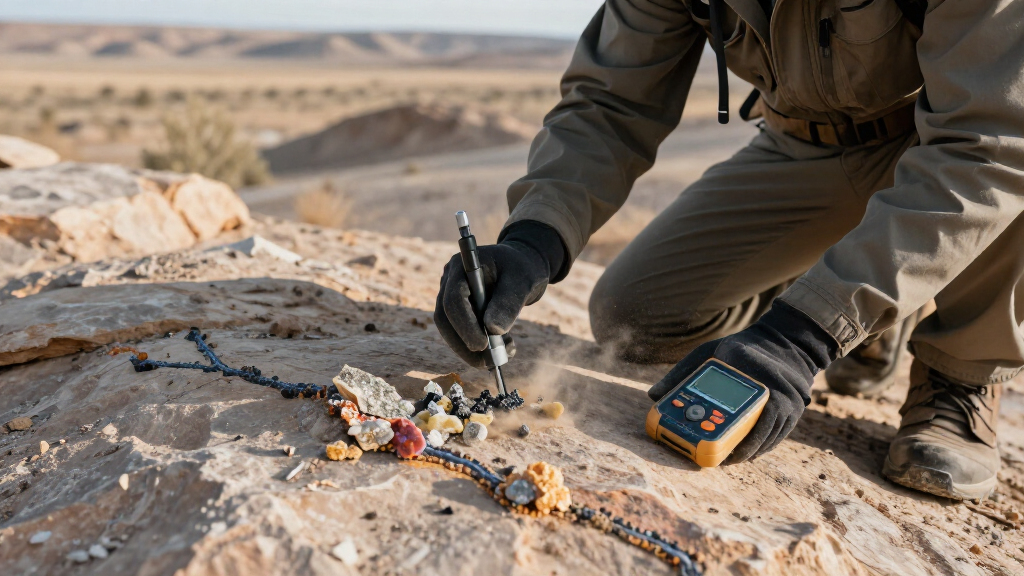
geology tools for mineral detection
As an affiliate, we earn on qualifying purchases.
As an affiliate, we earn on qualifying purchases.
Key Questions
What did Curiosity find?
The rover encountered blocks covered, and possibly filled, with small disc-shaped features in a change from the finely layered bedrock in its recent workspaces.
What might have made the disc-shaped features?
NASA’s team offered two possibilities: crystal growth that produces disc-like shapes, or fragments of a harder rock layer that broke apart and accumulated. Neither explanation is confirmed.
Why does Curiosity need to drill?
Drilling would let the rover supply a sample to CheMin, its X-ray diffraction instrument, which the team says it needs to identify minerals.
Did Curiosity drill the selected rock?
The blog reports that the team selected a target and planned contact science, a preload test and drilling if the checks went well. It does not confirm that drilling occurred.
Where is the planned drill site in the mission’s geology?
NASA described it as Curiosity’s first drill site above the erosional supersurface, and said the rover had traveled more than a kilometer since its previous drill site at Campo Marte.
Source: primary
Fall Picks
fall essentials
As an affiliate, we earn on qualifying purchases.