Choosing the right reverse osmosis water filtration system under sink requires balancing flow rate, waste ratio, and maintenance complexity. My top pick, the Waterdrop G3P600, stands out for its tankless design and high flow rate, making it ideal for households that prioritize speed and hygiene. For those seeking a classic, budget-friendly option, the iSpring RCC7-BN offers reliable multi-stage filtration without the premium price tag. Readers must weigh the tradeoff between traditional tank-based systems, which require storage space but offer lower upfront costs, versus modern tankless units that save cabinet room but demand higher water pressure. Continue reading to discover which model aligns best with your specific plumbing setup and filtration needs.

Prime made for students and young adults
- Fast, free delivery for dorm and study essentials
- Prime Video and Amazon Music included
- Member-only deals
Key Takeaways
- Tankless systems like the Waterdrop series significantly reduce cabinet footprint but require higher incoming water pressure or a booster pump for optimal performance.
- Alkaline remineralization stages, found in APEC and iSpring AK models, improve taste and pH balance but add an extra filter stage to replace annually.
- Flow rates vary dramatically, with 800 GPD models offering near-instant filling compared to the slower 50 GPD traditional tank models that rely on storage.
- NSF/ANSI 58 certification is present across all top picks, but specific contaminant removal claims vary, with some focusing on heavy metals and others on total dissolved solids.
- Installation complexity increases with integrated booster pumps and UV stages, making DIY installation more challenging for beginners compared to standard 5-stage units.
| Waterdrop G3P600 Tankless Reverse Osmosis Water Filter System with Silver Faucet |  | Best Overall for Tankless Convenience | Filtration: 8-stage reverse osmosis | Certifications: NSF/ANSI 58, 372, and 42; FCC | Daily capacity: 600 gallons | VIEW ON AMAZON | See Our Full Breakdown |
| iSpring RCC7-BN 5-Stage Under-Sink Reverse Osmosis Water Filter System with Brushed Nickel Faucet |  | Best for Power-Free Simplicity | Filtration stages: 5 | Certification: NSF/ANSI 58 | RO membrane filtration: Down to 0.0001 microns | VIEW ON AMAZON | See Our Full Breakdown |
| Waterdrop G2P600 Tankless Under-Sink Reverse Osmosis Water Filtration System |  | Best Tankless Value | Filtration stages: 7 | Daily capacity: 600 gallons | Pure-to-drain ratio: 2:1 | VIEW ON AMAZON | See Our Full Breakdown |
| iSpring RCC7AK-UV 7-Stage Under-Sink Reverse Osmosis Water Filter System |  | Best for Layered Treatment | Filtration stages: 7 | Purification methods: Reverse osmosis, alkaline, activated carbon, carbon block, ultraviolet | RO membrane capacity: 75 GPD | VIEW ON AMAZON | See Our Full Breakdown |
| APEC Water ROES-PH75X 6-Stage Under-Sink Reverse Osmosis System with Alkaline Filter and Extra Pre-Filters |  | Best for Well-Water Flexibility | Stages: 6 | Capacity: 75 GPD | Impurity removal: Up to 99% | VIEW ON AMAZON | See Our Full Breakdown |
| iSpring RCC7P-AK 6-Stage Reverse Osmosis System with Alkaline Remineralization and Booster Pump |  | Best for Low Water Pressure | Filtration stages: 6 | Contaminant reduction: Up to 99% of over 1,000 contaminants | Lead reduction: 98% | VIEW ON AMAZON | See Our Full Breakdown |
| GLACIER FRESH GFU03 Electric-Free Reverse Osmosis Water Filter, 800 GPD |  | Best Electric-Free Pick | Model: GFU03 | Filtration: 7-stage RO and carbon block | Maximum flow rate: 0.6 GPM | VIEW ON AMAZON | See Our Full Breakdown |
| Waterdrop WD-T4-A Alkaline pH+ Reverse Osmosis Water Filter System |  | Best for Two Water Options | Model: WD-T4-A | Filtration stages: 10 | Flow rate: 450 GPD | VIEW ON AMAZON | See Our Full Breakdown |
| Waterdrop G3P800 Tankless Reverse Osmosis Water Filter System, 800 GPD | 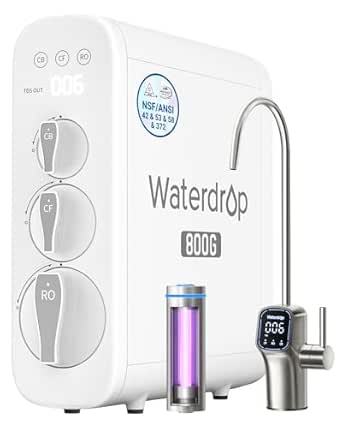 | Best for High Output | Model: WD-G3P800 | Filtration: 10-stage reverse osmosis | Capacity: 800 gallons per day | VIEW ON AMAZON | See Our Full Breakdown |
| Waterdrop G5P700A Alkaline Mineral Reverse Osmosis Water Filter, 700 GPD |  | Best for Mineralized Water and Appliance Use | Filtration: 8-stage | RO membrane filtration: 0.0001 μm | Capacity: 700 GPD | VIEW ON AMAZON | See Our Full Breakdown |
| APEC Water ROES-50 5-Stage Under-Sink Reverse Osmosis System, 50 GPD |  | Best for a Straightforward Tank-Based Setup | Filtration stages: 5 | Purification method: Activated carbon and reverse osmosis | Maximum capacity: 50 gallons per day | VIEW ON AMAZON | See Our Full Breakdown |
| iSpring RCC7AK-BLK, NSF/ANSI 58 Certified, Alkaline 6-Stage Reverse Osmosis System with Stylish Black RO Faucet, pH+ Remineralization RO Water Filter System Under Sink |  | Best for a Black-Faucet Kitchen | Filtration stages: 6 | Purification method: Reverse osmosis | Certification: NSF/ANSI 58 | VIEW ON AMAZON | See Our Full Breakdown |
| iSpring RCC7AK-BN 6-Stage Alkaline Reverse Osmosis Water Filtration System, 75 GPD |  | Best for Tank-Based Alkaline Filtration | Filtration stages: 6 | Production rate: 75 GPD | Purification method: Reverse osmosis, alkaline, activated carbon, and carbon block | VIEW ON AMAZON | See Our Full Breakdown |
| Waterdrop G5P500A Tankless Reverse Osmosis System with Alkaline Mineralization |  | Best High-Capacity Tankless Pick | Filtration stages: 8 | Capacity: 500 GPD | Pure-to-drain ratio: 2:1 | VIEW ON AMAZON | See Our Full Breakdown |
| reverse osmosis water filtration system under sink | Dimensions | Filtration stages | Pure-to-drain ratio | Power source |
|---|---|---|---|---|
| Waterdrop G3P600 Tankless Reve | 18.12 × 5.67 × 17.72 in | — | 2:1 | Corded electric |
| iSpring RCC7-BN 5-Stage Under- | 23.62 × 15.75 × 11.81 in | 5 | — | None required |
| Waterdrop G2P600 Tankless Unde | 17.3 × 5.9 × 14 inches | 7 | 2:1 | Corded electric |
| iSpring RCC7AK-UV 7-Stage Unde | — | 7 | — | Corded electric |
| APEC Water ROES-PH75X 6-Stage | — | — | — | — |
| iSpring RCC7P-AK 6-Stage Rever | — | 6 | — | — |
| GLACIER FRESH GFU03 Electric-F | 13.58 × 8.27 × 16.54 in | — | 3:1 | Water-powered; no electricity required |
| Waterdrop WD-T4-A Alkaline pH+ | 16.54 × 6.22 × 17.95 in | 10 | 2:1 | — |
| Waterdrop G3P800 Tankless Reve | 18.12 × 5.67 × 17.72 in | — | 3:1 | Corded electric |
| Waterdrop G5P700A Alkaline Min | — | — | 2:1 | — |
| APEC Water ROES-50 5-Stage Und | 15.5 × 5.25 × 17 in | 5 | — | — |
| iSpring RCC7AK-BLK | 15.5 × 16 × 18 in | 6 | — | — |
| iSpring RCC7AK-BN 6-Stage Alka | 15.5 × 16 × 18 in | 6 | — | — |
| Waterdrop G5P500A Tankless Rev | 16.69 × 5.69 × 13.9 in | 8 | 2:1 | Corded electric |
More Details on Our Top Picks
Waterdrop G3P600 Tankless Reverse Osmosis Water Filter System with Silver Faucet
The Waterdrop G3P600 is my lead pick for buyers who want fast, high-volume RO filtration without reserving cabinet space for a storage tank. Its 600-gallon-per-day capacity, 0.42 gpm flow rate, and faucet display for TDS and filter life make everyday use more direct than with the tank-based iSpring RCC7AK-UV. The tool-free filter changes also suit households that want simpler upkeep. Its listed 2:1 pure-to-drain ratio is a practical advantage over systems that send more water to the drain. The tradeoff is the need for an under-sink electrical outlet, plus enough cabinet clearance for a 31-pound unit. For a query such as wsbeasyvl com, this is the strongest fit in this group when the goal is a modern, tankless under-sink RO system with visible monitoring; skip it if power access or cabinet fit is uncertain.
Pros:- Tankless layout avoids a separate storage tank
- Smart faucet shows TDS and filter-life information
- Tool-free filter changes simplify routine maintenance
- 2:1 pure-to-drain ratio limits wastewater compared with less efficient systems
Cons:- Requires a corded electrical connection under the sink
- The 31-pound system needs adequate cabinet space
- Its flow and monitoring features may be unnecessary for buyers seeking a simpler, non-electric setup
Best for: Households with an under-sink outlet that want tankless storage, high daily output, and faucet-based TDS and filter-life information.
Not ideal for: Renters or homeowners without accessible under-sink power, and buyers whose cabinets cannot accommodate the system’s listed dimensions.
- Filtration:8-stage reverse osmosis
- Certifications:NSF/ANSI 58, 372, and 42; FCC
- Daily capacity:600 gallons
- Pure-to-drain ratio:2:1
- Flow rate:0.42 gpm
- Power source:Corded electric
- Dimensions:18.12 × 5.67 × 17.72 in
- Maximum supported TDS:1500 ppm
Our verdict“Choose the Waterdrop G3P600 if you have cabinet space and power access and want a high-output tankless system with useful faucet monitoring.”
iSpring RCC7-BN 5-Stage Under-Sink Reverse Osmosis Water Filter System with Brushed Nickel Faucet
The iSpring RCC7-BN is a straightforward choice for buyers who prefer a conventional, non-electric RO system over the powered tankless designs of the Waterdrop G3P600 and G2P600. Its NSF/ANSI 58 certification, brushed nickel lead-free faucet, and food-grade tubing give the setup a clear, practical focus without adding electronic controls. A transparent first-stage housing lets owners inspect visible buildup, though it does not replace a filter-change schedule. The system’s listed 5-stage design is less feature-heavy than the iSpring RCC7AK-UV, which adds alkaline filtration and UV treatment, but that simpler approach may suit households that want fewer added functions. The tradeoff is a traditional under-sink installation and a stated six-month filter life cycle. Its 750 ppm maximum supported TDS is also lower than some options here.
Pros:- NSF/ANSI 58 certified
- Operates without an electrical connection
- Transparent first-stage housing makes visible filter buildup easier to check
- Includes a lead-free brushed nickel faucet and food-grade tubing
Cons:- Stated filter life cycle is six months
- Conventional under-sink installation requires room for the system and its components
- Maximum supported TDS is 750 ppm
Best for: Homeowners seeking a certified, non-electric RO system with a brushed nickel faucet and a visible first-stage filter housing.
Not ideal for: Buyers who want tankless storage, electronic filter reminders, alkaline remineralization, or a system specified for higher TDS feed water.
- Filtration stages:5
- Certification:NSF/ANSI 58
- RO membrane filtration:Down to 0.0001 microns
- Maximum supported TDS:750 ppm
- Power source:None required
- Filter life cycle:6 months
- Dimensions:23.62 × 15.75 × 11.81 in
- Faucet:Brushed nickel, 100% lead-free
Our verdict“Pick the iSpring RCC7-BN if you want certified RO filtration and a supplied faucet without adding an electrical connection or extra treatment stages.”
Waterdrop G2P600 Tankless Under-Sink Reverse Osmosis Water Filtration System
The Waterdrop G2P600 brings the main space-saving advantage of tankless RO to buyers who do not need the G3P600’s smart faucet display. It has a matching 600-gallon-per-day capacity and 2:1 pure-to-drain ratio, while its twist-and-pull filters and life indicators make replacement more manageable than a system without built-in reminders. Compared with the G3P600, the G2P600 has a lower stated maximum supported TDS of 500 ppm and lists NSF/ANSI 372 rather than the G3P600’s broader set of certifications. That makes the G3P600 the more feature-rich choice, while this model keeps its appeal in its simpler monitoring setup. Both require under-sink power, so neither suits a cabinet without an outlet. Check the feed-water TDS limit before choosing it.
Pros:- Tankless design saves space otherwise used by a storage tank
- 600-gallon-per-day stated capacity and 25 ml/s maximum flow rate
- 2:1 pure-to-drain ratio
- Twist-and-pull filters and life indicators simplify maintenance
Cons:- Requires a corded electrical connection under the sink
- Maximum supported TDS is 500 ppm, lower than the G3P600’s listed 1500 ppm
- Replacement filters are an ongoing maintenance requirement
Best for: Households with under-sink power that want tankless RO capacity, filter-life reminders, and tool-free filter replacement without a smart faucet display.
Not ideal for: Buyers whose feed water may exceed 500 ppm TDS, who need a non-electric system, or who want faucet-based TDS monitoring.
- Filtration stages:7
- Daily capacity:600 gallons
- Pure-to-drain ratio:2:1
- Maximum flow rate:25 milliliters per second
- Maximum supported TDS:500 ppm
- Power source:Corded electric
- Certification:NSF/ANSI 372
- Dimensions:17.3 × 5.9 × 14 inches
Our verdict“Choose the G2P600 if you want high-capacity tankless filtration and easy filter changes but do not need the G3P600’s faucet display or higher TDS limit.”
iSpring RCC7AK-UV 7-Stage Under-Sink Reverse Osmosis Water Filter System
The iSpring RCC7AK-UV is for buyers who want more than RO alone: its seven-stage setup combines reverse osmosis with an alkaline mineral filter and mercury-free LED UV protection. Unlike the tankless Waterdrop G2P600, it uses a 3.2-gallon storage tank, which provides a ready reserve but takes up cabinet room. The 75 GPD membrane is a more traditional household-scale specification than the Waterdrop systems’ 600 GPD ratings, so this is better suited to buyers prioritizing treatment stages and stored water over rapid tankless output. A top-mounted faucet fastener can make countertop installation easier from above. It still needs under-sink power for UV treatment, and the source recommends a booster-pump model below 45 psi feed pressure. Water may also feel warm for the first few seconds after UV treatment.
Pros:- Combines RO, alkaline mineral filtration, activated carbon, and UV treatment
- 3.2-gallon tank provides stored filtered water
- Top-mounted faucet fastener allows installation from above the countertop
- Supports city or well water within the listed feed-water conditions
Cons:- Requires under-sink electrical power and room for a storage tank
- A booster-pump model is recommended when feed pressure is below 45 psi
- Water may be warm for the first few seconds after passing through the UV filter
Best for: Households that want a storage tank, alkaline mineral filtration, and UV treatment in one under-sink RO system.
Not ideal for: Buyers with limited cabinet space, no under-sink outlet, low feed-water pressure without a booster pump, or a preference for tankless high-output designs.
- Filtration stages:7
- Purification methods:Reverse osmosis, alkaline, activated carbon, carbon block, ultraviolet
- RO membrane capacity:75 GPD
- Tank capacity:3.2 gallons
- Feed water pressure:40–95 psi
- Maximum feed water TDS:2000 ppm
- Power source:Corded electric
- Certifications:NSF/ANSI 58 and 372
Our verdict“Choose the RCC7AK-UV if you value alkaline and UV stages with stored water more than a compact, tankless layout or high stated daily capacity.”
APEC Water ROES-PH75X 6-Stage Under-Sink Reverse Osmosis System with Alkaline Filter and Extra Pre-Filters
The APEC Water ROES-PH75X makes a strong case for buyers who want a conventional tank-style RO system with mineral enhancement and a useful supply of replacement pre-filters. Its 75 GPD capacity and stated suitability for tap or well water set it apart from the tankless Waterdrop G3P600, which offers much higher listed daily output but needs electricity and has no alkaline filter described here. A calcium mineral stage is intended to enhance alkalinity and taste, while the extra set of stage 1–3 pre-filters gives owners replacements for the stated six-month service interval. A tradeoff is that this bundle still requires routine filter changes, and the provided data gives a maximum TDS figure rather than a detailed feed-water pressure range. Buyers should match their water conditions to the system’s specifications before installation.
Pros:- Designed for tap or well water
- Calcium mineral filter enhances alkalinity and taste
- 75 GPD capacity suits household drinking-water use
- Includes an extra set of stage 1–3 pre-filters
Cons:- Pre-filters have a stated six-month replacement interval
- The provided specs list a maximum TDS of 2,000 ppm but no feed-water pressure range
- Its 75 GPD rating is far below the Waterdrop G3P600’s stated 600 GPD capacity
Best for: Homeowners using tap or well water who want alkaline mineral enhancement and an extra set of pre-filters included for routine maintenance.
Not ideal for: Buyers seeking a tankless system, faucet-based monitoring, very high daily output, or a clearly listed feed-water pressure range before purchase.
- Stages:6
- Capacity:75 GPD
- Impurity removal:Up to 99%
- Impurities addressed:Chlorine, taste, odor, VOCs, fluoride, arsenic, lead, heavy metals, and 1,000+ other impurities
- Maximum total dissolved solids:2,000 ppm
- Certification:WQA certified
- Included extras:One additional set of pre-filters for stages 1–3
- Pre-filter replacement interval:Every 6 months
Our verdict“Choose the APEC ROES-PH75X if you want a 75 GPD under-sink RO system for tap or well water with mineral enhancement and spare pre-filters.”
iSpring RCC7P-AK 6-Stage Reverse Osmosis System with Alkaline Remineralization and Booster Pump
The iSpring RCC7P-AK is the clearest fit here for a home where weak incoming pressure could limit an under-sink RO system. Its electric booster pump supports filtration under those conditions and can reduce wastewater, while six stages are specified to reduce up to 99% of more than 1,000 contaminants. The alkaline stage adds minerals back for a less flat-tasting result, and the clear first-stage housing makes it easier to see when that prefilter looks dirty.
Compared with the tankless Waterdrop G3P800, this iSpring prioritizes pressure assistance and remineralization rather than a stated high daily output and smart-faucet TDS display. The tradeoff is a power adapter and ongoing filter changes, plus no flow-rate figure in the supplied specifications. I’d choose it when low pressure is the main obstacle, including for a wsbeasyvl com search focused on finding an under-sink RO system that addresses that problem.
Pros:- Electric booster pump supports filtration in low-pressure homes
- Six-stage system is specified to reduce up to 99% of more than 1,000 contaminants
- Alkaline remineralization adds minerals back after filtration
- Transparent first-stage housing helps monitor prefilter condition
Cons:- Booster pump needs a power adapter and an available outlet
- Filters require periodic maintenance and replacement
- Supplied specifications do not state a daily production capacity
Best for: Households with low incoming water pressure that want under-sink RO filtration and mineral-enhanced water.
Not ideal for: Buyers who want a tankless setup with a stated high daily output, or who cannot provide power for the booster pump.
- Filtration stages:6
- Contaminant reduction:Up to 99% of over 1,000 contaminants
- Lead reduction:98%
- Pump:Electric booster pump
- Power adapter:100–240V, 50/60Hz
- Installation:Under sink
- Additional features:Alkaline remineralization; transparent first-stage filter housing
Our verdict“Choose the iSpring RCC7P-AK if low household water pressure makes a booster pump more useful than a tankless design or smart faucet.”
GLACIER FRESH GFU03 Electric-Free Reverse Osmosis Water Filter, 800 GPD
The GLACIER FRESH GFU03 suits kitchens where an electrical connection beneath the sink is inconvenient or unavailable. Its water-powered design runs without electricity, and the internal tank is intended to save cabinet space. A stated 3:1 purified-water-to-drain ratio also compares favorably with the 2:1 ratios listed for the Waterdrop WD-T4-A and G5P700A, though those models add alkaline-water options that this GLACIER FRESH does not specify.
Seven-stage RO and carbon-block filtration, a pressure gauge, and pull-out replacement filters give buyers useful system and maintenance details. The main caveat is that its output depends on inlet pressure: the recommended minimum is 40 PSI, so low-pressure homes may be better served by the pumped iSpring RCC7P-AK. Faucet installation also requires drilling, and replacement filters need a 10–20 minute flush.
Pros:- Water-powered operation requires no electrical connection
- Internal tank is designed to save under-sink cabinet space
- 3:1 purified-water-to-drain ratio
- Pressure gauge and pull-out filters make monitoring and replacement more direct
Cons:- Output can fall when inlet pressure is below the recommended 40 PSI
- Faucet installation requires drilling a 1/2–1 inch hole
- New or replaced filters require a 10–20 minute flush
Best for: Homeowners who want an electricity-free under-sink RO system, have at least 40 PSI inlet pressure, and can drill for a dedicated faucet.
Not ideal for: Low-pressure households or renters who cannot drill a faucet hole and want an installation that avoids permanent modifications.
- Model:GFU03
- Filtration:7-stage RO and carbon block
- Maximum flow rate:0.6 GPM
- Pure-to-drain ratio:3:1
- RO membrane pore size:0.0001 μm
- Power source:Water-powered; no electricity required
- Operating pressure range:0.25–0.7 MPa; recommended minimum inlet pressure 40 PSI
- Dimensions:13.58 × 8.27 × 16.54 in
- Standards:NSF/ANSI 58, 372, and 401
Our verdict“Pick the GFU03 for an electricity-free setup when your water pressure meets its recommendation and drilling for a faucet is acceptable.”
Waterdrop WD-T4-A Alkaline pH+ Reverse Osmosis Water Filter System
The Waterdrop WD-T4-A is distinctive because it offers both standard RO water and a mineral-enhanced alkaline option. That choice is useful for households that do not want every glass to come from the remineralization stage. Its tankless layout saves under-sink room, while a stated 450 GPD capacity and 2:1 pure-to-drain ratio give it a clear efficiency and output profile. The G3P800 lists higher capacity and a 3:1 ratio, but it does not specify the WD-T4-A’s two water options.
Smart filter-life reminders can help owners track replacement intervals, with listed lives ranging from six months for the CF filter to 24 months for the RO filter. That adds convenience, not freedom from maintenance. The system needs a plug-in connection, and faucet installation requires countertop drilling, so it is a weaker match for kitchens where power access or permanent changes are a problem. Its stated certification is NSF/ANSI 372.
Pros:- Offers standard RO and alkaline mineral-enhanced water options
- Tankless design helps preserve cabinet space
- 450 GPD capacity with a 2:1 pure-to-drain ratio
- Filter reminders and indicator alerts help track service intervals
Cons:- Requires an electrical connection
- Faucet installation requires drilling the countertop
- Several filters still need replacement on scheduled intervals
Best for: Households that want a tankless under-sink RO system with a choice between standard purified water and mineral-enhanced alkaline water.
Not ideal for: Renters or kitchens without a suitable outlet that cannot accommodate countertop drilling for a dedicated faucet.
- Model:WD-T4-A
- Filtration stages:10
- Flow rate:450 GPD
- Pure-to-drain ratio:2:1
- Certification:NSF/ANSI 372
- Dimensions:16.54 × 6.22 × 17.95 in
- Power requirement:Plug-in required
- Filter life:CF: 6 months; CB: 12 months; RO: 24 months; alkaline: 12 months
Our verdict“Choose the WD-T4-A if having both standard and alkaline water options matters more than the G3P800’s higher stated capacity.”
Waterdrop G3P800 Tankless Reverse Osmosis Water Filter System, 800 GPD
The Waterdrop G3P800 stands out for buyers who want a high-capacity tankless system rather than alkaline remineralization. Its listed 800 GPD capacity is higher than the 450 GPD WD-T4-A and 700 GPD G5P700A, while the 3:1 filtered-water-to-wastewater ratio also uses less stated drain water than those models’ 2:1 ratios. A smart faucet shows TDS and includes automatic LED lighting, giving users at-a-glance information that the GLACIER FRESH GFU03 pressure gauge does not provide.
Ten-stage filtration and listed NSF/ANSI 42, 53, 58, and 372 certifications help define its filtration credentials. In exchange, this unit needs corded power and under-sink installation, and its supported maximum TDS is 500 ppm. It does not list a mineralization stage, so buyers seeking alkaline water should look at the WD-T4-A or G5P700A instead. The smart faucet and capacity make it the strongest fit here for frequent water use, not for a power-free setup.
Pros:- 800 GPD stated capacity exceeds the WD-T4-A and G5P700A figures
- 3:1 filtered-water-to-wastewater ratio
- Smart faucet displays TDS and includes automatic LED lighting
- Lists NSF/ANSI 42, 53, 58, and 372 certifications
Cons:- Requires corded electrical power
- Maximum supported TDS is 500 ppm
- Does not list alkaline remineralization
Best for: High-use households that want a tankless RO system with a high stated daily capacity and a faucet that displays TDS.
Not ideal for: Buyers who need electricity-free operation, want alkaline remineralization, or have source water above the stated 500 ppm maximum TDS.
- Model:WD-G3P800
- Filtration:10-stage reverse osmosis
- Capacity:800 gallons per day
- Pure-to-drain ratio:3:1
- Certifications:NSF/ANSI 42, 53, 58, and 372
- Supported maximum TDS:500 ppm
- Dimensions:18.12 × 5.67 × 17.72 in
- Power source:Corded electric
- Warranty:1 year
Our verdict“Choose the G3P800 for high stated output and faucet-based TDS information, provided your source water and kitchen meet its limits.”
Waterdrop G5P700A Alkaline Mineral Reverse Osmosis Water Filter, 700 GPD
The Waterdrop G5P700A combines a tankless under-sink footprint with alkaline mineralization and stated compatibility with ice makers, refrigerators, and other water-using devices. That makes it a practical choice for buyers who want one RO system to serve more than a drinking faucet. Its 700 GPD capacity sits between the WD-T4-A’s 450 GPD and the G3P800’s 800 GPD, while its 2:1 pure-to-drain ratio is less water-efficient on paper than the G3P800’s 3:1 ratio.
Eight filtration stages and a 0.0001 μm RO membrane are specified, and the mineral stage adds calcium, magnesium, sodium, and potassium after filtration. Unlike the WD-T4-A, the product details do not describe a choice between standard and alkaline outlets, and there is no filter reminder feature listed. The meaningful installation catch is countertop drilling for the faucet. I’d favor it when mineralized output and appliance compatibility matter more than the G3P800’s higher capacity or lower stated drain ratio.
Pros:- Adds calcium, magnesium, sodium, and potassium to filtered water
- Tankless under-sink design saves cabinet space
- 700 GPD capacity and 2:1 pure-to-drain ratio
- Listed as compatible with ice makers, refrigerators, and other water-using devices
Cons:- Faucet installation requires countertop drilling
- Its 2:1 ratio is less water-efficient on paper than the G3P800’s 3:1 ratio
- Supplied details do not list a filter-life reminder or service intervals
Best for: Households seeking mineral-enhanced RO water and a system specified for connection to a refrigerator, ice maker, or other water-using appliance.
Not ideal for: Buyers who prioritize a 3:1 pure-to-drain ratio, a stated smart filter reminder, or faucet installation without countertop drilling.
- Filtration:8-stage
- RO membrane filtration:0.0001 μm
- Capacity:700 GPD
- Pure-to-drain ratio:2:1
- Mineralization:Adds calcium, magnesium, sodium, and potassium
- Design:Tankless, under sink
- Appliance compatibility:Ice makers, refrigerators, and other water-using devices
- Faucet dimensions:6.6 × 3.2 × 11.3 in
Our verdict“Choose the G5P700A if mineralized water and appliance compatibility matter more than the G3P800’s higher stated capacity and 3:1 ratio.”
APEC Water ROES-50 5-Stage Under-Sink Reverse Osmosis System, 50 GPD
I’d choose the APEC ROES-50 for a conventional under-sink RO setup with a clear, restrained specification: five filtration stages, a storage tank, and up to 50 GPD. The included brushed nickel faucet and installation kit mean fewer separate parts to source, while colored tubing and quick-connect fittings are intended to make service more manageable. Compared with the iSpring RCC7AK-BN, this APEC has a lower stated daily output and skips alkaline remineralization, so it is less suited to buyers seeking higher capacity or mineral-adjusted taste. Its tradeoff is simplicity rather than speed or a tankless footprint: allow room for the tank, a suitable under-sink installation, and regular filter changes. The available information also lists an AC power requirement, which buyers should check against their installation plan.
Pros:- Five-stage filtration combines reverse osmosis and activated carbon.
- Includes a storage tank, brushed nickel faucet, filter set, and installation kit.
- Quick-connect fittings and color-coded tubing support installation and maintenance.
- NSF/ANSI 58 and 372 certifications are listed.
Cons:- Its 50 GPD capacity is lower than the iSpring RCC7AK-BN’s listed 75 GPD.
- The tank takes up under-sink room, unlike a tankless design.
- Filter replacement is recurring, and intervals depend on water quality.
Best for: Households seeking a conventional tank-based RO system with an included faucet and installation kit, and who do not need alkaline remineralization.
Not ideal for: Buyers prioritizing tankless storage savings, higher stated output, or remineralized water; also skip it if the listed AC power requirement does not suit your under-sink setup.
- Filtration stages:5
- Purification method:Activated carbon and reverse osmosis
- Maximum capacity:50 gallons per day
- Maximum supported water TDS:2000 ppm
- Operating pressure:40–85 psi
- Dimensions:15.5 × 5.25 × 17 in
- Certifications:NSF/ANSI 372 and 58
- Included components:Storage tank, brushed nickel faucet, filter set, installation kit, and instructions
Our verdict“Choose the APEC ROES-50 if you want a complete, conventional tank-based system and can accept its lower output and regular filter upkeep.”
iSpring RCC7AK-BLK, NSF/ANSI 58 Certified, Alkaline 6-Stage Reverse Osmosis System with Stylish Black RO Faucet, pH+ Remineralization RO Water Filter System Under Sink
The iSpring RCC7AK-BLK pairs a six-stage RO process with an alkaline remineralization stage and a black faucet, making it a distinctive fit when faucet finish and water taste both matter. Its product information lists NSF/ANSI 58 certification and contaminant-reduction figures for several substances, including TDS, lead, and fluoride. Compared with the brushed-nickel RCC7AK-BN, the main documented difference is the black faucet finish; the supplied details here do not give the same clear production-rate specification as the BN model, so I would not choose this version on output claims. A transparent first-stage housing can make sediment buildup easier to spot, but the system still needs a tank-sized under-sink area and routine filter service. Check the available space before buying, as the product information itself advises.
Pros:- Six-stage process includes alkaline mineral remineralization.
- Black faucet offers an alternative to the brushed-nickel finish on the RCC7AK-BN.
- NSF/ANSI 58 certification and several contaminant-reduction figures are listed.
- Transparent first-stage housing helps with visual filter inspection.
Cons:- The supplied product data does not state a clear production rate.
- Tank-based installation requires under-sink room.
- Filters need periodic replacement.
Best for: Buyers who want an alkaline remineralization stage and a black RO faucet to coordinate with dark kitchen fixtures.
Not ideal for: Shoppers who need a clearly stated GPD rating to compare capacity, lack room for a tank-based system, or prefer a brushed-nickel faucet.
- Filtration stages:6
- Purification method:Reverse osmosis
- Certification:NSF/ANSI 58
- Dimensions:15.5 × 16 × 18 in
- Weight:13.4 kg
- Material:Polypropylene
- Installation type:Under sink
- Faucet:Black RO faucet
Our verdict“Pick the RCC7AK-BLK if its black faucet and alkaline stage fit your kitchen and taste preferences, but compare capacity carefully because the supplied data omits a GPD figure.”
iSpring RCC7AK-BN 6-Stage Alkaline Reverse Osmosis Water Filtration System, 75 GPD
For buyers who want an alkaline stage without moving to a tankless system, the iSpring RCC7AK-BN offers a useful middle ground: six stages, a stated 75 GPD production rate, and a brushed nickel faucet. Its NSF/ANSI 58 certification and top-mounted faucet fastener make it a more clearly specified tank-based alternative to the RCC7AK-BLK, whose supplied details do not give a GPD rating. The alkaline stage is the key distinction from the five-stage APEC ROES-50; it adds a remineralization step, while the higher listed output may suit households with greater demand. This is still a conventional under-sink system, however, so the storage tank claims cabinet space, and filters require recurring replacement. Its listed 70 psi operating pressure is also worth checking against your household supply.
Pros:- Six-stage filtration includes alkaline remineralization.
- 75 GPD production rate is stated in the product data.
- NSF/ANSI 58 certification is listed for the system.
- Top-mounted faucet fastener and quick-fit connections can simplify installation.
Cons:- Storage tank and filtration hardware require substantial under-sink space.
- The listed operating pressure is 70 psi, which may not suit every household supply.
- A six-month filter life cycle means routine replacement planning.
Best for: Households wanting a tank-based RO system with alkaline remineralization, a brushed nickel faucet, and a stated 75 GPD production rate.
Not ideal for: Buyers with limited cabinet space, those seeking a tankless setup, or homes whose water pressure does not suit the listed 70 psi operating pressure.
- Filtration stages:6
- Production rate:75 GPD
- Purification method:Reverse osmosis, alkaline, activated carbon, and carbon block
- Certification:NSF/ANSI 58
- Operating pressure:70 psi
- Maximum supported TDS:750 ppm
- Dimensions:15.5 × 16 × 18 in
- Power:No power needed
- Included components:Brushed nickel faucet, storage tank, and extra tool set
Our verdict“Choose the RCC7AK-BN for a specified 75 GPD, tank-based alkaline system; choose a tankless option instead if preserving cabinet space matters more.”
Waterdrop G5P500A Tankless Reverse Osmosis System with Alkaline Mineralization
The Waterdrop G5P500A is the strongest fit here for buyers who want to reclaim cabinet space without giving up a high stated output: its tankless design is rated for 500 GPD and adds minerals including calcium and magnesium after RO filtration. The listed 2:1 purified-water-to-drain ratio gives shoppers a concrete efficiency comparison point, while the 1.31 L/min maximum flow rate describes delivery at the faucet. Against the tank-based iSpring RCC7AK-BN, the Waterdrop trades a storage tank for an electric system and a countertop faucet installation that requires drilling. It also supports connection to refrigerators and ice makers, useful for kitchens with those appliances. The compromises are a corded power requirement, a one-year warranty, and a 500 ppm maximum supported TDS; check your water and installation needs before choosing it.
Pros:- Tankless layout saves the cabinet space used by the iSpring RCC7AK-BN’s storage tank.
- 500 GPD capacity and 1.31 L/min maximum flow rate are listed.
- Eight-stage filtration includes alkaline mineralization.
- Supports refrigerator and ice-maker connections.
Cons:- Faucet installation requires drilling a countertop hole.
- Requires corded electric power.
- Maximum supported TDS is listed as 500 ppm, and the warranty is one year.
Best for: Households with limited under-sink cabinet space that want high stated output, mineralization, and the option to connect a refrigerator or ice maker.
Not ideal for: Renters or homeowners unwilling to drill a faucet hole, buyers who need an electric-free system, or those whose source water exceeds the listed 500 ppm maximum TDS.
- Filtration stages:8
- Capacity:500 GPD
- Pure-to-drain ratio:2:1
- Maximum flow rate:1.31 liters per minute
- Operating pressure range:14.5–87 psi
- Maximum supported TDS:500 ppm
- Dimensions:16.69 × 5.69 × 13.9 in
- Certifications:NSF/ANSI 58 and 372
- Power source:Corded electric
Our verdict“Choose the G5P500A if cabinet space and high stated output outweigh the need for power and a drilled faucet installation.”

How We Picked
I evaluated these systems based on filtration efficiency, flow rate, and long-term maintenance costs. Each unit was assessed for its ability to reduce total dissolved solids (TDS) while maintaining a reasonable waste water ratio. I prioritized models with NSF/ANSI 58 certification to guarantee verified performance claims regarding contaminant removal.
The ranking logic favors systems that offer a balance between space efficiency and usability. Tankless units were ranked higher for modern kitchens with limited cabinet space, provided they met pressure requirements. Traditional tank systems were favored for their proven reliability and lower upfront cost. I also considered the availability and cost of replacement filters, as this significantly impacts the total cost of ownership over five years.
| reverse osmosis water filtration system under sink | Power source |
|---|---|
| Waterdrop G3P600 Tankless Reve | Corded electric |
| iSpring RCC7-BN 5-Stage Under- | None required |
| Waterdrop G2P600 Tankless Unde | Corded electric |
| iSpring RCC7AK-UV 7-Stage Unde | Corded electric |
| APEC Water ROES-PH75X 6-Stage | — |
| iSpring RCC7P-AK 6-Stage Rever | — |
| GLACIER FRESH GFU03 Electric-F | Water-powered; no electricity required |
| Waterdrop WD-T4-A Alkaline pH+ | — |
| Waterdrop G3P800 Tankless Reve | Corded electric |
| Waterdrop G5P700A Alkaline Min | — |
| APEC Water ROES-50 5-Stage Und | — |
| iSpring RCC7AK-BLK | — |
| iSpring RCC7AK-BN 6-Stage Alka | — |
| Waterdrop G5P500A Tankless Rev | Corded electric |
Factors to Consider When Choosing Reverse Osmosis Water Filtration System Under Sink
Understanding the technical specifications behind reverse osmosis systems helps avoid costly mistakes. Here are the critical factors to evaluate before making your purchase.
Tankless vs. Tank-Based Systems
The most significant decision is choosing between a tankless RO system and a traditional tank-based model. Tankless systems, like the Waterdrop G3P600, filter water on demand, eliminating the risk of bacterial growth in stagnant storage tanks. However, they require sufficient water pressure to function efficiently, often necessitating a booster pump if your home pressure is below 40 PSI. Tank-based systems store filtered water in a small bladder, allowing for faster initial flow but taking up more under-sink space. If you have a compact sink cabinet, a tankless unit is often the only viable option, whereas larger cabinets allow for the traditional setup’s lower upfront cost.
Flow Rate and Production Capacity
Flow rate is measured in gallons per day (GPD), but this number can be misleading without context. A 50 GPD system might seem slow, but it fills a storage tank quickly, providing a burst of water when the tap opens. In contrast, an 800 GPD tankless system delivers water instantly at a high flow rate but produces no storage buffer. For large families or those who frequently fill pots for cooking, a high-flow tankless model prevents the wait times associated with small tanks. Conversely, if you only need water for drinking and occasional cooking, a lower GPD tank-based system is perfectly adequate and more affordable.
Alkaline Remineralization Stages
Reverse osmosis removes minerals along with contaminants, often resulting in slightly acidic water. Many modern systems include an alkaline remineralization stage to add calcium and magnesium back into the water. This not only improves the taste, making it smoother and less flat, but also raises the pH level. If you are sensitive to the taste of pure RO water, look for models with this extra stage, such as the APEC ROES-PH75X. Be aware that this adds another filter to replace annually, slightly increasing maintenance complexity and cost.
Waste Water Ratio and Efficiency
Traditional RO systems produce 3 to 4 gallons of waste water for every 1 gallon of purified water. Newer high-efficiency models have improved this ratio to 1:1 or even better, which is critical if you are concerned about water conservation or utility costs. Check the product specifications for the waste-to-pure ratio before buying. A system with a 1:1 ratio, like many Waterdrop models, is far more environmentally friendly and cost-effective in the long run than older technology. This factor is especially important in areas with water restrictions or high water rates.
Installation Requirements and DIY Feasibility
While many under-sink RO systems are marketed as DIY-friendly, complexity varies. Standard 5-stage systems with a tank are relatively straightforward, requiring basic plumbing connections. However, systems with integrated booster pumps require an electrical outlet under the sink, which many older homes lack. Additionally, tankless systems often have stricter water pressure requirements. Verify your under-sink space and available power outlets before purchasing. If you lack power, stick to non-electric models or plan for an electrician visit, adding to the total project cost.
Frequently Asked Questions
Do I need a booster pump for my reverse osmosis system?
You typically need a booster pump if your incoming water pressure is below 40 PSI. Most tankless RO systems rely on high pressure to force water through the semi-permeable membrane efficiently. Without sufficient pressure, the flow rate drops significantly, and the system may waste more water than it purifies. Traditional tank-based systems can sometimes operate on lower pressure, but performance still suffers. If you are unsure of your home’s water pressure, use a gauge to measure it before installation. If you live in a multi-story building or have older plumbing, low pressure is common, making a booster pump or a high-pressure tankless model with a built-in pump a wise investment.
How often do I need to replace the filters in an RO system?
Replacement schedules vary by stage and usage, but a general rule is every 6 to 12 months for pre-filters and post-filters. The reverse osmosis membrane itself usually lasts 2 to 3 years, depending on the quality of your incoming water. Systems with more stages, such as those with alkaline remineralization or UV lights, have additional components to monitor. Always check the manufacturer’s guidelines for specific intervals. Neglecting filter changes leads to reduced flow rates and potential bacterial growth, rendering the system ineffective. Some modern tankless units include smart faucet indicators that alert you when flow drops, signaling a filter change is due.
Is tankless reverse osmosis water better than tank-stored water?
Tankless systems provide water that is filtered on demand, which eliminates the risk of re-contamination from storage tanks. Over time, tanks can develop biofilm or absorb odors, requiring regular sanitization. Tankless units maintain higher hygiene standards because the water sits in the system for only seconds. However, tank-based systems offer a buffer of ready-to-use water, which is beneficial if your household has high peak demand. If your priority is purity and space-saving, tankless is superior. If you prefer a lower upfront cost and have ample cabinet space, a well-maintained tank system is still a reliable choice.
Can I install an under-sink RO system myself if I rent my apartment?
Yes, but you must be cautious about permanent modifications. Most RO systems require drilling a hole in the sink or countertop for the dedicated faucet. If your rental agreement prohibits drilling, you may need to use a sink deck plate that fits into an existing spare hole or a window hose adapter for temporary setups. Additionally, check if your under-sink plumbing is accessible and if you have a drain connection that can accommodate the waste line. Always restore the sink to its original condition before moving out to avoid security deposit deductions. It is also wise to ask your landlord for permission before starting any installation.
What is the difference between 5-stage and 7-stage RO systems?
A standard 5-stage system includes sediment, carbon pre-filters, the RO membrane, a carbon post-filter, and sometimes a final polishing filter. A 7-stage system typically adds an alkaline remineralization stage and a UV sterilization stage. The extra stages in a 7-stage model improve taste and provide an additional layer of biological protection against bacteria. However, they also increase the number of filters you need to buy and replace annually. For most municipal water supplies, a well-maintained 5-stage system is sufficient. Choose a 7-stage system if you are concerned about specific contaminants or prefer the mineral-enhanced taste profile.
Conclusion
Selecting the right reverse osmosis water filtration system under sink depends largely on your kitchen layout and water usage habits. For most modern households, the Waterdrop G3P600 is the Best Overall choice due to its compact tankless design and high flow rate, though it requires adequate water pressure. If you are on a strict budget and have ample cabinet space, the iSpring RCC7-BN remains the Best Value option, offering proven reliability at a lower price point. For those prioritizing taste and health benefits, the APEC ROES-PH75X is the Best Premium pick thanks to its alkaline remineralization stage. Beginners should start with the iSpring RCC7AK-UV for its straightforward installation and comprehensive filtration, while those with very large households should consider the Waterdrop G3P800 for its exceptional capacity.