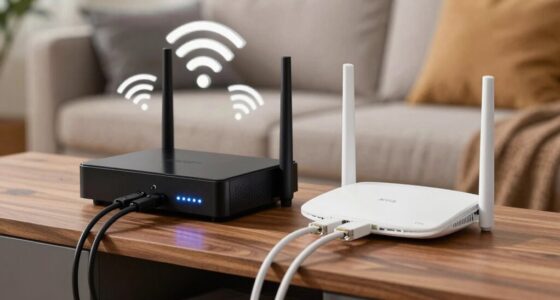
Wi-Fi 6, Wi-Fi 6E, and Wi-Fi 7 all aim to improve your wireless experience, with each stepping up in speed, capacity, and efficiency. Wi-Fi 6 operates on 2.4 and 5 GHz bands, while Wi-Fi 6E adds the 6 GHz spectrum for less congestion and faster connections. Wi-Fi 7 promises even higher speeds, better multi-band support, and enhanced performance. If you’re curious about how these upgrades can benefit you, sticking until the end reveals more details.
Key Takeaways
- Wi-Fi 6 improves efficiency and capacity on 2.4 and 5 GHz, while Wi-Fi 6E adds support for the less congested 6 GHz band.
- Wi-Fi 6E offers faster speeds and lower latency due to the additional 6 GHz spectrum, unlike Wi-Fi 6.
- Wi-Fi 7 promises higher speeds, better congestion management, and multi-band support, but requires new hardware.
- Wi-Fi 6 is widely supported now; Wi-Fi 6E is gradually expanding; Wi-Fi 7 is still in development.
- Future Wi-Fi standards like Wi-Fi 7 aim to handle more devices and demanding applications beyond current capabilities.

As wireless technology continues to evolve, understanding the differences between Wi-Fi 6, Wi-Fi 6E, and Wi-Fi 7 becomes essential for choosing the right network for your needs. These standards are designed to improve your internet experience by reducing network congestion and accommodating more devices simultaneously. Wi-Fi 6, also known as 802.11ax, introduces significant upgrades over previous generations, mainly focusing on efficiency and capacity. It uses Orthogonal Frequency Division Multiple Access (OFDMA), which allows multiple devices to transmit data simultaneously, reducing delays and improving overall network performance. If you have a household with many smart devices, streaming services, or work-from-home setups, Wi-Fi 6 helps manage this increased demand smoothly.
Device compatibility is a key factor when considering Wi-Fi 6. Most current devices, like newer smartphones, laptops, and smart home gadgets, support Wi-Fi 6, but older gadgets may not. Upgrading your network to Wi-Fi 6 can be beneficial, but you’ll want to ensure your devices can take advantage of its features. If you have mostly older devices, you might not notice a huge difference yet, but future-proofing with Wi-Fi 6 makes sense as more gadgets adopt the standard. Additionally, Wi-Fi 6’s increased capacity helps reduce network bottlenecks, especially in dense environments.
Ensure your devices support Wi-Fi 6 to maximize its benefits and future-proof your network.
Wi-Fi 6E extends the capabilities of Wi-Fi 6 by operating in the 6 GHz band, in addition to the 2.4 GHz and 5 GHz bands used by Wi-Fi 6. This additional spectrum provides much more bandwidth, which means less interference and congestion, especially in crowded environments like apartment buildings or offices. The wider channels available in the 6 GHz band enable faster speeds and lower latency, making it ideal for high-bandwidth activities such as 4K streaming, virtual reality, or online gaming. However, device compatibility becomes even more critical here, as Wi-Fi 6E requires specific hardware support. Not all devices support 6 GHz yet, so check your gadgets before upgrading if you want to leverage Wi-Fi 6E’s full potential.
Wi-Fi 7, still in development, promises even more enhancements, including higher maximum speeds, better handling of network congestion, and improved support for a multitude of devices. It’s expected to operate across multiple bands, including the 6 GHz spectrum, and introduce new technologies like 4096-QAM for more efficient data transmission. For you, this means a future-proof network capable of supporting the most demanding applications and the growing number of connected devices. As with Wi-Fi 6E, device compatibility will determine how soon you can benefit from Wi-Fi 7’s advancements. Upgrading hardware will likely be necessary to experience its full benefits, but it’s poised to redefine wireless connectivity standards.
Frequently Asked Questions
Will Wi-Fi 7 Be Compatible With Existing Wi-Fi 6 and 6E Devices?
Wi-Fi 7 will be compatible with existing Wi-Fi 6 and 6E devices, but compatibility depends on your hardware and software updates. Compatibility concerns may arise if your current devices lack the necessary hardware or firmware upgrades. To guarantee seamless connectivity, consider upgrade pathways like new routers or network adapters that support Wi-Fi 7. This way, you’ll enjoy the latest speeds and features without losing connection with your existing devices.
How Do Wi-Fi 6E and Wi-Fi 7 Impact Battery Life of Devices?
Wi-Fi 6E and Wi-Fi 7 can impact your device’s battery life, but it depends on your device’s power management. They might increase power consumption due to higher data speeds and broader bandwidth, but using device battery optimization and power consumption strategies can help. Enable features like Wi-Fi power saving modes, limit background activity, and keep your firmware updated to maximize battery life while enjoying faster, more reliable connections.
Are There Geographic Restrictions for Deploying Wi-Fi 6E and Wi-Fi 7?
Think of Wi-Fi 6E and Wi-Fi 7 as travelers with passports. Their deployment depends on regional licensing and spectrum allocation, which act as borders. In some countries, regulations restrict access to certain frequency bands, delaying or limiting rollout. You’ll find these standards more available where spectrum is allocated freely, but in others, you might face restrictions, making the global deployment uneven and subject to local policies.
What Security Enhancements Are Introduced With Wi-Fi 7?
With Wi-Fi 7, you get improved security features like advanced encryption, which guarantees your data stays protected from prying eyes. It also introduces enhanced authentication methods, making it harder for unauthorized users to access your network. These upgrades help you enjoy faster, more reliable connections while keeping your information safe. Overall, Wi-Fi 7’s security enhancements give you peace of mind in today’s increasingly connected world.
Can Wi-Fi 6E and Wi-Fi 7 Coexist With Older Wi-Fi Standards?
Yes, Wi-Fi 6E and Wi-Fi 7 can coexist with older Wi-Fi standards. They handle interference management well, allowing devices to operate smoothly alongside legacy networks. During device migration, newer Wi-Fi versions gradually replace older ones, ensuring compatibility and minimal disruption. This seamless integration helps you upgrade without losing connection stability, as the networks intelligently manage interference and support various device generations simultaneously.
Conclusion
As you explore these Wi-Fi advancements, think of each version as a new chapter in your digital journey. Wi-Fi 6 offers a solid foundation, Wi-Fi 6E opens new doors to less crowded spaces, and Wi-Fi 7 promises even brighter horizons. Embrace these changes as a gentle breeze guiding your devices towards smoother, faster connections. In this evolving landscape, each step brings you closer to a seamless, connected world where technology gracefully keeps pace with your life.