
TL;DR

Prime made for students and young adults
- Fast, free delivery for dorm and study essentials
- Prime Video and Amazon Music included
- Member-only deals
A Nature article reports a recurring, highly regular one-minute oscillation in grid frequency across power systems on five continents. The researchers present evidence that clock-synchronized control actions in battery-based uninterruptible power supplies create periodic demand peaks, though the scale of the effect in individual grids and its operational consequences remain uncertain.
A study published in Nature reports a highly regular one-minute oscillation in grid frequency across power systems worldwide, linking the pattern to clock-synchronized control actions in battery-based uninterruptible power supplies (UPSs). The finding matters because coordinated actions by many digital devices can create recurring changes in electricity demand, adding a control challenge for grids balancing supply and load in real time.
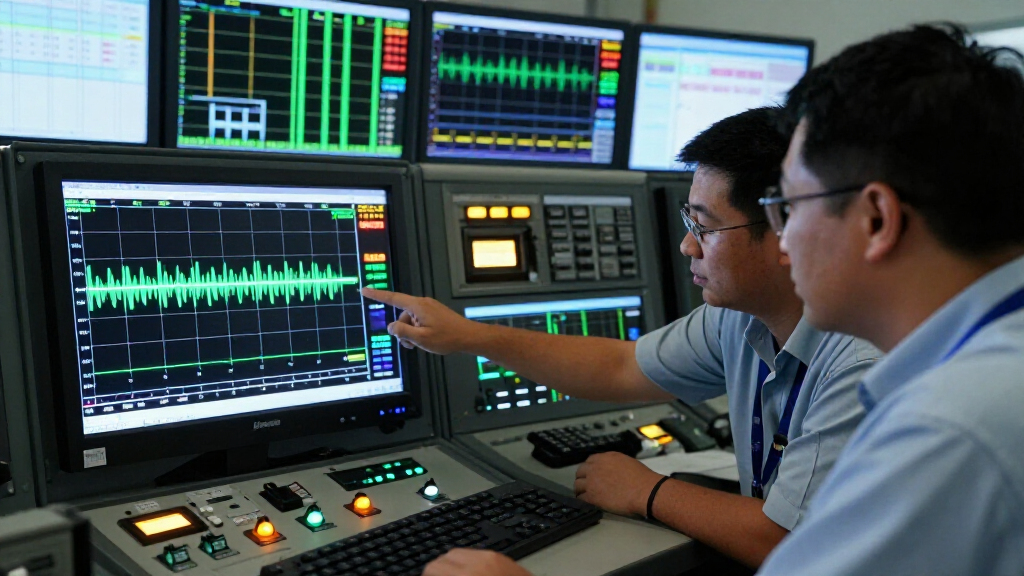
The researchers analyzed frequency time series from grids spanning five continents, ranging in scale from Iceland’s system, serving about 400,000 customers, to the Continental European synchronous area, serving more than 400 million. Their Fourier analysis identified a periodic pattern with a period of exactly one minute. Measurements came from transmission-level monitoring in several large grids, including Continental Europe, Britain, Scandinavia and Australia; other measurements were taken at distribution level.
The article provides empirical evidence that clock-synchronized controls in battery UPS units produce periodic power-demand peaks. It also reports that the resulting signal can propagate through the electricity network across voltage levels, reaching the transmission interface. The authors describe the mechanism as a broader cyber-physical effect: devices that follow external timing signals or recurring software routines may act together, even when each device is operating as designed.
The study says the amplitude of the one-minute pattern has increased in several grids, but the supplied report does not specify the size of those increases. It also notes that recurrent frequency deviations can occur during normal operation and that larger deviations can arise during contingencies. The one-minute pattern is not described as a blackout or an immediate grid emergency.
When Digital Loads Move Together
Electricity systems must continually match generation with demand. Grid frequency reflects that balance: it tends to rise when generation exceeds load and fall when demand exceeds generation. A recurring demand pulse from many synchronized devices can therefore become visible in frequency measurements, even if no single device has a large effect.
The finding points to a risk that comes from coordination rather than malfunction. As battery storage, data centres, electric vehicle chargers, heat pumps and other digitally controlled equipment expand, software timing can influence aggregate load. The study does not establish that these devices all produce the same pattern, but it identifies synchronized controls as a mechanism that grid operators and equipment designers may need to account for.
The authors say the oscillation can contribute to wear on equipment, particularly hydropower turbines, and has prompted stricter load-frequency control requirements. They also connect the concern to falling system inertia, which can make frequency more sensitive to coherent power imbalances. These are operational reasons to examine the pattern; the report does not quantify resulting costs or show that the oscillation has caused a major outage.
Popular right now

Bose QuietComfort True Wireless Earbuds with Active Noise Cancellation, Black

Hisense 85 U7 Mini-LED ULED 4K UHD Smart Google TV (85U7SG, 2026)

Bose QuietComfort Wireless Noise-Cancelling Headphones, Petal Pink
As an affiliate, we earn on qualifying purchases.
A Different Source of Grid Oscillation
Power systems already experience recurring frequency patterns at different time scales. The article notes that a prominent 60-minute pattern in Continental Europe is associated with electricity trading in hourly blocks. Earlier work has also discussed oscillations around one minute, known as ultralow-frequency oscillations, and linked some of them to resonance in hydropower turbine-governor systems.
The authors distinguish their proposed explanation from those resonance effects. They argue that an oscillation without an external timing signal does not readily account for a pattern that is phase-coherent over long periods or observed reproducibly across different grids. Their account instead focuses on digital controls that share timing and can cause many devices to adjust their power use together.
This matters as electricity networks become more dependent on software-controlled equipment. The study frames the grid as a cyber-physical system, where the timing and coordination of digital routines can affect physical power flows. Its result is not evidence that every synchronized device causes a harmful disturbance; it identifies a mechanism and documents a recurring signal that warrants attention.
How Large the Operational Effect Is
The supplied report does not state the amplitude of the oscillations in each grid, identify which specific UPS products or control settings contribute most, or quantify how much of the observed variation can be attributed to those units. Although the researchers say the signal reaches the transmission interface, the summary does not provide a grid-by-grid breakdown of its strength or operational impact.
It is also unclear from the supplied material how widely the proposed mechanism applies to other device classes, or how much the pattern changes as device populations and controls change. The authors describe the synchronization mechanism as general, but the evidence highlighted here centers on battery UPS systems. The study does not report that the pattern has caused a blackout or a specific equipment failure.
Control Design and Grid Monitoring
The authors argue that mitigation can happen at the source, through improved control design. The report supplied here does not specify a particular software change, technical standard, or implementation deadline. Further work would need to establish which control routines create the strongest synchronized peaks and test how changes affect both the disturbance and the devices’ intended functions.
Grid operators and researchers can also compare measurements across voltage levels and systems to track the pattern’s amplitude and its relationship to changes in demand or control settings. The next practical question is whether measures aimed at UPS timing can reduce the recurring signal without compromising backup-power performance. No regulator action or scheduled follow-up study is identified in the supplied source.
Key Questions
What did the Nature study find?
It reports a highly regular one-minute oscillation in grid frequency across multiple power systems and presents evidence linking it to synchronized digital controls.
What is the proposed source of the disturbance?
The researchers link periodic demand peaks to clock-synchronized control actions in battery UPS systems. They say the broader mechanism may apply to digitally controlled devices that share timing signals or recurring routines.
Does the study say the oscillation has caused a blackout?
No such event is reported in the supplied material. The study describes a recurring frequency pattern and discusses possible equipment wear and grid-control implications, not a specific blackout caused by it.
Why can a one-minute pattern matter to grid operators?
Frequency reflects the balance between generation and demand. A recurring load change from many devices acting together can add to the balancing task, particularly as systems become more sensitive to coherent power imbalances.
What remains unknown?
The supplied report does not quantify the pattern’s amplitude in each grid, identify the most influential devices or control settings, or measure the resulting costs and equipment effects. It also gives no specific mitigation schedule.
Source: nature.com