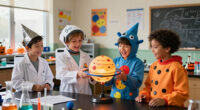
Choose a science concept, build a wearable costume around it, and check that the result is safe and recognizable. This guide is for beginners, families, and groups who want a practical science-themed Halloween costume without specialized sewing or craft skills. Most costumes take 1–3 hours to assemble, depending on decoration and drying time.

Get school and study supplies delivered free — and shop member deals
- Fast, free delivery on millions of items
- Access to Prime Big Deal Days deals on October 6–7
- Prime Video, Amazon Music and more included

Hercicy 3-Piece Halloween American Scientist Costume Set
- ✔ Fabric: Polyester
- ✔ Care: Machine wash
- ✔ Coat length: 40.94 inches (104 cm)
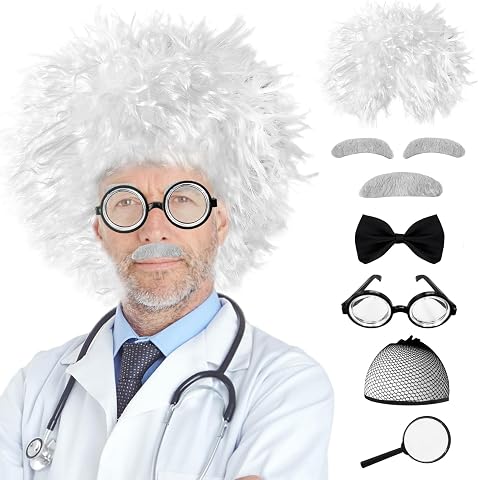
Mad Scientist Old Man Costume Set with Wig, Glasses, Beard, and Accessories
- ✔ Set contents: Wig, eyebrows, beard, glasses, magnifying glass, and bow tie
- ✔ Wig material: Synthetic fibers
- ✔ Glasses material: Plastic

Kids’ Doctor and Scientist Costume Kit with Lab Coat, Goggles, ID Card, and Magnifying Glass
- ✔ Intended wearer: Children
- ✔ Lab coat fabric: Polyester-cotton blend
- ✔ Coat features: Buttons and two pockets
Difficulty: Beginner | Time: 1–3 hours, plus shopping time if needed
What You’ll Need
Tools & Materials:
- A base outfit such as a lab coat, plain shirt, dark clothing, or coveralls
- Safe costume materials such as cardboard, paper, felt, washable paint, and tape
- Scissors and markers
- Glue or fabric-safe adhesive
- Optional accessories such as goggles, a clipboard, or a small flashlight
Knowledge:
- Basic cutting, drawing, and attaching decorations
- Ability to check clothing and props for fit, visibility, and safe movement
Set aside 1–3 hours for assembly and allow extra time for paint or glue to dry. Check the event’s rules before using props, masks, lights, or materials that may be restricted. For children, have an adult handle sharp scissors, hot glue, and small detachable pieces.
Hercicy 3-Piece Halloween American Scientist Costume Set
Hercicy takes the top spot because it supplies the main clothing piece and two details that make the outfit read as a deliberate science costume: a dark red bow tie and a pack of chemistry molecule balls. The light-blue coat gives the look a distinctive color contrast compared with the white lab coat in the kids’ kit, while the molecule prop connects the outfit directly to chemistry. For a party where we want a recognizable scientist without sourcing several extras, this is the most balanced bundle in the lineup.The coat is listed at 40.94 inches long with a 44.09-inch chest circumference, useful reference points for checking fit before ordering. However, the available size information is limited, so those measurements should not be treated as assurance of a comfortable fit across different builds or over bulky clothes. Compared with the Mad Scientist set, Hercicy provides an actual coat rather than focusing on face and hair accessories; the tradeoff is that it does not create as exaggerated a character. The polyester coat is machine washable, a practical advantage over the old-man set’s hand-wash-only wig, though the product details do not specify care for every accessory.We’d choose it for an adult who wants a straightforward, ready-to-recognize scientist look and values easy coat care. We’d skip it if precise sizing is essential and cannot be confirmed, or if the goal is a wild, comic mad-scientist transformation.
Pros:
- Includes a light-blue lab coat, adult bow tie, and chemistry molecule-ball prop.
- Unisex styling suits a range of science-themed events.
- Machine-washable polyester coat is relatively straightforward to care for.
- Color contrast helps distinguish it from a basic white lab coat outfit.
Cons:
- Limited size information may make fit difficult to judge.
- Does not include the wig, beard, or glasses that create the Mad Scientist set’s more dramatic character.
Best for: Adults who want a coordinated scientist costume with a lab coat, bow tie, and chemistry-themed prop.
Not ideal for: Shoppers who need extensive sizing guidance, a highly theatrical mad-scientist character, or a costume with fit details beyond the listed coat measurements.
Bottom line: Choose Hercicy when we want the most complete adult scientist outfit in this lineup, provided the coat measurements work for the wearer.
“Choose Hercicy when we want the most complete adult scientist outfit in this lineup, provided the coat measurements work for the wearer.”
Mad Scientist Old Man Costume Set with Wig, Glasses, Beard, and Accessories
This set ranks second because it is the lineup’s most character-driven choice. A white wig, eyebrows, beard, glasses, magnifying glass, and bow tie can turn ordinary clothes into an elderly mad scientist persona, making it a strong pick when visual comedy matters more than receiving a lab coat. Unlike Hercicy, it does not provide the core garment; we’ll need to supply clothing ourselves, ideally something that helps the accessories read as a complete look.The glasses are described as not affecting sight, which is useful at a party or classroom event, but the facial details need more attention: the mustache and eyebrows are self-adhesive. That may make application fiddly, and we should not count on them feeling comfortable for every wearer or staying put through a long evening. Its synthetic wig also requires gentle hand washing and air drying without heat. In comparison, Hercicy is easier to assemble as an outfit and has machine-washable coat care, while this option offers much more personality from the neck up. The children’s kit, meanwhile, is a better match for practical pretend play than for this adult-style comic disguise.We’d pick it for someone who enjoys a bold, humorous costume role and is happy to style their own clothes and attach facial pieces. It is less suitable for anyone seeking a ready-to-wear full outfit, low-maintenance cleaning, or a look that avoids adhesive details.
Pros:
- Includes wig, eyebrows, beard, glasses, magnifying glass, and bow tie.
- Creates a more theatrical character than the coat-centered Hercicy set.
- Glasses are described as not affecting sight.
- Can be used for Halloween, costume parties, and classroom activities.
Cons:
- Mustache and eyebrows are self-adhesive and may take patience to apply.
- No lab coat or full outfit is included, so clothing must be supplied separately.
- Wig requires gentle hand washing and air drying without heat.
Best for: Costume wearers who want an exaggerated old professor or mad scientist character built around hair, facial accessories, and props.
Not ideal for: Buyers who want a lab coat included, dislike adhesive facial pieces, or need a costume that can be quickly machine washed.
Bottom line: Choose this set for a comic mad-scientist character, not for a complete lab-coat costume or the simplest care routine.
“Choose this set for a comic mad-scientist character, not for a complete lab-coat costume or the simplest care routine.”
Kids’ Doctor and Scientist Costume Kit with Lab Coat, Goggles, ID Card, and Magnifying Glass
This children’s kit is the clear choice for younger scientists because its loose-fit lab coat is designed for movement and its two pockets add a practical detail for pretend play. Plastic goggles, an ID card, and a magnifying glass give a child props to use while acting out experiments or classroom scenarios. Compared with Hercicy’s more adult-oriented outfit, this set prioritizes playability over a polished Halloween character; compared with the Mad Scientist set, it avoids a wig and adhesive facial pieces altogether.The coat is made from a polyester-cotton blend and has buttons, while the accessories are plastic. That distinction matters: the coat can be machine washed in cold water and tumble dried on low, but the accessories need to be wiped with a damp cloth. The plastic pieces may not feel as substantial as fabric components, so we’d treat them as dress-up props rather than durable equipment. Its doctor-and-scientist framing also gives it flexibility for school projects and play after Halloween, though it may look less specifically chemistry-themed than Hercicy’s molecule-ball set.We’d choose this kit when comfort and repeated imaginative use are the priorities. It is not the best fit for an adult, for a child who wants an elaborate mad-scientist disguise, or for families expecting non-plastic accessories. Within this lineup, its strength is being a kid-focused activity costume, not the most dramatic Halloween transformation.
Pros:
- Loose-fit coat supports comfortable movement during play.
- Includes goggles, an ID card, and a magnifying glass.
- Two coat pockets add useful space for pretend-play accessories.
- Coat care is clearly specified, with cold machine washing and low tumble drying.
Cons:
- Accessories are plastic and require separate wipe-clean care.
- Its doctor-and-scientist theme is less distinctive as a chemistry costume than Hercicy’s molecule-prop set.
Best for: Children who want a comfortable lab-coat costume they can also use for science-themed parties, school projects, and pretend play.
Not ideal for: Adults, shoppers seeking an elaborate character costume, or buyers who prefer accessories made from materials other than plastic.
Bottom line: Pick this kit for a child who values comfortable, reusable pretend play more than a dramatic Halloween character look.
“Pick this kit for a child who values comfortable, reusable pretend play more than a dramatic Halloween character look.”
As an Amazon Associate we earn from qualifying purchases.
Before You Start
Pick a theme that can be understood from a few clear visual cues. A scientist needs little more than a coat, name badge, and safe goggles; a planet can use a round, dark outfit with orbit bands; a DNA costume can use two colored strands joined by crosspieces. Avoid real chemicals, glass labware, dry ice, lasers, and anything that produces heat, sparks, or fumes. Keep the wearer’s face visible and leave room to walk, sit, and use the restroom.
Step-by-Step Instructions
Step 1: Choose one clear science theme
Select a single subject that can be shown with an outfit and one or two props. Options include a scientist, astronaut, planet, molecule, DNA strand, cell, fossil, or weather system. If you are making costumes for a group, choose related roles, such as planets in one solar system or members of a research team. Write down the theme and the visual clues someone should notice first.
Tip: Use a familiar subject if the costume needs to read quickly in a crowded room. Add a short label if the idea could be mistaken for something else.
Check: You can explain the costume in one short sentence, and you can name its main visual clue.
Step 2: Choose a comfortable base outfit
Use clothing the wearer already owns or can comfortably wear for several hours. Choose a lab coat over ordinary clothes for a scientist, dark clothing for space themes, or a plain shirt as a base for a molecule or cell. Try the outfit on before adding decorations. Check that sleeves, hems, and fasteners do not restrict movement or drag on the floor.
Tip: For outdoor events, plan for the weather: put the costume over warm layers when needed, and avoid long capes or loose pieces that could catch on objects.
Check: The wearer can walk, sit, raise their arms, and use the bathroom without the outfit pulling or coming loose.
Step 3: Gather materials and plan the main feature
Lay out the base outfit, decorations, and props before attaching anything. Pick one focal feature, such as a cardboard planet ring, a large molecule symbol, or a printed scientist name badge. Use lightweight, flexible materials where possible. Sketch the placement on paper or pin pieces in place so you can see the overall effect before committing.
Tip: Choose washable or removable decorations if you want to reuse the clothing. Test paint or adhesive on a hidden area first.
Check: All materials are on hand, the main feature is easy to identify, and its placement does not block the wearer’s face or movement.
Step 4: Make and attach the costume’s main feature
Cut, draw, or assemble the focal feature. For a planet, make an orbit band from flexible card or fabric and secure it so it cannot swing into the wearer’s face. For DNA, attach colored strips or ribbons to a shirt rather than building a rigid structure around the body. For a scientist, add a name badge, notebook, or simple paper formula to the coat. Attach decorations with fabric-safe adhesive, tape, or secure stitching, following product directions.
Tip: Do not attach sharp pieces, heavy objects, or anything that could break into pointed fragments. Keep small decorations firmly secured, especially on costumes for young children.
Check: The main feature stays attached when the wearer moves gently, and it does not poke, pinch, or obstruct them.
Step 5: Add a label or simple supporting details
Add one or two details that clarify the science idea, such as a readable planet name, a simple molecular formula, a scientist badge, or a fossil label. Keep text large enough to read at arm’s length. Use accurate, simple wording; decorative scientific-looking symbols can confuse the costume if they do not match the subject. Skip extra decorations that compete with the focal feature.
Tip: A label is especially helpful for abstract concepts such as atoms, cells, and DNA. Use plain language if the costume is for a young child.
Check: A person unfamiliar with the project can identify the theme from the outfit and its label or main prop.
Step 6: Check props, visibility, and event rules
Choose only lightweight, nonfunctional props, such as a paper clipboard, toy telescope, or empty plastic test tubes designed for costume use. Do not carry real laboratory equipment or containers with chemicals. Check that any goggles or headwear fit without slipping, and keep the wearer’s eyes and hearing unobstructed. Review event rules for prop weapons, masks, lights, and materials before leaving.
Tip: A prop is optional. If it makes walking, supervision, or entry to the event harder, leave it at home.
Check: The wearer can see clearly, hear nearby people, and carry or wear every accessory comfortably.
Step 7: Do a full dress rehearsal
Have the wearer put on the complete costume, including shoes and accessories. Walk around indoors, turn, sit, raise both arms, and test any battery-powered decoration. Secure loose ends and remove anything that blocks vision, catches on furniture, or becomes uncomfortable. Pack tape or a spare fastener for a quick repair if the costume will be worn away from home.
Tip: Use comfortable, stable shoes and avoid dragging hems. If the costume includes lights, keep wires secured and use the power source as directed by its maker.
Check: The costume stays in place through normal movement, the wearer can see and breathe freely, and all lights or attachments work as planned.
Common Mistakes to Avoid
- Adding many unrelated details until the theme becomes hard to recognize. — Keep one focal feature and add only a few supporting details. Ask someone unfamiliar with the plan what the costume represents before the event.
Troubleshooting
Problem: People cannot tell what the costume represents.
Solution:
Make the main visual clue larger or more distinct, remove competing decorations, and add a short, readable label or badge. Ask someone outside the project to identify it before the event.
What Success Looks Like
The finished costume presents one clear science theme, stays securely attached during ordinary movement, and feels comfortable for the planned event. The wearer can see, hear, breathe, walk, and sit without obstruction. Props are lightweight and permitted, decorations have dried, and someone unfamiliar with the costume can identify its subject from its main feature or label.
Next Steps
Pack the costume and any permitted props together, along with a small repair kit containing tape or spare fasteners. After the event, remove decorations according to their material instructions, clean the clothing as its care label directs, and store reusable pieces flat or in a labeled container. If a child will wear the costume again, recheck fit and attachment points before each use.
Frequently Asked Questions
What is the easiest science-themed costume to make?
A scientist is usually the simplest: wear a lab coat or white shirt, add a name badge, and carry a paper notebook or clipboard. Check that any borrowed coat fits and that the accessories are safe and permitted.
How can I make a science costume without sewing?
Use clothing as the base and attach paper, felt, or lightweight card with fabric-safe tape or adhesive. Test the attachment on a hidden area, follow the product directions, and rehearse the costume to find loose pieces.
How do I make a costume for a group?
Pick one shared topic and assign distinct roles, such as different planets, scientists working on a project, or parts of a cell. Use a shared color or label style so the costumes look related while each person remains easy to identify.
Can I use real science equipment as a prop?
Use costume-safe substitutes instead. Real glass, chemicals, sharp tools, and functioning lab equipment can break, spill, or create safety problems, and an event may prohibit them. Choose lightweight paper, cardboard, or purpose-made toy props.
Halloween Picks
halloween
As an affiliate, we earn on qualifying purchases.

![Sean Carroll Explains The Biggest Ideas In The Universe – Full Interview [Video] (2025)](https://rottenpanda.com/wp-content/uploads/2026/09/sean-carroll-explains-the-biggest-ideas-in-the-universe-full-interview-video-202-featured-560x300.jpg)