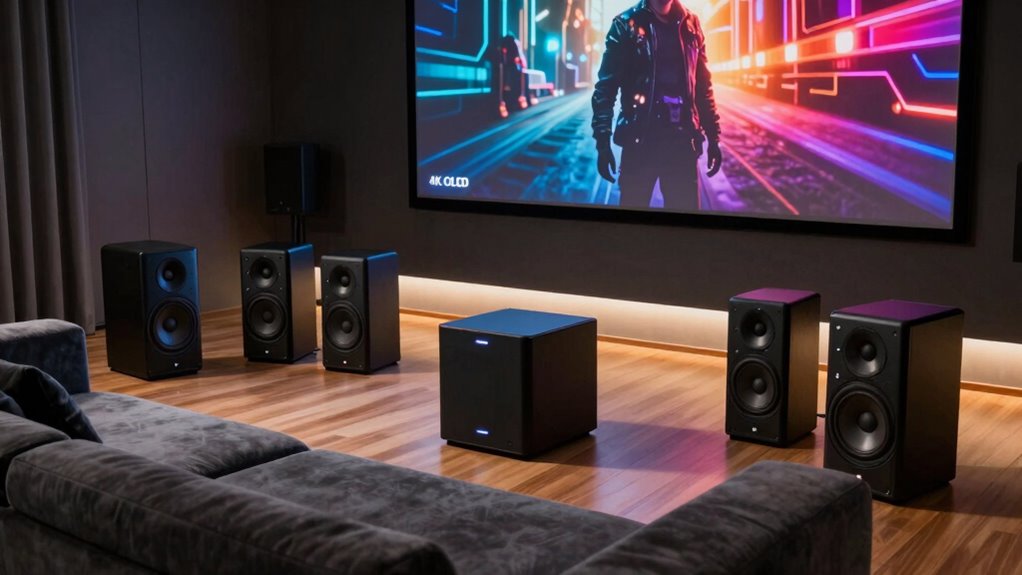

A 5.1 home theater speaker system can deliver separate front, center, surround, and subwoofer channels, but the systems in this roundup vary widely in setup and expansion options. My best overall pick is the Klipsch Reference pack with the Onkyo TX-NR7100, which pairs a full speaker set with a capable receiver. The Klipsch Reference Cinema 5.1.4 is a standout for buyers who want height effects, while the Yamaha YHT-4950U offers a more approachable receiver-based package. The main tradeoff is between the flexibility and room-filling sound of separate speakers and the simpler installation of soundbars such as the Sony and LG. Read on for the full breakdown, including which systems make sense for different rooms, budgets, and setup preferences.

Prime made for students and young adults
- Fast, free delivery for dorm and study essentials
- Prime Video and Amazon Music included
- Member-only deals
Key Takeaways
- Complete receiver bundles lead for flexibility: The Klipsch packages with Onkyo or Denon receivers combine separate speakers and an AVR, giving buyers a clearer path to source switching and system adjustments than a soundbar.
- Height-channel support is not the same across the lineup: The Klipsch Cinema 5.1.4 and Dolby Atmos packages target immersive overhead effects, while standard 5.1 systems focus on surround channels at ear level.
- The Yamaha YHT-4950U is the simpler receiver-based entry point: It offers a more straightforward package than the larger Klipsch floorstanding-speaker bundles, though buyers should compare its connectivity and format support with the newer YHT-4970U.
- Soundbars trade speaker separation for easier placement: Sony’s 6.5.1-channel system and LG’s 4.1-channel S40TR reduce the need to manage a conventional AVR-and-speaker setup, but they are not direct substitutes for a discrete 5.1 speaker package.
- More speakers can mean more room demands: The Klipsch 5.2 and floorstanding-speaker systems offer a larger, more expandable setup, but need more space and placement planning than the Klipsch 5.1 pack or compact Energy Take Classic.
| Klipsch Reference Home Theater Pack with R-625FA, R-52C, R-41M Speakers, Subwoofers, and Onkyo TX-NR7100 Receiver |  | Best for Expandable Dolby Atmos | Included components: 2 R-625FA floorstanding speakers, 2 R-12SW subwoofers, R-52C center, R-41M bookshelf speakers, Onkyo TX-NR7100 receiver | Frequency response: 38 Hz–21 kHz | Sensitivity: 96 dB | VIEW ON AMAZON | See Our Full Breakdown |
| Sony BRAVIA Theater System 6.5.1ch Soundbar with Subwoofer & Rear Speakers |  | Best for Easy BRAVIA TV Integration | Speaker type: Soundbar system | Channel description: 6.5.1ch | Audio output mode: Surround | VIEW ON AMAZON | See Our Full Breakdown |
| Yamaha YHT-4950U 5.1-Channel Home Theater System with Bluetooth and 4K Ultra HD |  | Best for Straightforward 5.1 Setup | Channel configuration: 5.1 | Included components: AV receiver, 5 speakers, subwoofer, speaker wire | Video resolution: 4K Ultra HD at 60 fps | VIEW ON AMAZON | See Our Full Breakdown |
| Klipsch Reference Cinema Dolby Atmos 5.1.4 System |  | Best Compact Atmos Satellite System | Channel configuration: 5.1.4 | Speaker type: Satellite | Audio output mode: Surround | VIEW ON AMAZON | See Our Full Breakdown |
| Klipsch Reference 5.2 Home Theater System with Onkyo TX-NR7100 |  | Best for Dual-Subwoofer Bass | System configuration: 5.2 home theater system | Floorstanding speakers: Klipsch R-625FA | Center channel: Klipsch R-52C | VIEW ON AMAZON | See Our Full Breakdown |
| Klipsch Reference 5.1 Dolby Atmos Home Theater System with R-625FA Floorstanding Speakers, R-52C Center, R-41M Surrounds & R-12SW Subwoofer |  | Best for Built-In Height Effects | Configuration: 5.1 with Dolby Atmos elevation channels | Floorstanding speakers: R-625FA | Center channel: R-52C | VIEW ON AMAZON | See Our Full Breakdown |
| Yamaha YHT-4970U 5.1-Channel Home Theater System with Dolby Atmos and 4K/8K Support |  | Best Complete System for TV and Gaming | Receiver: Yamaha RX300A | Speaker configuration: 2 front, 1 center, 2 surround, 1 powered subwoofer | Video support: 4K/120Hz and 8K/60Hz | VIEW ON AMAZON | See Our Full Breakdown |
| LG S40TR 4.1 Channel Home Theater Soundbar with Wireless Subwoofer and Rear Speakers |  | Best Compact, Low-Wiring Alternative | Channel configuration: 4.1 | Subwoofer: Wireless | Rear speakers: Wireless rear speakers | VIEW ON AMAZON | See Our Full Breakdown |
| Klipsch Reference 5.1 Home Theater Pack, Black |  | Best Traditional 5.1 Speaker Package | Configuration: 5.1 | Front speakers: 2 x R-620F floorstanding speakers | Center speaker: R-52C | VIEW ON AMAZON | See Our Full Breakdown |
| Energy 5.1 Take Classic Home Theater System (Set of Six, Black) |  | Best for Flexible Satellite Placement | Configuration: 5.1, set of six | Satellite speakers: 4, wall mountable | Center channel: Included | VIEW ON AMAZON | See Our Full Breakdown |
| Klipsch Reference Dolby Atmos Home Theater System with Onkyo TX-NR7100 Receiver |  | Best for Height-Effect Atmos | Speaker configuration: Dolby Atmos floorstanding, bookshelf, center-channel speakers, and subwoofer | Subwoofer size: 12 inches | Receiver: Onkyo TX-NR7100 | VIEW ON AMAZON | See Our Full Breakdown |
| Klipsch Reference 5.1 Home Theater Speaker Bundle with Denon AVR-S670H Receiver |  | Best for a Straightforward Klipsch 5.1 Setup | Channel configuration: 5.1 | Front speakers: Klipsch R-610F floorstanding speakers | Center channel: Klipsch R-52C | VIEW ON AMAZON | See Our Full Breakdown |
More Details on Our Top Picks
Klipsch Reference Home Theater Pack with R-625FA, R-52C, R-41M Speakers, Subwoofers, and Onkyo TX-NR7100 Receiver
This bundle is the most flexible pick here for someone who wants a receiver-based theater and room to grow: its Onkyo TX-NR7100 and up-firing R-625FA towers support a more immersive presentation than the Yamaha YHT-4950U’s conventional 5.1 package. Two R-12SW subwoofers give bass more coverage than a single-subwoofer setup, while the R-41M surrounds and R-52C center complete the speaker set. 8K support also gives the receiver a newer video connection path than the Yamaha’s 4K-focused spec. The tradeoff is scale: floorstanding speakers, dual subs, and a full AVR take more room and setup work than the Sony BRAVIA soundbar. Choose this when speaker placement and future expansion matter more than a quick, compact installation.
Pros:- Includes a complete speaker package, two subwoofers, and an Onkyo 9.2-channel receiver
- Dolby Atmos support and R-625FA towers add height-effect capability
- 8K support provides a newer video connection option than the Yamaha YHT-4950U
- 96 dB sensitivity supports high output from the main speakers
Cons:- Full-size speakers and dual subwoofers need substantial placement space
- Receiver-based setup and speaker wiring can be demanding for first-time buyers
- The included components may be more system than a small room needs
Best for: Home theater buyers who want a full-size Klipsch speaker system, Dolby Atmos support, and an AV receiver with room to expand.
Not ideal for: Apartment listeners, beginners seeking a simple soundbar setup, or anyone without space for floorstanding speakers and two subwoofers.
- Included components:2 R-625FA floorstanding speakers, 2 R-12SW subwoofers, R-52C center, R-41M bookshelf speakers, Onkyo TX-NR7100 receiver
- Frequency response:38 Hz–21 kHz
- Sensitivity:96 dB
- Impedance:8 ohms
- Main-channel power handling:100 W continuous / 400 W peak
- Height-channel power handling:75 W continuous / 150 W peak
- Receiver and video support:Onkyo TX-NR7100; 8K support
- Speaker technology:Tractrix Horn
- Warranty:Klipsch 5-year warranty
Our verdict“Pick this bundle if you want a spacious, expandable Klipsch theater with Dolby Atmos and can accommodate its full-size components.”
Sony BRAVIA Theater System 6.5.1ch Soundbar with Subwoofer & Rear Speakers
For a buyer who values a simpler living-room installation over separate passive speakers, the Sony BRAVIA system is the easiest fit in this group. Its soundbar, subwoofer, and rear speakers offer surround sound with Dolby Atmos and DTS:X, while Bluetooth adds a straightforward route for music playback. With a compatible BRAVIA TV, Voice Zoom 3 can help dialogue stand out, a convenience the receiver-based Klipsch bundles do not list as an integrated TV feature. The tradeoff is less flexibility: unlike the Yamaha YHT-4950U, this is not a conventional AV receiver package with multiple HDMI inputs specified. Its 35.7-inch bar is compact compared with Klipsch floorstanding towers, but the rear speakers and subwoofer still need space and power. Pick it for convenient TV-centered use, not a highly configurable speaker build.
Pros:- Soundbar, subwoofer, and rear speakers provide a packaged surround setup
- Supports Dolby Atmos and DTS:X
- Voice Zoom 3 works with compatible BRAVIA TVs
- Bluetooth supports wireless music playback
Cons:- BRAVIA-specific dialogue features depend on a compatible Sony TV
- Does not offer the stated receiver and input flexibility of the Yamaha YHT-4950U
- Rear speakers and subwoofer still require room placement and connections
Best for: BRAVIA TV owners who want surround effects, clearer dialogue features, and Bluetooth streaming without assembling a traditional AVR system.
Not ideal for: Buyers seeking a receiver with specified HDMI inputs, wired speaker flexibility, or a system they can expand with separate components.
- Speaker type:Soundbar system
- Channel description:6.5.1ch
- Audio output mode:Surround
- Audio formats:Dolby Atmos and DTS:X
- Maximum output power:1000 W
- Soundbar dimensions:3.6 in D × 35.7 in W × 2.6 in H
- Connectivity:Bluetooth
- Mounting:Tabletop or wall mount
- Additional feature:Voice Zoom 3 with compatible BRAVIA TV
Our verdict“Choose this Sony system if easy BRAVIA integration matters more than the expandability of a separate AV receiver and speaker package.”
Yamaha YHT-4950U 5.1-Channel Home Theater System with Bluetooth and 4K Ultra HD
The Yamaha YHT-4950U is the practical choice for buyers who want a conventional 5.1-channel system with an included receiver, five speakers, subwoofer, and speaker wire. Its YPAO room optimization helps simplify setup by tuning the system to the listening space, while Bluetooth covers basic wireless music playback. Against the Klipsch Reference bundles, Yamaha keeps the configuration simpler and focuses on 4K video pass-through rather than the Onkyo package’s 8K support and Dolby Atmos height effects. That makes it a better match for a straightforward TV, movie, and gaming setup than for a theater built around height channels or future expansion. All speakers require wired connections, so placement involves cable planning. Choose it when the complete 5.1 package and automated setup matter more than Atmos or wireless surround speakers.
Pros:- Includes receiver, five speakers, subwoofer, and speaker wire
- YPAO room optimization can ease initial setup
- Supports 4K video at 60 fps with Dolby Vision and Hybrid Log-Gamma
- Bluetooth and four HDMI ports support common home entertainment needs
Cons:- Speakers require wired connections, which limits placement convenience
- 4K-focused video support lacks the 8K specification listed for the Onkyo bundle
- Conventional 5.1 configuration does not provide the stated Dolby Atmos height setup of the Klipsch options
Best for: First-time home theater buyers who want a complete wired 5.1 system with receiver, speaker wire, Bluetooth, and guided room calibration.
Not ideal for: Buyers who want Dolby Atmos height speakers, 8K support, or wireless rear speakers.
- Channel configuration:5.1
- Included components:AV receiver, 5 speakers, subwoofer, speaker wire
- Video resolution:4K Ultra HD at 60 fps
- HDR support:Dolby Vision and Hybrid Log-Gamma
- Connectivity:HDMI, Bluetooth, Ethernet, coaxial, optical, USB, auxiliary
- HDMI ports:4
- Frequency response:28 Hz–25 kHz
- AV receiver dimensions:17 in W × 6 in H × 12 in D
- Subwoofer dimensions:11 in W × 11 in H × 13 in D
Our verdict“Choose the Yamaha if you want an approachable, complete wired 5.1 package and do not need Atmos or 8K support.”
Klipsch Reference Cinema Dolby Atmos 5.1.4 System
This Klipsch system suits buyers who want 5.1.4 Dolby Atmos effects from satellite speakers rather than the large towers in the R-625FA bundles. Four height-effect speakers give it a more explicit overhead-channel focus than the Yamaha YHT-4950U’s standard 5.1 arrangement, while Tractrix horns and aluminum tweeters are designed for clear, direct sound. The smaller satellite format can be easier to fit around a room than floorstanding speakers, though the system still needs careful placement and wall mounting is listed as its mounting type. Unlike the Sony BRAVIA bar, this is a wired component-style setup rather than an integrated soundbar package. The supplied data gives limited detail on the subwoofer and receiver, so buyers should confirm what their full installation requires. Pick it for compact Atmos placement, not a no-fuss setup.
Pros:- 5.1.4 channel configuration includes four height-effect channels
- Satellite design takes less floor space than the R-625FA towers
- Tractrix horn and aluminum tweeter construction
- Built-in digital subwoofer amplifier and bass boost feature
Cons:- Wall mounting and careful placement add installation work
- Wired connectivity offers less placement freedom than a wireless soundbar arrangement
- Provided specifications offer limited detail about the receiver and subwoofer configuration
Best for: Home theater owners who want four Atmos height channels in a satellite-speaker format and can mount and wire speakers around the room.
Not ideal for: Buyers seeking a plug-and-play soundbar, wireless speaker connections, or the detailed receiver-and-speaker bundle specified with the larger Klipsch systems.
- Channel configuration:5.1.4
- Speaker type:Satellite
- Audio output mode:Surround
- Connectivity:Wired RCA
- Enclosure material:Aluminum
- Speaker size:5.25 in
- Woofer diameter:4 in
- Subwoofer feature:Built-in digital amplifier and bass boost
- Mounting type:Wall mount
Our verdict“Pick this system for a satellite-based Atmos layout when you can handle wall mounting and wiring instead of opting for the simpler Sony soundbar.”
Klipsch Reference 5.2 Home Theater System with Onkyo TX-NR7100
For buyers whose priority is fuller, more evenly distributed bass, this 5.2 Klipsch bundle pairs two 12-inch R-12SW powered subwoofers with the same core speaker lineup and Onkyo TX-NR7100 receiver listed in the first Klipsch package. Compared with that 5.1 bundle, the defining difference is the second subwoofer; the provided description does not list Dolby Atmos as a feature here, so I would not choose it over the Atmos-oriented option for height effects. The 9.2-channel receiver supports 8K/4K video, leaving scope beyond the current 5.2 speaker arrangement, though setup involves substantial equipment and wiring. This package is a strong fit for a larger room where low-frequency coverage matters more than a compact footprint. Skip it if one subwoofer is enough or you want a simpler system.
Pros:- Includes two 12-inch, 400 W powered subwoofers
- Bundles R-625FA towers, R-52C center, and R-41M bookshelf speakers
- Onkyo TX-NR7100 is a 9.2-channel receiver with 8K/4K support
- Dual subs can offer more flexible bass placement than a single-subwoofer package
Cons:- Two large subwoofers take more floor space and require placement planning
- Receiver and speaker setup can be complex for beginners
- The listed product description does not specify Dolby Atmos support
Best for: Movie and music listeners with a larger room who want dual-subwoofer bass and an AV receiver that can support a broader system configuration.
Not ideal for: Small-room buyers, beginners seeking minimal setup, or shoppers whose main goal is explicitly specified Dolby Atmos height-channel playback.
- System configuration:5.2 home theater system
- Floorstanding speakers:Klipsch R-625FA
- Center channel:Klipsch R-52C
- Bookshelf speakers:Klipsch R-41M
- Subwoofers:2 powered R-12SW, 12 in, 400 W each
- AV receiver:Onkyo TX-NR7100
- Receiver channels:9.2
- Video support:8K/4K
- Receiver power:220 W per channel
Our verdict“Choose this 5.2 bundle over the 5.1 Klipsch package if dual-subwoofer bass is your priority and you have room for the extra cabinet.”
Klipsch Reference 5.1 Dolby Atmos Home Theater System with R-625FA Floorstanding Speakers, R-52C Center, R-41M Surrounds & R-12SW Subwoofer
This Klipsch package is the clearest choice here for buyers who want Atmos height effects from a traditional speaker system: its R-625FA floorstanders add elevation channels, while the R-12SW brings a 12-inch driver for weightier movie impact. Compared with the Klipsch Reference 5.1 Home Theater Pack, this model adds Atmos-capable speaker hardware rather than relying on a conventional five-speaker layout. That advantage depends on using compatible amplification and content, so it is not a simple soundbar-style setup. The separate towers, center, surrounds, and subwoofer also need more floor and cable space than the LG S40TR. I’d pick it for a dedicated viewing room where cinematic scale matters more than compactness; buyers seeking a receiver-included package should look at the Klipsch bundle with the Onkyo receiver instead.
Pros:- R-625FA floorstanders provide Dolby Atmos elevation channels.
- 12-inch R-12SW subwoofer is suited to impactful movie bass.
- Tractrix Horn and LTS aluminum tweeter technologies are specified for the system.
- Five-year warranty and textured wood-grain MDF cabinets.
Cons:- Separate speakers and wiring require more placement and setup work than the LG S40TR soundbar.
- A compatible receiver is not listed among the included components.
- The full-size speaker layout may not suit compact rooms.
Best for: Home theater fans with room for floorstanding speakers who want physical Dolby Atmos elevation channels and substantial subwoofer output.
Not ideal for: Apartment dwellers or buyers wanting a compact, receiver-included, low-effort system; the multi-speaker layout needs space and compatible amplification.
- Configuration:5.1 with Dolby Atmos elevation channels
- Floorstanding speakers:R-625FA
- Center channel:R-52C
- Surround speakers:R-41M
- Subwoofer:R-12SW
- Subwoofer output:400W peak
- Speaker technologies:Dolby Atmos, Tractrix Horn, LTS aluminum tweeters, spun copper IMG woofers
- Cabinet material:Textured wood-grain MDF
- Warranty:5 years
Our verdict“Choose this Klipsch system if you want speaker-based Atmos height effects and have the space and amplification for a multi-component setup.”
Yamaha YHT-4970U 5.1-Channel Home Theater System with Dolby Atmos and 4K/8K Support
Yamaha’s strongest case is that this package combines an AV receiver, five speakers, and a subwoofer with modern video connections, so buyers can build a system without sourcing the receiver separately. Its stated 4K/120Hz and 8K/60Hz support, plus Dolby Vision and HDR10+, make it a better fit for a mixed movie-and-gaming setup than the Energy Take Classic, which is a speaker set without listed video switching. Room correction and an included setup microphone can help with initial placement, while Bluetooth Multipoint adds a convenient way to stream from paired devices. The tradeoff is that this is still a collection of separate components, not the compact simplicity of the LG S40TR. Also, the listed surround format includes DTS Virtual:X; buyers seeking dedicated upward-firing Atmos speakers should compare it with the Klipsch R-625FA system.
Pros:- Includes an AV receiver, five speakers, and a powered subwoofer.
- Supports 4K/120Hz, 8K/60Hz, Dolby Vision, and HDR10+ video formats.
- Room correction microphone and on-screen setup menu are included.
- Bluetooth Multipoint supports wireless streaming from paired devices.
Cons:- Separate receiver and speakers take more space and setup effort than the LG S40TR.
- The feature set may take technical adjustment to configure.
- Dedicated upward-firing Atmos speakers are not listed, unlike the Klipsch R-625FA package.
Best for: TV and console owners who want a receiver-and-speaker package with high-refresh-rate video support, room correction, and Bluetooth streaming.
Not ideal for: Buyers who want physical Atmos elevation speakers, a small footprint, or a system that avoids receiver setup and multiple components.
- Receiver:Yamaha RX300A
- Speaker configuration:2 front, 1 center, 2 surround, 1 powered subwoofer
- Video support:4K/120Hz and 8K/60Hz
- HDR formats:Dolby Vision and HDR10+
- Connectivity:HDMI eARC/ARC and Bluetooth Multipoint
- Sound features:Dolby Atmos and DTS Virtual:X
- Included setup accessories:Speaker wire, subwoofer cable, setup microphone, remote, and FM antenna
Our verdict“Pick the Yamaha if you want a full receiver-based system that can serve both current video sources and a surround-sound setup.”
LG S40TR 4.1 Channel Home Theater Soundbar with Wireless Subwoofer and Rear Speakers
The LG S40TR is the most space-conscious option in this group, using a 28.4-inch soundbar, wireless subwoofer, and wireless rear speakers rather than the separate front towers and center channel found in either Klipsch package. That makes it a more practical fit for smaller living rooms or buyers who do not want a full receiver-and-speaker installation. Dolby Audio, DTS Digital, and Clear Voice Plus target everyday TV listening as well as films, while app control gives owners a way to adjust settings without a receiver interface. The “wireless” rear connection does not remove every cable: the rear speakers still need power and a wired connection, according to the supplied drawbacks. Its 4.1-channel design also differs from a conventional 5.1 package like the Energy Take Classic, so choose it for convenient placement rather than a fully discrete 5.1 layout.
Pros:- Soundbar format takes less room than Klipsch floorstanding-speaker packages.
- Wireless subwoofer and rear speakers simplify placement compared with long front-to-back cable runs.
- Clear Voice Plus is intended to improve dialogue clarity.
- Remote control and LG Soundbar App provide two ways to adjust settings.
Cons:- Rear speakers still require a wired connection and AC power.
- 4.1 channels are not the same as the discrete 5.1 layout offered by the Energy Take Classic.
- Compatibility may be limited with non-LG TVs.
Best for: Small-room TV owners who want rear surround speakers and a separate subwoofer without placing full-size towers or a conventional AV receiver.
Not ideal for: Buyers who specifically require a discrete 5.1 speaker configuration, physical Atmos height channels, or a setup independent of LG app and TV compatibility.
- Channel configuration:4.1
- Subwoofer:Wireless
- Rear speakers:Wireless rear speakers
- Soundbar dimensions:28.4 x 2.5 x 3.4 inches
- Subwoofer dimensions:6.7 x 12.6 x 9.9 inches
- Audio formats:Dolby Audio and DTS Digital
- Voice feature:Clear Voice Plus
- Control:Remote control and LG Soundbar App
Our verdict“Choose the LG if compact placement and simpler system integration matter more than a traditional discrete 5.1 speaker layout.”
Klipsch Reference 5.1 Home Theater Pack, Black
This Klipsch set suits buyers who want a conventional 5.1 layout built around two floorstanding speakers, a dedicated center, two bookshelf surrounds, and a subwoofer. Its 96dB sensitivity is a useful distinction for matching with an appropriate receiver, while the R-12SW’s stated 400W output gives the package a substantial bass component. Compared with the Klipsch R-625FA Atmos system, this pack uses R-620F floorstanders and does not list elevation channels, so it is the more straightforward pick for standard surround sound rather than height effects. Gold-plated binding posts support a wired receiver connection, but there is no wireless option listed and no receiver included in the provided components. The towers and subwoofer also ask for more room than the LG S40TR. Choose it for a traditional speaker-first installation; skip it if compactness or built-in Atmos is the priority.
Pros:- Includes two floorstanding speakers, a center channel, two bookshelf surrounds, and a subwoofer.
- 96dB sensitivity is specified for the speaker system.
- 400W subwoofer and 12-inch driver are listed for bass output.
- Five-year limited warranty and gold-plated binding posts.
Cons:- No wireless connectivity is listed, unlike the LG S40TR’s wireless subwoofer and rear-speaker connections.
- Floorstanding speakers and subwoofer need more placement space than a soundbar system.
- Receiver is not listed among the included components, and this package does not specify Atmos elevation channels.
Best for: Buyers building a wired, traditional 5.1 system who want two floorstanding fronts, bookshelf surrounds, and a dedicated center speaker.
Not ideal for: People short on floor space, seeking wireless connectivity, or wanting the built-in Atmos elevation channels found on the Klipsch R-625FA system.
- Configuration:5.1
- Front speakers:2 x R-620F floorstanding speakers
- Center speaker:R-52C
- Surround speakers:2 x R-41M bookshelf speakers
- Subwoofer:R-12SW, 400W
- Sensitivity:96dB
- Connectivity:Gold-plated binding posts
- Finish:Black
- Warranty:5-year limited warranty
Our verdict“Choose this pack for a wired, traditional 5.1 setup with floorstanding front speakers, not for compact placement or Atmos height effects.”
Energy 5.1 Take Classic Home Theater System (Set of Six, Black)
Energy’s Take Classic is the placement-flexibility pick: its four wall-mountable satellite speakers let buyers build a 5.1 layout without making room for floorstanding towers. That makes it a different proposition from both Klipsch packages, which use larger floorstanders for the front channels. The included center and 8-inch, 200-watt subwoofer complete the system, while the Convergent Source Module and Ribbed Elliptical Surround technologies are specified as part of its speaker design. Its smaller satellite format may suit a room where wall placement is easier than arranging stands, though it still requires wiring and thoughtful positioning. Compared with the LG S40TR, this is a traditional wired speaker system rather than a soundbar with wireless components. Buyers seeking the stronger stated subwoofer output of the Klipsch R-12SW should look there instead.
Pros:- Four satellite speakers are wall mountable for flexible placement.
- Includes a dedicated center channel and 8-inch subwoofer.
- 200-watt subwoofer adds a defined bass component to the package.
- High-gloss black MDF cabinets give the system a coordinated finish.
Cons:- Wired speaker placement still takes planning and cable routing, unlike the LG S40TR’s wireless subwoofer and rear connections.
- Its 8-inch, 200-watt subwoofer has lower stated output than the 400W Klipsch R-12SW.
- Satellite format does not provide the floorstanding front speakers included with the Klipsch Reference 5.1 Pack.
Best for: Home theater buyers who need wall-mountable satellite speakers and want a traditional wired 5.1 layout without floorstanding fronts.
Not ideal for: Listeners seeking wireless setup, large floorstanding front speakers, or the higher stated subwoofer output of the Klipsch R-12SW packages.
- Configuration:5.1, set of six
- Satellite speakers:4, wall mountable
- Center channel:Included
- Subwoofer power:200 watts
- Subwoofer driver:8-inch
- Cabinet finish:High-gloss black MDF
- Speaker technologies:Ribbed Elliptical Surround and Convergent Source Module
Our verdict“Pick the Energy Take Classic if wall-mountable satellites and flexible room placement matter more than floorstanding speakers or wireless convenience.”
Klipsch Reference Dolby Atmos Home Theater System with Onkyo TX-NR7100 Receiver
I’d choose this bundle when overhead sound and system flexibility matter more than a straightforward 5.1 setup. Its Dolby Atmos floorstanding speakers pair with a 9.2-channel Onkyo receiver, giving the system more channel capacity than the Denon-based Klipsch Reference 5.1 bundle. That makes it the better fit for buyers planning an expanded surround layout, while the Denon package is a simpler match for a conventional 5.1 room. The 12-inch powered subwoofer adds weight to film effects, and HEOS streaming and voice-control support bring modern playback options. The tradeoff is a larger, more involved installation: multiple speakers and a capable receiver need room, careful placement, and calibration. I’d skip it if you want a compact system or only need basic surround sound.
Pros:- Dolby Atmos-enabled floorstanding speakers add height effects beyond a conventional 5.1 presentation.
- The 9.2-channel receiver offers more channel capacity than the Denon AVR-S670H bundle.
- A 12-inch powered subwoofer supports weighty low-frequency effects.
- HEOS streaming, voice-control support, and automatic room calibration add useful setup and playback features.
Cons:- The speaker package and receiver require substantial room and placement planning.
- Getting the best result calls for more setup and calibration than a soundbar or basic 5.1 package.
- The added Atmos and receiver capability may be unnecessary for buyers who only want standard surround sound.
Best for: Home theater owners with room for floorstanding speakers who want Dolby Atmos height effects, a 9.2-channel receiver, and room to expand their system.
Not ideal for: Buyers with small rooms, limited setup time, or a preference for a simple soundbar-style installation.
- Speaker configuration:Dolby Atmos floorstanding, bookshelf, center-channel speakers, and subwoofer
- Subwoofer size:12 inches
- Receiver:Onkyo TX-NR7100
- Receiver channels:9.2
- Power per channel:220W at 6 ohms
- Video support:8K/4K
- Wireless streaming:HEOS
- Setup and control:Automatic room calibration and voice-control support
- Finish:Black wood-grain cabinets with textured vinyl finish
Our verdict“Choose this Klipsch bundle if you want Atmos height effects and a flexible 9.2-channel foundation, but pick a simpler 5.1 system if easy setup matters more.”
Klipsch Reference 5.1 Home Theater Speaker Bundle with Denon AVR-S670H Receiver
This bundle is the more direct choice for buyers who want traditional 5.1 surround sound without paying for the Atmos-focused design and 9.2-channel receiver in the Klipsch Reference Dolby Atmos system. The package pairs R-610F floorstanding fronts with an R-52C center and R-41M bookshelf surrounds, giving movies a dedicated dialogue channel and distinct rear effects. Its R-12SW subwoofer is rated at 400W, while the Denon AVR-S670H brings 8K receiver support. Compared with the Onkyo-based bundle, this one keeps the stated speaker layout firmly in 5.1, so it suits buyers who don’t need height effects or extra channel capacity. The tradeoff remains a full set of wired speakers and a receiver to place and configure; it isn’t a compact or beginner-proof alternative to a soundbar.
Pros:- The R-610F floorstanding speakers provide a substantial front soundstage.
- A dedicated R-52C center channel supports clear dialogue placement.
- The R-12SW subwoofer is specified at 12 inches and 400W for bass-heavy content.
- The Denon AVR-S670H supports 8K video and streaming capabilities.
Cons:- The stated package is a conventional 5.1 system, without the Atmos height-speaker setup of the Onkyo bundle.
- Floorstanding speakers, surrounds, subwoofer, and receiver take space and require placement work.
- Receiver and speaker setup may be demanding for first-time home theater owners.
Best for: Movie and gaming fans who want Klipsch floorstanding front speakers, a dedicated 5.1 layout, and an 8K-capable Denon receiver.
Not ideal for: Buyers seeking Dolby Atmos height effects, an expandable 9.2-channel platform, or a compact system with minimal setup.
- Channel configuration:5.1
- Front speakers:Klipsch R-610F floorstanding speakers
- Center channel:Klipsch R-52C
- Surround speakers:Klipsch R-41M bookshelf speakers
- Subwoofer:Klipsch R-12SW, 12 inches, 400W
- Receiver:Denon AVR-S670H 8K AV receiver
- Finish:Black textured wood-grain vinyl
Our verdict“Pick this bundle for a full Klipsch 5.1 system with a Denon 8K receiver; choose the Onkyo package if Atmos and extra channel capacity are priorities.”

How We Picked
I compared each option by how well its system type, channel layout, receiver or soundbar functions, and included components match the needs of a home theater buyer. I gave weight to clear channel roles, usable connectivity, upgrade flexibility, and setup demands, since these factors determine whether a package works as a complete system or leaves the buyer with important additions to make. I also considered the footprint and likely placement challenges of larger floorstanding speakers against the convenience of compact speakers and soundbars.
The ranking favors systems that make a strong, coherent choice for their intended buyer rather than simply offering the most components. The Klipsch-and-Onkyo bundle ranks first for combining a full speaker package and receiver; Atmos-capable systems follow for buyers who value height effects. Yamaha’s packages offer a more approachable receiver-based route, while soundbars and compact systems rank lower for buyers seeking discrete, expandable 5.1 playback—but can be a better match when installation simplicity or limited space matters most.
Factors to Consider When Choosing Home Theater Speaker System 51
Before choosing a 5.1 home theater system, decide what you want the package to solve: stronger dialogue, surround effects, easier installation, or a foundation you can upgrade. These broader checks can prevent a mismatch between the system’s channel claims and your room, devices, or willingness to run cables.
Confirm the channel layout you are actually buying
A standard 5.1 layout uses three front channels, two surround channels, and one subwoofer channel, but product naming can describe different arrangements. Soundbars may use virtual processing or additional drivers, while Atmos systems add height channels for compatible soundtracks. Decide whether you want separate speakers around the room or a compact bar that simulates a wider sound field. Do not assume a system labeled 5.1.4 is just a conventional 5.1 package with a minor feature added: the extra height channels affect placement and content compatibility. Match the system’s layout to what you will watch and where speakers can physically go.
Check the receiver and source connections before choosing speakers
With a receiver-based package, the AVR is the hub connecting a television, streaming device, game console, and other sources. Count the inputs you need now, then leave room for devices you may add later. Check support for the video formats and audio features used by your equipment rather than relying on a broad “4K” or “8K” label alone. A soundbar usually reduces receiver setup, but its connection options and expansion path differ from those of an AVR. A common mistake is buying speakers first and discovering that the receiver cannot handle the desired connections or channel arrangement.
Plan speaker placement and cable routes in advance
A separate-speaker system depends on placement: the center channel belongs near the display, while surround speakers need positions that create a sense of sound around the seating area. Floorstanding speakers take more space than compact bookshelf models, and extra Atmos speakers add further placement demands. Measure the room and mark likely speaker locations before settling on a package. Account for doorways, walkways, furniture, and safe cable paths; a system that cannot be positioned properly may perform less convincingly than a smaller, simpler option. Wireless subwoofer or rear-speaker links can reduce some cable runs, but do not assume every connection in a soundbar system is wireless.
Choose between a complete bundle and a system you can build around
A package that includes both speakers and a receiver can simplify compatibility decisions and provide a functioning system in one purchase. Separate components can offer more control over future upgrades, but buyers need to confirm speaker and receiver compatibility themselves. Look closely at what is included: some bundles add a receiver, while others focus on speakers and may require a compatible AVR. Avoid paying for a feature set you will not use, such as extra channels that your room cannot accommodate. If future expansion matters, favor an AVR-based package and check its supported configurations before deciding.
Size the system to the room, not just the feature list
Large speakers and multiple subwoofer channels can suit a spacious room, but they also demand more floor space and careful placement. In a smaller living room, compact speakers or a soundbar may be easier to fit and less intrusive. Room shape, open doorways, and seating distance also affect how surround effects reach listeners. Avoid choosing the most elaborate layout solely because its channel count is higher; the extra speakers have little value if they cannot be placed in useful positions. Think about neighbors and shared walls as well, since strong low-frequency output can carry beyond the listening area.
Compare setup effort with the benefits you will use
Receiver-based systems offer more direct control over separate speakers and connected devices, but require more setup, speaker wiring, and space for equipment. Soundbars cut down on component count and can be a practical choice when a quick, tidy installation matters more than a conventional discrete-speaker layout. Compact packages can also reduce placement demands, though they may not offer the same upgrade flexibility as a full AVR system. Consider who will configure the system and whether you are comfortable adjusting speaker levels and receiver settings. The best fit is the system whose advantages you will use often enough to justify its setup demands.
Frequently Asked Questions
Is a 5.1 soundbar system equivalent to a receiver-based 5.1 speaker system?
Not necessarily. A receiver-based package uses separate speakers for the front, center, and surround positions, while a soundbar combines some channels into one enclosure and may use processing to create a wider effect. Soundbars generally suit buyers who value simpler placement and fewer components. Separate speakers offer more control over positioning and a more direct upgrade path, but need more space and wiring. Compare the actual speaker layout and connections, not only the channel number in the product name.
Should I choose an Atmos system instead of a standard 5.1 package?
Choose Atmos if you have compatible content and can place the height speakers as the system requires. It adds a vertical dimension to supported soundtracks, but does not replace the need for well-positioned front and surround speakers. A standard 5.1 system may be the better fit if your room has limited ceiling or speaker placement options. Also check whether the package includes the receiver and channels needed for its stated layout. Buyers who mainly watch stereo or standard surround content may get more practical value from a well-matched 5.1 setup.
Do I need a receiver if I buy one of these speaker packages?
It depends on the package. Several Klipsch bundles listed here include an Onkyo or Denon receiver, while speaker-only systems need a compatible AVR to power and manage the speakers. Soundbars such as the Sony and LG are designed as integrated systems and do not use a conventional receiver in the same way. Check the included-components list before buying, then confirm that the receiver supports the channels and connections you need. This avoids ending up with speakers that cannot connect to your television and sources as planned.
Is the larger Klipsch 5.2 system a better choice than a 5.1 package for my room?
Not automatically. A 5.2 arrangement adds a second subwoofer channel, which can be useful in some rooms, but it also takes extra space and requires more placement work. A 5.1 system may be easier to position and can suit a modest listening area well. Room dimensions, seating locations, and low-frequency behavior matter more than the channel count alone. If you cannot place and configure the extra subwoofer sensibly, a simpler package may be the more practical choice.
What should I prioritize if I am new to home theater setup?
Start with a package that includes the key components you need and has a manageable layout for your room. A receiver-based system gives you separate speakers and useful flexibility, but it also requires cable routing and receiver setup; a soundbar simplifies installation at the cost of a different speaker arrangement. Before buying, check whether the receiver is included, how many speakers need wiring, and where each can sit. Keep the first setup focused on a layout you can place correctly rather than choosing extra channels you may not use. The Yamaha YHT-4950U is a reasonable receiver-based starting point in this lineup, while a soundbar suits buyers who place a higher priority on a simpler install.
Conclusion
For a balanced, expandable system that arrives with a receiver, I recommend the Klipsch Reference pack with the Onkyo TX-NR7100 as best overall. The Yamaha YHT-4950U is my best value-style pick for buyers seeking a more approachable receiver-based package, while the Klipsch Dolby Atmos and 5.1.4 options are best for premium immersive setups with room for height speakers. For beginners who want fewer components to position, the Sony BRAVIA Theater System 6.5.1ch or LG S40TR is easier to approach than a full AVR-and-speaker bundle. Buyers with limited space can look at the Energy Take Classic or the Klipsch 5.1 pack; those with a larger room and expansion plans may prefer the Klipsch 5.2 system. Match the layout to your room and setup preference before choosing by channel count alone.
Halloween Picks
halloween
As an affiliate, we earn on qualifying purchases.