
TL;DR

Prime made for students and young adults
- Fast, free delivery for dorm and study essentials
- Prime Video and Amazon Music included
- Member-only deals
Researchers examined two burials dating to about 8,700–8,000 BCE at Göbeklitepe in Türkiye. Their condition resembles that of hundreds of scattered bones at the site, supporting the explanation that erosion carried remains from graves beneath higher parts of the mound into monumental buildings.
Two burials dating to the Pre-Pottery Neolithic B period have given researchers new evidence about the hundreds of human bone fragments scattered at Göbeklitepe in southeastern Türkiye. A study published in PLOS One reports that the remains resemble bones from the burials and suggests that erosion and slope movement carried many fragments downhill from graves elsewhere on the mound.
The burials date to between 8,700 and 8,000 BCE. Researchers examined their bones and compared them with 928 human bone fragments recovered across the site. The study reports similar patterns of fragmentation and damage, which the authors say support an explanation involving movement of soil and debris rather than one coordinated burial practice accounting for all the scattered remains.
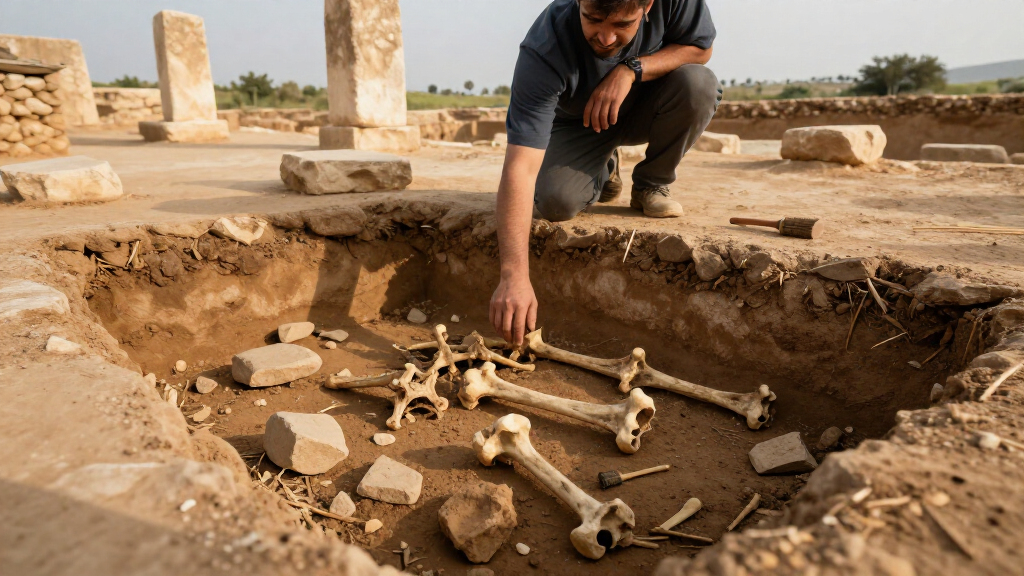
One burial lay in a pit beneath the plaster floor of a rectangular building. It contained remains from at least three people: a woman aged at least 35, a man aged 20 to 30, and a girl aged 11 to 14. Some bones may belong to a fourth person. Their bodies were no longer arranged as complete skeletons: skulls lay together in one part of the pit, while other bones formed separate clusters. The presence of small hand and foot bones suggests that complete bodies or limbs had initially been placed there.
The second grave held a young adult, likely a woman aged 20 to 30, placed on her left side with her legs flexed and her face toward the east. Most of the skeleton remained in position, although many bones were fragmented. Researchers found no cut marks, heat damage, or ochre on the bones in the burials. Some had rodent gnawing, and breaks were consistent with pressure or changes in the burial soil.
How Graves Became Scattered Remains
The findings offer a possible explanation for why human remains appear across about 3,000 square meters and through several meters of deposits at Göbeklitepe. The study proposes that people buried their dead beneath building floors on higher parts of the settlement. As the mound accumulated soil and debris, erosion and slope slides may have carried bones downhill, mixing them with other material inside monumental buildings.
This matters because the fragments need not all reflect a single unusual funerary custom. Their spread and the presence of people of different ages and sexes together can be understood, at least in part, as the result of burials later disturbed by movement of the mound. The two graves provide a comparison for interpreting the dispersed material, though they do not settle how every bone arrived where it was found.
The study also allows for more than one explanation. Earlier research noted that some skulls bear deep cuts associated with deliberate treatment, and skull fragments are overrepresented in the assemblage. Those observations leave room for special practices involving some individuals alongside ordinary burials and later movement of remains.
A Puzzle Beneath the Monumental Buildings
Göbeklitepe is an early Neolithic archaeological site in Türkiye known for its monumental buildings. Since excavations began in 1995, researchers have found human bones scattered through deposits at the site. Their distribution prompted questions about whether the remains reflected particular treatment after death, movement from graves, or several processes over time.
Previous research reported signs of deliberate treatment on certain skulls, including deep cuts. It also counted 408 skull fragments, compared with 283 fragments from other parts of the skeleton. The new study does not dismiss those findings. Instead, it compares the two burials with the broader collection and argues that many scattered fragments may have reached the buildings through erosion. The distinction matters: evidence about some skulls does not by itself explain the origin of every fragment across the mound.
The report is based on a study by J. Gresky and L. Clare, published in 2026 in PLOS One as “First burials give insights into mortuary rites at Göbeklitepe, Early Neolithic Türkiye.” The authors examined two burials and compared their bones with remains recovered from the monumental buildings. The article’s account of the findings identifies the graves as the first two intact burials discovered at the site.
What the Bones Cannot Yet Resolve
The study does not establish that erosion accounts for every scattered bone, nor does it rule out other burial customs at Göbeklitepe. Some skulls show signs of deliberate modification, and the authors say further bone studies and direct dating are needed to establish when different practices took place. The available findings also do not identify the precise path or timing by which each fragment moved from a grave into a building deposit.
The first burial’s remains may represent a fourth person, but that possibility is not confirmed. More broadly, the comparison supports a process that could explain many fragments; it does not prove that all remains shared the same origin or history. The source report gives the study’s conclusions but does not provide a direct quotation from the researchers.
Further Dating and Bone Analysis
The researchers call for additional study of the bones and direct dating to clarify when burial and post-burial practices occurred. Those steps could help distinguish remains moved by erosion from evidence of deliberate treatment and establish how these processes relate in time.
For now, the two burials provide a new point of comparison for the 928 fragments recovered around the site. As further analysis proceeds, researchers may be able to determine how much of the scattered assemblage came from ordinary graves and how much reflects other treatment of the dead.
Key Questions
What did researchers find at Göbeklitepe?
They examined two burials dating to about 8,700–8,000 BCE, the first two intact burials reported at the site. The graves contained remains from at least four people in total, though one grave may include a fourth individual.
How might the burials explain scattered bones?
The study suggests that erosion and slope movement carried bones downhill from graves beneath buildings higher on the mound, mixing them into deposits within monumental buildings.
Does the study rule out special treatment of the dead?
No. Some skulls at Göbeklitepe show signs of deliberate modification. The study suggests that many scattered bones may have moved through erosion, while leaving open the possibility of other burial customs.
What remains uncertain?
Researchers have not established when all the practices occurred or whether erosion explains every fragment. The study calls for more bone analysis and direct dating.
Source: hn
Fall Picks
fall essentials
As an affiliate, we earn on qualifying purchases.